Showing posts with label Clark Gable. Show all posts

Wednesday, March 2, 2016

These Movies Are Condemned!

The Catholic Legion of Decency.
No, CLOD is not from a Monty Python sketch. Nor is it a clandestine group of super-villains from a Venture Brothers episode.
Founded in 1933, the organization was the moral police for Hollywood, ushering in the Production Code Era. Before 1933, Hollywood studios paid lip service to religious organizations who were upset with the morals of Tinseltown and the degenerate films it produced. (Their word, not mine.) The movie moguls knew that sex and violence sold tickets so they saw no reason to change their business plans, but they needed to appease the shrill moralists who could organize boycotts of films. In 1930, they propped-up an ex-Postmaster General (Will H. Hayes), had him come up with a strict list of Don'ts and Be Carefuls that they publicly said they would honor, and went merrily about their way making movies full of sex and violence.
This gambit worked for a couple years but religious leaders like the Archbishop of Cincinnati finally felt that enough was enough and organized the Legion of Decency to force Hollywood to clean up its act. While its mission statement was to provide a ratings system to alert their parishioners to movies that were "immoral", the more effective purpose was to organize boycotts of films the Legion deemed unfit for human consumption. The threat of well-organized boycotts by Catholics in the larger urban centers where most theaters made their money was enough to finally force the hand of Hollywood producers.
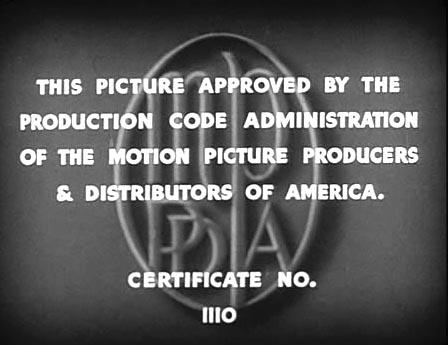
They created the Production Code Administration under the helm of super-Catholic Joseph I. Breen, or as I like to call him, JIB. The Administration would be given the authority to oversee the moviemaking process from script to final-cut and "suggest" edits based on the Production Code's strict guidelines. And by suggest, I mean that if you didn't do what JIB said, you would not get a PCA Seal of Approval and theaters would not release your film for fear of reprisals from the Legion. This meant that from 1934 on, movies had to punish wrongdoers, not show a toilet, keep the romance out of the bedroom, make sure women's bits were covered tastefully, and forget any depiction of homosexuality.
What a bore, right?
Of course creative filmmakers were quickly able to find ways around the code, using visual shorthand like fade-outs after kissing, eye-matches, and clues that someone "smelled of lavender" to still give their savvy audience members the verboten thrills they craved. These clever end-runs helped create the Hollywood style that would dominate the movies from the '30's until the Code was replaced by the MPAA ratings system in 1968. And we owe it all to the goody-goodies of the Legion of Decency.

Turner Classic Movies is having some fun this Lent by showing films that either helped bring on the Code or caused a stir with the Legion after the code was implemented. They're calling it Condemned and you can go to their oddly designed website to see a list of the movies they are showing.

My picks?

 The Story of Temple Drake (1933)- Based on the William Faulkner novel Sanctuary, Temple Drake would be a difficult movie to make even today. Temple (Miriam Hopkins) is the daughter of a prominent Southern judge and she likes to live fast with booze and boys.
One stormy night she accidentally winds-up held hostage by a rough bootlegger (luggy Jack La Rue) who kills her escort and rapes her. If that's not bad enough, when he heads to the big city he takes Temple with him. But is Temple being held against her will- or has she got a bad case of Stockholm syndrome- or Bad Boy-itis? It's a complicated story that goes to the edge with issues of rape and female sexuality. This is one of those "degenerate" movies whose content inspired the creation of the Legion.

Black Narcissus (1947)- What could the Legion have found objectionable in a movie about a group of nuns living in a monastery in the Himalayas? Plenty. The Powell and Pressburger classic has a palpable sexual undertone with looks flying between Sister Superior (the always wonderful Deborah Kerr) and Mr. Dean (the well-legged David Farrar) which makes Sister Ruth (creepy, creepy Kathleen Bryon) literally go mad with jealousy. As with all Powell and Pressburger films, the Technicolor palate and settings are visually lush and the tense ending is worth the wait. Unfortunately flashback scenes to when Kerr wasn't a nun were cut out of the American release to appease the Legion.


The Outlaw (1943)- This is the movie that made Jane Russell's ta-tas stars. This story of Jesse James with some feminine license taken with history was originally shot by gazillionaire film producer and aviation wunderkind Howard Hughes in 1941. But Russell's low-cut blouses caused so much trouble with the PCA that the film wasn't released widely until 1946. By then the film was so notorious that it sold bonkers tickets and launched Russell's career as a no nonsense actress and cross-your-heart bra pitchperson.

Baby Face (1933)- This is one of my favorite Pre-Code films. Barbara Stanwyck is an un-apologetic social climber who goes from her father's speakeasy to extravagant New York penthouse by using her feminine charms. Along the way there are broken engagements, blackmail, and murder, but Stanwyck always manages to survive. Stanwyck is young and vital here- and so down-to-earth that you hardly blame her for all her misdeeds. She is the product of a rotten world and just does the best she can to survive in it. The ending for this film was re-shot because the New York State Censorship Board had a cow, but much of the naughtiness is left intact with lascivious looks, sex-charged-banter, and camera movement that perfectly visualizes Stanwyck's climb up the corporate ladder. A must-see.

Baby Doll (1956)- This movie is weird- but worth a look. Elia Kazan and Tennessee Williams re-teamed to film the story of Southerner Archie Leigh Meighan (a drawling Karl Malden) who marries a 17-year-old (also drawling Carroll Baker) who coos like a child, sleeps in a nursery crib, and dresses like Jon Benet. It's bad enough that Archie is still waiting to consummate his marriage but along comes an Italian slickster (swarthy-toned Eli Wallach) who has his own ideas about Baby Doll. One look at the trailer and you can guess why the Legion lost their minds. Somehow this film got four Oscar noms- I'm assuming because the Academy figured if it was Kazan, it had to be Oscar-worthy. Eh...

Strange Cargo (1940)- I really like this movie. The final pairing of Crawford and Gable, this strange film is a hybrid of prison escape film, romance, and religious allegory. Verne (Gable) is a prisoner in a French penal colony and Julie (Crawford) is a lady of the night who wants to get back to the mainland and start over. They meet cute on a dock, and when Verne and some fellow prisoners plot an escape, Verne takes Julie along. The intrepid band fights their way through jungles, swamps, and an ocean crossing to find freedom.
One of the escapees, Bible-quoting Cambreau (Ian Hunter) is a calming spiritual influence and seems to know what will happen before it does. Is Cambreau a man, or the Son of you-know-who? The Legion was not too happy about this thinly-veiled depiction of Christ, and Julie's "vocation", so edits were made. Luckily the sparks between Crawford and Gable are impossible to dull, and their electric banter is a reminder of why these two were paired so often on the screen- and why they maintained a long-standing affair off-screen.

So tune into TCM and piss off the Legion by watching some "immoral" movies!

Tuesday, February 9, 2016

Hollywood Steps Out!

Remember this Warner Brothers cartoon?
If ever there was a night where all these stars were in Ciro's at the same time, I would break the laws of time travel to be there.


Here's a list of appearances that I can name (and some I can't):

1. Mary Pickford?
2. Douglass Fairbanks?
3. Adolphe Menjou
4. Actress?
5. Cary Grant
6. Garbo (as a big-footed cigarette girl)
7. Edward G. Robinson
8. Ann Sheridan (the Oomph Girl)
9. Chaplin?
10. Fatty Arbuckle?
11. Bette Davis is absent
12. So is Kate Smith
13. So is the cast of Dagwood
14. Johnny Weismuller
15. Is the hatcheck girl anybody famous?
16. Is Ayn Rand checking her fur?
17. James Cagney
18. Humphrey Bogart
19. George Raft
20. Garbo again
21. Harpo Marx
22. Clark Gable and a mystery woman
23. Bing Crosby and a jockey with horse
24. Leopold Stokowski
25. Jimmy Stewart
26. Dorothy Lamour
27. Clark Gable cruising his mystery woman
28. Tyrone Power
29. Sonja Henning
30. Frankenstein
31. Larry, Moe, and Curly
32. Oliver Hardy... and twin blondes.
33. Dancing couple? Lauren Bacall?
34. Mickey and Judy
35. Lewis Stone as Judge Hardy
36. Clark Gable still cruising
37. Bing Crosby and his gambling problem
38. Miss Sally Rand and her bubble dance.
39. Kay Kayser
40. I can only name 2 of these five gents- William Powell and Wallace Beery
41. Peter Lorre
42. Henry Fonda
43. J, Edgar Hoover... saying 'G' over and over.
44. Another group of 5 that I only know two of: Boris Karlof and Buster Keaton
45. Don't know who comes up to the group
46. I know I should know this one- but can't figure it out.
47. The Invisible Man
48. Harpo's back!
49. Finally Groucho appears.

Can you pick out the stars?

Monday, February 1, 2016

Happy Birthday, King!

 From the early 1930's until his death in 1960, the undisputed king of the silver screen was jug-eared rogue, Clark Gable. Before the birth of the Method and the death of the studio system, Gable ruled the Hollywood roost. His presence in a movie was, for a time, a surefire guarantee to send ticket sales soaring. Women wanted to be hauled up a staircase by him, and men hoped to achieve his mastery of masculinity so they could haul their own women. Even little Judy Garland crooned him a love song. His romances on and off the screen were fodder for the gossip columns. He is believed to have fathered a love child with Loretta Young out of wedlock, had a long-standing affair with co-star Joan Crawford, and married his match in Hollywood beauty Carole Lombard. Her death in a plane accident in 1942 devastated Gable, and added mourning widower to the Gable persona. His life became even more like one of his Hollywood movies when he enlisted in the Air Force and flew missions in World War II, becoming a real-life American hero.

While Gable was a male ideal in the golden era of Hollywood, his masculinity was different from those of his cowboy contemporaries. Gable seemed equally at home in a tux or a pair of a dungarees, moving easily between the two classes. He was like a mixture of John Wayne and William Powell. His real talent seemed to be to mesh so well with some of the strongest actresses of the period- in fact, it's hard to think of Gable without his leading ladies. Where the more solitary men like Wayne and Spencer Tracy came off as images of singular manhood, Gable was masculine because he went toe-to-toe with feisty, powerful women, and came out as their equal.

On what would have been his 115th birthday, here is a list of some of my favorite Clark Gable films:

Night Nurse (1931)
Gable's breakout role was as Nick, a dick-y chauffeur for a messed-up rich family (a role James Cagney turned down due to his rising stardom). Nick's not terribly lovable in this- he knocks out Barbara Stanwyck for chrissakes. But there was something about him that stood out, and after this picture, MGM groomed Gable for stardom. The film is dark with drunks and attempted infanticide- and Pre-Code Stanwyck is always a treat.

Red Dust (1932)
The pairing of Gable with MGM blonde bombshell Jean Harlow is cinema magic. Gable is rubber plantation manager Dennis Carson who willingly hosts smartmouth hooker, Vantine (Harlow) during the rainy season. Vantine has hopes of keeping Dennis' attentions until married goody-goody, Barbara Willis  (the beautifully uptight Mary Astor) shows up and piques Dennis' libido. The sexual tension is palpable in this love triangle and as the typhoon rages so do these lovers. Gable and Harlow became good friends on this film and he was co-starring with Harlow when she died suddenly during the making of Saratoga (1937). For those of you who recoil at Asian stereotypes, watch out for Willie Fung as an inane, cackling functionary.

It Happened One Night (1934)
Winner of five Oscars including the only win for Gable, It Happened One Night is an iconic Hollywood comedy that lives up to the hype. Claudette Colbert and Gable are evenly matched as a runaway heiress and a newspaperman who is desperate to get the story. Directed by cinematic master Frank Capra, the movie blends a comedy of classes, a road movie, and a screwball romance. Who can forget Colbert hiking up her skirt to grab a ride on a country road? Or Gable wearing no undershirt in a hotel room divided by a sheet? Legend has it that the scene killed the undershirt industry because men everywhere went undershirt-less like Gable- but that's probably a lot of PR puffing.

Gone with the Wind (1939)
While the earnest search for the actress to play Scarlett O'Hara filled every possible newspaper column and radio minute, the search for Rhett Butler was much easier. Producer David O. Selznick wanted Gable from the beginning so all he had to do was convince his father-in-law Louis B. Mayer to loan out his biggest star to play the role. Mayer acquiesced for a high price and the rest, as they say, is history. The making of GWTW is as much an epic as the movie itself. Books have been written on the subject and the legends have been proved and disproved time and time again.
I'll only say this- Gable seems flawlessly comfortable in the role and with his formidable co-star, Vivien Leigh. It's probably a combination of his acting talent and the director. Gable was keen to get Victor Fleming to replace "women's director" George Cukor. Maybe he was worried the women's performances would overshadow him under Cukor's guidance (he'd acted with strong women before to no complaint), maybe he was uncomfortable working with a "fag" director (the most swishy item of gossip suggested that Gable was once a callboy and Cukor knew it), or maybe he was just very comfortable with Victor Fleming, having already worked with him on the wildly successful Red Dust. Whatever the reason, it is impossible to imagine anyone else saying, "Frankly my dear, I don't give a damn", as he exits one of the greatest screen romances ever made.

Strange Cargo (1940)
Strange is the operative word. This film is about a bunch of prisoners who escape a French penal colony and brave a jungle and the ocean to find freedom. Seems like a typical action film, right? Well what if one of the escapees turns out to be Jesus? And what if the prisoners bring along Joan Crawford? Can Jesus and Joan sit in the same boat? In their eighth and final film together, Crawford and Gable spark wonderfully with verbal barbs and slaps to the face before clinching embraces. Crawford said that Gable was the greatest actor because he had balls. And she should know. Crawford claimed that when Carole Lombard died, Gable turned to her for comfort. Watching Gable and Crawford on-screen you can sense that there was indeed a deep bond between these two "tough-guys."

The Misfits (1961)
Marilyn Monroe used to fantasize when she was a child that Clark Gable was her father. So it must have been a titch surreal for Monroe when Gable was cast as her lover in her husband, Arthur Miller's movie. Monroe was ecstatic to work with Gable, but it didn't take long for Monroe's demons, drug abuse, and disintegrating marriage to overwhelm the production. Gable is rumored to have said, "Working with Marilyn on The Misfits nearly gave me a heart attack." He died twelve days after shooting ended of a heart attack.
This is the last completed film of both Gable and Monroe who died in August of 1962 of a drug overdose. For that reason alone, it is a memorable piece of film history. But there is something more to the picture. There is an ethereal quality to it- almost as if these two huge stars were already entering the dreamland of their posthumous legends. At the end they drive into the desert night towards the star-filled horizon- right where they belonged.