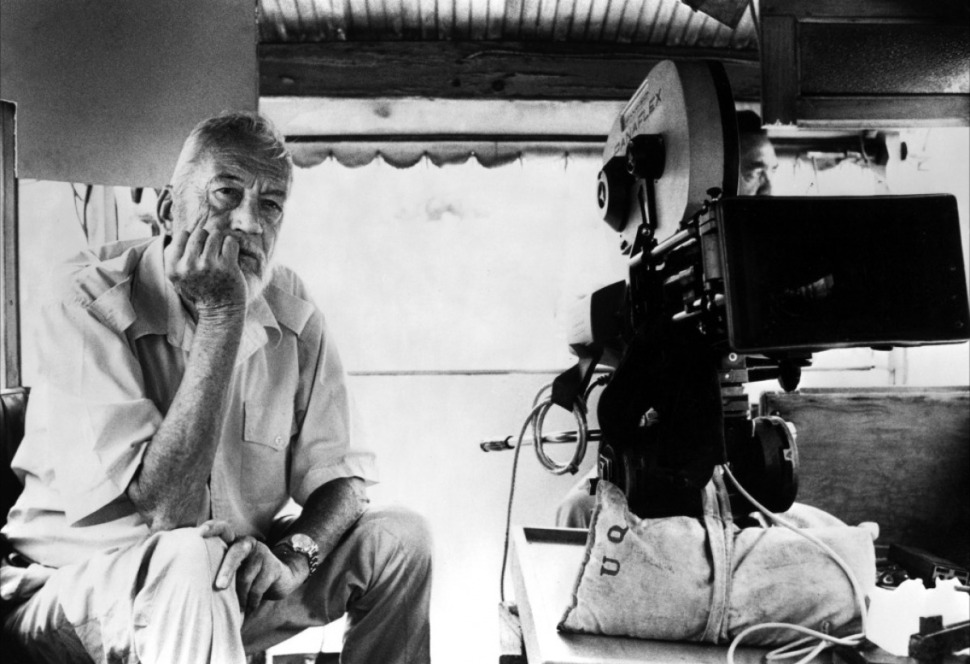
They don't make 'em like John Huston anymore. The writer/director/actor was legendary for his hard-drinking, womanizing, and caution-thrown-to-the-wind lifestyle that resembled one of the characters from his movies. But the man knew how to make a movie and in particular, was masterful at leading actors to Oscars. Fifteen actors were nominated under his direction, and four of them won- including his father Walter and daughter Anjelica.
His style evolved over the years- but always maintained a certain grittiness- a desire to show the rougher side of the human soul. With nine nominations and two Oscar wins, Huston was well-regarded during his own lifetime and his
The Maltese Falcon (1941) is considered the archetype for film noir- even if that designation is arguable.
So in honor of what would be Mr. Huston's 110th birthday, here are my Top 5 Hustons (minus
Maltese Falcon which my faithful readers will recall I previously opined on.)
The Treasure of the Sierra Madre (1948)
Based on a novel by B. Traven,
Treasure stars Humphrey Bogart, Tim Holt, and Walter Huston as a trio of down-on-their luck Americans in Mexico who tramp into the mountains to mine some easy gold. But nothing goes quite as planned and soon bandits, thirst, and good old fashioned greed tear the group apart proving that what glitters might be gold, but gold ultimately sucks.
Huston made the choice to film on location in Mexico- something that gave studio boss Jack Warner agita. But the stark look of the Mexican wilderness is perfect for the dark themes of the film, the hot sun scorching the humanity of these characters while at the same time acting as a visual metaphor for the wasted desolation left after greed burns everything else away.
Huston wanted his actors to be more realistic, so he convinced his father to do the role of Howard without his false teeth. The dedication to gritty realness makes this film stand-out from other studio product of the time- and it made an impact with critics and the Oscars.
Treasure took home three golden statues- two for John as Best Director and Best Adapted Screenplay and one for his old pa.
Walter accepted the award saying, "Many, many years ago, I brought up a boy and I said to him, 'Son, if you ever become a writer, try to write a good part for your old man sometime'. Well, by cracky, that's what he did!" This shared golden moment between a son and his father would not happen again. Walter Huston died a year later, and John never won another Oscar.
Look out for the childhood cameo of future
Baretta star and accused murderer, Robert Blake as a Mexican lottery ticket vendor. So much for realistic casting...
Key Largo (1948)
The first time I watched
Key Largo, I thought, "Here we go again. Bogey and Bacall." But on repeated viewings, I've come to realize that while Humphrey and Lauren are the stars, it's the character actors around them that shine. Ex-soldier Frank McCloud (Bogart doing his reliable world-weary routine) goes to see his old Army pal's widow Nora (the beguiling Lauren Bacall) who runs a Key Largo hotel with her wheelchair-bound father (Lionel Barrymore grumping it up).
If the visit from the best friend of your dead husband isn't enough, Nora has to house a vicious gangster (Edward G. Robinson at his sadistic best) while a hurricane threatens to blow them all away. The ending feels eerily like the movie that Bogey and Bacall met on (
To Have and Have Not (1944)), and that may be because Huston used the ending for that movie that Howard Hawks didn't shoot back in '44.
What really makes this film unique are the performances from recognizable stars playing washed-up versions of their typical screen personae. Robinson as an aging mobster who may be losing his grip, Oscar-winner Claire Trevor playing his drunken moll who has to sing for her drinks, and the always crotchety Barrymore who, if he could, would get out of his chair and do something! But you can't Lionel, you can't get out of that chair.
Unlike
Treasure,
Key Largo was shot almost entirely on the Warner's lot. Huston returned to the manufactured world of noir with shadows, shutters, and fog hiding faces, secrets, and desires. Where
Treasure exposes greed in the hot Mexican sun,
Key Largo hides it in the dark of a Florida hurricane.
Key Largo is a heck of a lot of fun, even if you have to watch Edward G. Robinson take a bath.
The African Queen (1951)
There aren't alot of movies whose shoots are worthy of a book being written about them. Certainly
Gone with the Wind (1939),
The Wizard of Oz (1939),
Cleopatra (1963), and
Apocalypse Now (1979) have spawned books, documentaries, and hours of "Making Of" segments. In 1987 Katherine Hepburn wrote a book titled
The Making of "The African Queen": or how I Went to Africa with Bogart, Bacall and Almost Lost My Mind. It's a perfect illustration of the madness that Huston seemed to thrive on when making his films.
The African Queen takes place in WWI German East Africa where an uptight missionary named Rose (Hepburn, of course) finds herself marooned after Germans burn down the village she was living in and kill her brother. Crude mailboat captain Charlie Allnut (Bogart again) rescues this damsel in distress and soon finds that his plans to just get the heck out of Africa have been commandeered by his feisty passenger. Rose intends to strike a blow for Mother England and take The African Queen down the river to blow up a German battleship. A war of wills and a fight against nature bring these two opposites together as they steam towards their fate down the dark river.
Huston was determined to get as much of the real Africa into this film as possible. So much so that he hauled the cast, the boat, and the unwieldy Technicolor cameras to Uganda and the Congo. The very thought sounds nightmarish- and apparently it was. The entire crew was struck with dysentery- with the exception of Huston and Bogart.
It seems the two were spared because rather than drink the affected water, the two drank whiskey and gin. Everyone else had to suffer through vomiting and diarrhea and in one instance a black mamba in the outhouse. Scenes were shot on the actual river rapids nearly killing Hepburn when the boiler almost fell on her, and the ship itself sank twice.
Dragging bulky equipment through the wilderness, torrential rains, wild animals, and frayed nerves all worked to put an end to
The African Queen. But the intrepid moviemakers soldiered on, and in the end they wound-up with a hit film that earned Bogart his only Oscar, and Hepburn and Huston more nominations. Huston received another gift during the shoot- a telegram delivered by a barefoot runner announced his wife had given birth to his daughter Anjelica in America.
The Misfits (1961)
The Misfits is often overshadowed by it's tragic place in film history as the last film made by both Clark Gable and Marilyn Monroe. While not well-received at the time, the film (especially when viewed on the big screen) is a stunning black-and-white picture that marries Huston's love of stark nature and conflicted character in a tragic tale of inevitable change.
Roslyn (Monroe) is in Reno getting a quickie divorce from a husband who "just wasn't there." Along the way she runs into toe-truck driver Guido (Eli Wallach) who convinces her and her new friend Isabelle (the always enjoyable Thelma Ritter) to join him and his mustangin' friend Gay (a not gay Clark Gable) at his unfinished house out in the Nevada desert. When they rope Perce (a much gay-er Montgomery Clift) into their group, the collection of lost souls is complete.
Like
African Queen, the production history for
Misfits was fraught with trouble. Monroe's marriage to
Misfits author Arthur Miller was visibly falling apart, and her reliance on sleeping pills caused her to be late or not to show up at all- which angered her co-stars and her director. Huston took to gambling (as one in Nevada does) and soon his gambling debts became a liability to the production, as did his heavy drinking. Gable was frustrated with the situation and blithely said, "Working with Marilyn Monroe on
The Misfits nearly gave me a heart attack." Gable died of a heart attack ten days after shooting finished.
Despite all the drama off-camera, the performances and visuals of this film are striking. Monroe has never seemed so ethereal- her blond hair and pale skin filmed up against the white desert- making her seem a part of nature. The familiar musical comedienne is nowhere to be found here. She is open and vulnerable in a way that she had never been filmed before.
Gable's performance is equally impressive in that he digs deep into a sense of despair that seems a contradiction to his normally strong, masculine screen persona. His eyes project the exhaustion and fear of a man who sees the world changing around him- into a world he no longer wants to be part of.
The Misfits feels very modern to me- and looks very much like many of the more independent features that would be coming out in the ensuing decade when the Hollywood studio machine broke down. Huston's stark black-and-white use of the Western terrain coupled with a more open, realistic acting style is an example of the changes happening in filmmaking, but they were ideas that Huston had been playing with all along.
Annie (1982)
Poor
Annie. Nobody wants her. No matter how hard she tries- nobody seems to like her. And yes, I'm talking about the movie and not the redhead. I know there are alot of people out there who hate the movie version of the 1977 Broadway musical and feel about "Tomorrow" much the same way as
Kathleen Turner does in Serial Mom (1994). But look at the cast! Carol Burnett, Albert Finney, Ann Reinking, Tim Curry, Bernadette Peters, and Geoffrey Holder! Edward Herrman plays FDR for God's sake! How can you not want to watch those people? And to think that this musical starring a bunch of little girls was directed by a drunken 76-year-old who hadn't really directed a musical before (unless you count the couple of dancing sequences and Zsa Zsa numbers in
Moulin Rouge (1952)- How could you not want to see that?
I get that Huston is an odd choice. The producers chose him because they said he was an "outsider." Annie's insufferably chipper song-and-dance numbers could use some of that old Huston roughness. And we get that with the superb Burnett as she chugs bathtub gin, woozily spinning and clunking through her apartment bitching about
"Little Girls", making out with her radio to the sound of Huston's voice.
Hannigan garners our sympathy for having to take care of these squealing moppets- even if they are underprivileged orphans. She's a wasted character that Huston knew just how to film.
The Oscar-nominated set design for the orphanage and Miss Hannigan's apartment is dingy and cheap- evoking a Depression era reality that reminds us that while Annie may seem like a sugar high hallucination, the rest of the world at that time was not fully dressed with a smile.
Even though it was critically savaged
Annie garnered enough kiddie viewers to become one of the Top 10 movies of 1982- a feat Huston hadn't achieved in over a decade. Huston would direct three more films before he rode off into the sunset-
Under the Volcano (1984), Prizzi's Honor (1985), and
The Dead (1987) and each of them garnered Oscar nods. Not a bad way to go.
What are your favorite John Huston flicks?