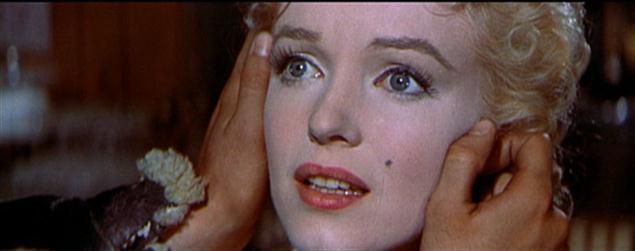
I find it hard to be objective about Marilyn Monroe. In the mid- '80's when I was an impressionable teengayger, the Marilyn re-resurgence was in full swing. Madonna hommaged/ripped-off "Diamonds Are a Girl's Best Friend" in her
"Material Girl" video. The sensationalist best-seller
Goddess: The Secret Lives of Marilyn Monroe was published, asserting that Marilyn was murdered due to her romantic entanglements with the Kennedys.
Marilyn's face and figure appeared on everything from posters to coffee mugs at Spencer's Gifts. I was swept up in this heady '50's nostalgia wave and could not get enough of the world's most famous blonde. I rented her movies on VHS and was captivated. Soon my bedroom resembled a Marilyn shrine, that face gazing at me from every conceivable surface on my walls.
Before Marilyn, the only classic movies I watched were Disney cartoons or kitschy old horror movies that showed late Saturday nights on
Creature Feature with Crenatia Mortem on KSHB TV out of Kansas City. So in a way, Marilyn was my classic film gateway drug. I started watching for her unique charisma and film image, but then reveled in the aesthetics, style, and writing of older movies- ultimately falling in love with them as well.
Marilyn introduced me to Billy Wilder, Howard Hawks, Bette Davis, Clark Gable, Cary Grant, and Thelma Ritter. From there, the endless world of classic movies was open to me.
I will always be grateful to Marilyn for leading me into that very special world.
On what would have been her 90th birthday, here are my Top 5 Marilyn Movies:
Gentlemen Prefer Blondes (1953)
It's apropos that the first Marilyn film I saw was the one that made Marilyn a star. Howard Hawks directed this classic musical about a couple of showgirls who know how to turn heads to make ends meet. Marilyn is Lorelei Lee the diamond-digger with a heart of a gold. Lorelei loves millionaire Gus Edmonds, Jr., but when Gus won't propose, Lorelei gets on a boat to Europe, knowing absence makes the heart grow fonder- and in this case jealous. It's not long before Lorelei has stirred-up shipboard trouble for her and gal-pal Dorothy Shaw (Jane Russell in full cross-your-heart bra mode) by chasing a diamond tiara ("I just love finding new places to wear diamonds") and the pudgy Sir who owns it.
Gentlemen was a big smash and made Marilyn a bankable star, cementing her "dumb blonde" character in popular culture.
Marilyn didn't play the first dumb blonde- Jean Harlow and Betty Grable created versions of the character before. But something about Marilyn's take was different. Marilyn added a sense of vulnerability and innocence, that made her feel more available to her audience. Her overt sexuality was not ambitious or manipulative, it was welcoming- almost natural so that it didn't come off as "dirty." Men believed this angel could fall in love with them, and women wanted to throw their arms around her and protect her from wolves in men's clothing. It was a hugely successful character- so successful that unfortunately, the public believed Marilyn wasn't acting- that she was the childlike sex object she portrayed. Marilyn fought the rest of her career to prove she wasn't Lorelei- a fight in many respects, she lost.
The Seven Year Itch (1955)
If
Gentlemen made Marilyn a star,
Seven Year Itch made her a supernova. Marilyn played The Girl Upstairs, an actress who is staying in the apartment above overly imaginative pulp novel editor, Richard Sherman (the goofy Tom Ewell). Richard's family is shipped-off to the country for the summer so he is left alone in the sweaty city, just him and his cinematic fantasies. When The Girl surprisingly accepts his clumsy invitation to have a drink in his air-conditioned apartment, poor Dickie realizes that after seven years of marriage, he has an itch he wants to scratch.
Marilyn's performance sparkles. Under the direction of Billy Wilder, she finds levels of sensitivity that make her so much more than a ditzy sex bomb. This girl feels sorry for the Creature from the Black Lagoon because "maybe he just craved a little affection"- and when Richard proclaims that he knows what girls like her want-
she re-educates him. The scene is beautifully tender- and legend has it that she did it in the first take. Marilyn also has the opportunity to play against type in a couple of Richard's fantasies, showing that she was capable of much more than the giggle and the wiggle.
The subway grate scene is so much a part of our culture, it's hard to imagine what that image of Marilyn tittering as her skirt billows up around her must have been like when it first appeared on the screen. Well... the funny thing is that what was shown in the movie was never as much as what was shown on billboards and newsreel footage. That full shot of Monroe's body from the heels all the way to her cherubic face that we are so familiar with
does not appear in the movie. But the image, shot on-location in front of thousands of cheering New Yorkers was aggressively sold before the movie came out to pack the houses- and it did. So even if it wasn't in the film itself, the idea of it alone was enough to give the audience an imagined voyeuristic thrill. And it gave us a
good Snickers ad.
Bus Stop (1956)
As 1955 came to a close Marilyn was at a turning point in her career. She had just divorced baseball legend Joe DiMaggio, and was anxious to get away from the image that Hollywood seemed determined to keep her trapped in. Marilyn used her considerable box-office muscle to defy the studio and demanded a new contract with better pay, director approval, and her own production company. It is a testament to her star power that the studios acceded to each of those demands.
She also had become a star pupil of Lee and Paula Strasberg of Actor's Studio fame, so she was anxious to leave the dumb blonde behind her, and have the world see her as a serious actress. Joshua Logan's production of
Bus Stop was tailor-made to introduce the new Marilyn.
Marilyn is Cherie, a chanteuse in a cruddy Phoenix bar. But Cherie has bigger dreams. Bo (the too-much Don Murray) is a cowboy who also has big dreams- of taking Cherie to his Montana farm where he will marry her and live home on the range ever after. Cherie would rather head for Hollywood and Vine, so a battle of wills (and lassos) begins.
The film suffers from the inaction that can plague stage-to-screen adaptations, and Don Murray makes your teeth grit when he's on the screen- except when he's doing topless sit-ups. Maybe his abs are the reason Murray was nominated for a Best Supporting Actor Oscar.
But watching Marilyn spread her acting wings is a joy. She inhabits Cherie, using her vulnerability and innocence to inform a character who is dreaming of something better- of a life where she's not taken advantage of and can be respected. Unfortunately, the film did not do well at the box office, and Marilyn was not nominated for the Oscar. Hollywood essentially rejected Marilyn's attempt at serious acting.
Some Like it Hot (1959)
Marilyn teamed with Wilder a second time, and the result is what many consider the greatest film comedy of the Golden Era. Marilyn is Sugar Kane, a ukulele player on a train to Florida, playing in an all-girls band to try and get away from men. So it's ironic that two of her new pals in Sweet Sue's Society Syncopators are men dressed up as women to escape the mob. Tony Curtis and Jack Lemmon are superb as Joe and Jerry and as Josephine and Daphne, two guys on the run in heels. Lemmon in particular is so wonderful that you can't help but wish he would stay as Daphne the rest of his life. The writing and the direction on this film are so whipsmart that I defy any viewer not to fall in love with it. It is one of the great achievements of film- and in my opinion- has not and will not show its age.
By the time Marilyn made
Some Like it Hot, she was in a very different position than she had been when she worked with Wilder on
Seven Year Itch. Her dependence on pills had become a daily concern. Her ability to show up ready to work was horribly compromised- and not helping issues was the fact that Paula Strasberg coddled her star and openly challenged Wilder's authority on the set. Wilder wound-up embittered against his star and according to him, much of the cast and crew were in the same boat. Tony Curtis remarked in a screening room, "Kissing Marilyn is like kissing Hitler." The comment got back to Marilyn- and it only exacerbated her serious emotional issues.
But through all of the offscreen drama, Marilyn turns in a luminous performance. Gone is the dopey blonde. Sugar is a sad sex siren, wanting so much to be loved, and tired of being used up like an
old tube of toothpaste- all squeezed out. Marilyn exposes the heart of this character instead of making it a joke. It is the finest comedy performance of her career.
Don't Bother to Knock (1952)
I left this movie for last- because even though it is the earliest film of the five, I think it shows a performance that Marilyn had always strived for- but because of her success, was prevented from doing later in her career.
Marilyn plays Nell, a young woman babysitting Bunny (Donna Corcoran) in a hotel room while Bunny's parents attend a banquet downstairs. When the man across the way (Richard Widmark) shows Nell some attention, it doesn't take much time for her to invite him over. Now what to do with Bunny...? It becomes apparent that Nell is missing some cards in her deck, and what starts out as a flirtation veers suddenly into unhinged infatuation, and full-blown psychosis.
The movie is a slight thriller with laconic work by Widmark and an early appearance by Anne Bancroft as a lounge singer. But again, the focus is on Marilyn- and this time her soft voice is not used as a seductive tool. It is the voice of a young woman who is mentally disturbed, unable to grasp reality, who doesn't see things the way they are.
It is utterly unlike anything Marilyn would portray later in her career- and I think it's safe to say that the only thing that kept Marilyn from being offered serious roles like Nell was the success she would find a year later playing comic roles like Lorelei Lee.
Don't Bother is a tantalizing what-if movie that hints at the actress inside this unforgettable Hollywood icon.