Showing posts with label Deborah Kerr. Show all posts

Friday, September 30, 2016

Happy Birthday Deborah Kerr!

Deborah Kerr is a real classy dame. The Scottish lass started off on the English stage but her peaches and cream complexion and lilting voice were discovered in 1941 by English film producer Gabriel Pascal and the rest, as they say, is film history. She made a splash in English films like Major Barbara (1941) and The Life and Death of Colonel Blimp (1943) and six years later she crossed the pond to work for MGM. Kerr racked up six Oscar nominations in her ensuing movie career until she became disgusted with the sex and violence of Hollywood films and retired in 1969.

The Academy's oversight in not giving this great actress a statuette was remedied in 1994 when she was presented with an honorary Oscar. I can't put it any better than Glenn Close did when she presented Kerr with her long overdue award.

In honor of what would have been her 95th birthday (she passed away in 2007), here are my Top 5 Deborah Kerr pictures:


Black Narcissus (1947)

I've written a titch about Black Narcissus as it pertains to screen censorship, but let's talk about how gorgeous this movie looks. Michael Powell and Emeric Pressburger were geniuses in the use of Technicolor. The greens, pinks, reds, and deep blues of this film transcend the two dimensions of the screen, giving rich life to the image.

More than just visual, these colors are used to maximum psychological effect. The deserted palace that these nuns now inhabit seems haunted by the colorful lives that have long since passed. All that is left is the color to coax these sisters from their sheltered lives. Both the cinematography and the sets would win Oscars.

One of the most fascinating aspects of Kerr's screen persona is her "veddy, veddy" British demeanor that at first appears reserved and cautious. But beneath Kerr's blue-green eyes burned desirous passions. This talent of Kerr's found perfect expression as Sister Clodagh, a woman trying to escape a past love by running off to the nunnery- only to find that you can't escape passion. Even in an old convent perched on Himalayan cliffs, love- and madness will find you.

From Here to Eternity (1953)

Even if you haven't seen From Here to Eternity, it's very probable that you've seen Kerr in the movie. The image of Kerr  macking Burt Lancaster right into the sand as a wave crashes over them is one of the most iconic in Hollywood history. But there's more to this multi-storied film than just that famous smooch.

The plot takes place on a Hawaiian army base right before the beginning of WWII. Montgomery Clift  (Oscar-nommed) is Private Prewitt who likes playing a horn instead of boxing- because you can't blind anyone with a trumpet. But his captain doesn't approve and proceeds to try and make his life hell until he boxes. So the Captain orders Sergeant Warden (Lancaster who was Oscar-nommed too)  to crack down on Pru, but what the C.O. doesn't know is Warden is making it with his wife (Kerr) while he's away.

All this abuse drives Pru to the local jukejoint/whorehouse where he falls into the arms of a prostitute (Oscar-winning TV housewife Donna Reed). During one of his visits, his best friend Maggio (Frank Sinatra winning his only Oscar) pisses off Hawaiian-shirted 'Fatso' (Ernest Borgnine in a beastly role that amazingly didn't get a nomination) and keeps paying for it for the rest of the film.

It sounds complicated- and it is- but it works as a sort of male-starring soap opera. Directed by Fred Zinnemann (Yes, another Oscar winner), the film does a great job of portraying the intersection of a group of people who are all dissatisfied with their lives in one way or another- finding in those connections some sort of fulfillment- however short-lived.

Kerr is wonderful as a neglected wife who is forced to choose between an unhappy- but stable marriage and a passionate romance. Joan Crawford was originally considered for the role- but was rejected when she insisted on using her own cameraman. I love my Crawford, but Kerr has an innate soft, damaged quality that really works in the role- earning Kerr her second Oscar nom. Eternity went on to win eight Academy Awards including Best Picture, but Kerr and Lancaster were not among them. As a consolation prize, we will always see them making out on that beach.

The King and I (1956)

A lush Rodgers and Hammerstein score with several indelible songs, gorgeous Thai sets and costumes (both of which won Oscars), Yul Brynner with his shirt off- What's not to love about The King and I?

This musical re-telling of the popular, somewhat true novel Anna and the King of Siam was a smash on Broadway and expectations were high for the film version. Since Yul Brynner had won a Tony for his role as King Mongkut of Siam (I like to call him Mong the Shirtless) he was a shoe-in for the movie.

Sadly, Gertrude Lawrence who won a Tony for her portrayal of Anna died from cancer, so a new Anna had to be found. After seeing her stagework, Brynner suggested Kerr- and while studio execs loved her looks and her acting, they didn't love her singing pipes. So legendary ghost-singer Marni Nixon was called-in to be Kerr's singing voice.

Nixon at a screening of the film talked about Kerr quite fondly, pointing out that most of the time actresses were told not to make it public that they were dubbed. But Kerr proudly announced that the beautiful voice you heard was Nixon's- giving credit where credit was due. That sense of independence and fairness shows in her plucky portrayal of Anna.

K & I is not without its issues. The casting of Russian Brynner and Puerto Rican Rita Moreno as Asians and the "Small House of Uncle Thomas" musical fantasy number are reminders that Hollywood musicals aren't shooting for racial authenticity. Heck! The film is banned in Thailand cause they don't like the portrayal of the king. But with nine Academy award nominations- including five wins (Kerr lost to Ingrid Bergman for Anastasia) this musical is worth some suspension of disbelief.

Tea and Sympathy (1956)

Speaking of stage to screen transfers, Kerr was no slouch on the boards herself. Even after she became a movie star she returned to the theater and in 1953 starred in the controversial Broadway play Tea and Sympathy. The story revolves around a young prep student named Tom (played both on Broadway and in the movie by the unrelated John Kerr) who has trouble at school because- well, he's a big old nelly.

But in the Fifties it wasn't as easy as recording an "It Gets Better" segment or going to your prom with your straight best friend. Openly discussing homosexuality was difficult on stage- and it was verboten on the screen (not to mention in real-life). Many thought the play's touchy subject would make it impossible to be made into a movie. But director Vincente Minnelli and writer Robert Anderson found a way to do it.

In the film, lots of codewords are used to describe Tom- like, "sensitive", "artistic", and "sister boy". All of which mean he does not measure up to the standard of masculinity that society dictates to young men. So Tom gets bullied and ostracized- which distresses Laura (Kerr) the wife of the sports coach. She decides to nurture the boy and provide him a safe haven to read, listen to classical music, and have a soft, feminine shoulder to cry on... and more.

What the film gets wrong by trying to hetero-wash Tom's sexuality and in a changed ending make Laura apologize for trying to "awaken" Tom, it gets right by highlighting that feeling of "otherness."

Minnelli was familiar with how it felt to not match society's definitions of manliness, and he beautifully depicts that yearning to be yourself while at the same time confronting a society that wants you to conform to sexual standards. Cinematically Minnelli creates a space where Tom can be Tom- much like the movies gave Minnelli a place to be an artist. T & S is a relic in how it addresses sexuality, but relics are also reminders of how far we've come- and how far we still have to go.

An Affair to Remember (1957)

I guess you could call it flattery when a Nora Ephron flick references one of your favorite classic romantic movies, bringing it back into the cultural zeitgeist. But I swear if one more person refers to An Affair to Remember as that "movie in Sleepless in Seattle"- there will be blood.

Affair is a re-make of the Charles Boyer/Irene Dunne starrer Love Affair (1939). And when I say re-make I mean it's literally a re-make. Director Leo McCarey who directed both movies saw no reason to change the script from the successful original and made very few changes. What did change was the actors- and while Boyer and Dunne are great- Cary Grant and Kerr are pure movie magic.

Nickie Ferrante (Grant) and Terry McKay (Kerr) meet cute on a transatlantic cruise and while sparks fly, both are in relationships with other people, so shipboard bridge partners are all they can be. But as the ship steams along, so do their feelings for each other, and before long they have fallen madly in love with each other. A trip to Nickie's Grandmere's bucolic Mediterranean home seals the deal and the two promise to meet each other at the top of the Empire State Building in six months if they are able to break-up with their respective partners and start a new life together. I will say no more.

Grant and Kerr have the kind of screen chemistry that legends are made of. The two are equals at witty banter and charm. Both know how to dress impeccably and order the best champagne- and drink it. The way they look at each other seems at once so human and so much more intense than real life. They are an impossible ideal that we nevertheless long for. It's no wonder we tear-up at An Affair to Remember- it's a cinematic impossibility that we wish wasn't so impossible.

No wonder Meg Ryan and Rosie O'Donnell blubbered watching it.


Monday, July 25, 2016

The Big Screen in the Sky: Marni Nixon

Heaven's heavenly chorus added a beautiful new voice on Sunday. Movie singer Marni Nixon passed away at the age of 86. Nixon was famous for being the voice of many a Hollywood actress in some of the great musicals from the Golden Era. If you thought you were listening to Deborah Kerr singing "Getting to Know You" in The King and I (1956) or Natalie Woods crooning "Tonight, Tonight" in West Side Story (1961) or Audrey Hepburn twittering "I Could Have Danced All Night" in My Fair Lady (1964) you were beguiled by arguably the best ghost singer in the industry.

Studios needed Nixon to help cover-up the fact that the actors cast in their musicals while stars, weren't always the best singers. So Nixon was used to sing full roles and sometimes as in the case with a high note in "Diamonds are a Girl's Best Friend" for Marilyn Monroe- bits of numbers. Nixon went unheralded for much of her career, but in an interview the gracious lady gave a couple years ago at a King and I screening, she admitted that Kerr was happy to tell the press it wasn't her singing. Wood, however, was devastated that the producers didn't use her voice and was always touchy about the subject.

Nixon took her unheralded work in stride and made many stage appearances as well as playing small parts in movies and television. Yes, she's Sister Sophia in The Sound of Music (1965). 
Nixon was an integral part of some magical movie moments- and I for one, will not forget that voice.

Wednesday, March 2, 2016

These Movies Are Condemned!

The Catholic Legion of Decency.
No, CLOD is not from a Monty Python sketch. Nor is it a clandestine group of super-villains from a Venture Brothers episode.
Founded in 1933, the organization was the moral police for Hollywood, ushering in the Production Code Era. Before 1933, Hollywood studios paid lip service to religious organizations who were upset with the morals of Tinseltown and the degenerate films it produced. (Their word, not mine.) The movie moguls knew that sex and violence sold tickets so they saw no reason to change their business plans, but they needed to appease the shrill moralists who could organize boycotts of films. In 1930, they propped-up an ex-Postmaster General (Will H. Hayes), had him come up with a strict list of Don'ts and Be Carefuls that they publicly said they would honor, and went merrily about their way making movies full of sex and violence.
This gambit worked for a couple years but religious leaders like the Archbishop of Cincinnati finally felt that enough was enough and organized the Legion of Decency to force Hollywood to clean up its act. While its mission statement was to provide a ratings system to alert their parishioners to movies that were "immoral", the more effective purpose was to organize boycotts of films the Legion deemed unfit for human consumption. The threat of well-organized boycotts by Catholics in the larger urban centers where most theaters made their money was enough to finally force the hand of Hollywood producers.
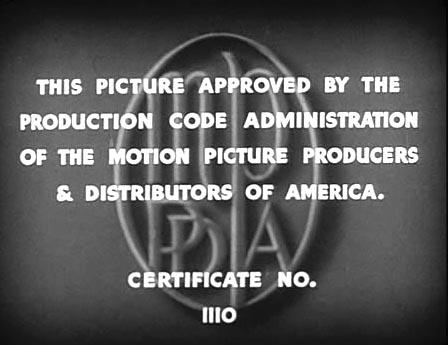
They created the Production Code Administration under the helm of super-Catholic Joseph I. Breen, or as I like to call him, JIB. The Administration would be given the authority to oversee the moviemaking process from script to final-cut and "suggest" edits based on the Production Code's strict guidelines. And by suggest, I mean that if you didn't do what JIB said, you would not get a PCA Seal of Approval and theaters would not release your film for fear of reprisals from the Legion. This meant that from 1934 on, movies had to punish wrongdoers, not show a toilet, keep the romance out of the bedroom, make sure women's bits were covered tastefully, and forget any depiction of homosexuality.
What a bore, right?
Of course creative filmmakers were quickly able to find ways around the code, using visual shorthand like fade-outs after kissing, eye-matches, and clues that someone "smelled of lavender" to still give their savvy audience members the verboten thrills they craved. These clever end-runs helped create the Hollywood style that would dominate the movies from the '30's until the Code was replaced by the MPAA ratings system in 1968. And we owe it all to the goody-goodies of the Legion of Decency.

Turner Classic Movies is having some fun this Lent by showing films that either helped bring on the Code or caused a stir with the Legion after the code was implemented. They're calling it Condemned and you can go to their oddly designed website to see a list of the movies they are showing.

My picks?

 The Story of Temple Drake (1933)- Based on the William Faulkner novel Sanctuary, Temple Drake would be a difficult movie to make even today. Temple (Miriam Hopkins) is the daughter of a prominent Southern judge and she likes to live fast with booze and boys.
One stormy night she accidentally winds-up held hostage by a rough bootlegger (luggy Jack La Rue) who kills her escort and rapes her. If that's not bad enough, when he heads to the big city he takes Temple with him. But is Temple being held against her will- or has she got a bad case of Stockholm syndrome- or Bad Boy-itis? It's a complicated story that goes to the edge with issues of rape and female sexuality. This is one of those "degenerate" movies whose content inspired the creation of the Legion.

Black Narcissus (1947)- What could the Legion have found objectionable in a movie about a group of nuns living in a monastery in the Himalayas? Plenty. The Powell and Pressburger classic has a palpable sexual undertone with looks flying between Sister Superior (the always wonderful Deborah Kerr) and Mr. Dean (the well-legged David Farrar) which makes Sister Ruth (creepy, creepy Kathleen Bryon) literally go mad with jealousy. As with all Powell and Pressburger films, the Technicolor palate and settings are visually lush and the tense ending is worth the wait. Unfortunately flashback scenes to when Kerr wasn't a nun were cut out of the American release to appease the Legion.


The Outlaw (1943)- This is the movie that made Jane Russell's ta-tas stars. This story of Jesse James with some feminine license taken with history was originally shot by gazillionaire film producer and aviation wunderkind Howard Hughes in 1941. But Russell's low-cut blouses caused so much trouble with the PCA that the film wasn't released widely until 1946. By then the film was so notorious that it sold bonkers tickets and launched Russell's career as a no nonsense actress and cross-your-heart bra pitchperson.

Baby Face (1933)- This is one of my favorite Pre-Code films. Barbara Stanwyck is an un-apologetic social climber who goes from her father's speakeasy to extravagant New York penthouse by using her feminine charms. Along the way there are broken engagements, blackmail, and murder, but Stanwyck always manages to survive. Stanwyck is young and vital here- and so down-to-earth that you hardly blame her for all her misdeeds. She is the product of a rotten world and just does the best she can to survive in it. The ending for this film was re-shot because the New York State Censorship Board had a cow, but much of the naughtiness is left intact with lascivious looks, sex-charged-banter, and camera movement that perfectly visualizes Stanwyck's climb up the corporate ladder. A must-see.

Baby Doll (1956)- This movie is weird- but worth a look. Elia Kazan and Tennessee Williams re-teamed to film the story of Southerner Archie Leigh Meighan (a drawling Karl Malden) who marries a 17-year-old (also drawling Carroll Baker) who coos like a child, sleeps in a nursery crib, and dresses like Jon Benet. It's bad enough that Archie is still waiting to consummate his marriage but along comes an Italian slickster (swarthy-toned Eli Wallach) who has his own ideas about Baby Doll. One look at the trailer and you can guess why the Legion lost their minds. Somehow this film got four Oscar noms- I'm assuming because the Academy figured if it was Kazan, it had to be Oscar-worthy. Eh...

Strange Cargo (1940)- I really like this movie. The final pairing of Crawford and Gable, this strange film is a hybrid of prison escape film, romance, and religious allegory. Verne (Gable) is a prisoner in a French penal colony and Julie (Crawford) is a lady of the night who wants to get back to the mainland and start over. They meet cute on a dock, and when Verne and some fellow prisoners plot an escape, Verne takes Julie along. The intrepid band fights their way through jungles, swamps, and an ocean crossing to find freedom.
One of the escapees, Bible-quoting Cambreau (Ian Hunter) is a calming spiritual influence and seems to know what will happen before it does. Is Cambreau a man, or the Son of you-know-who? The Legion was not too happy about this thinly-veiled depiction of Christ, and Julie's "vocation", so edits were made. Luckily the sparks between Crawford and Gable are impossible to dull, and their electric banter is a reminder of why these two were paired so often on the screen- and why they maintained a long-standing affair off-screen.

So tune into TCM and piss off the Legion by watching some "immoral" movies!

Sunday, January 10, 2016

Welcome to Lance's Werthwhile Classic Movie Diary!

Welcome, Movie (or Lance) Fans!

I am a classic movie nut. Everyone who knows me knows it. My family knew it when I papered my bedroom walls with Marilyn Monroe posters. My friends knew it when I loudly complained at our local watering hole that Christina Crawford's liar-liar-pants-on-fire book, Mommie Dearest ruined Joan Crawford's cinematic legacy. Everyone who's been on a date with me knows it when I make a Palm Beach Story reference and they stare blankly at me, my chances of getting laid disappearing like Rudy Vallee's chances of making it with Claudette Colbert. (That's a Palm Beach Story reference for those of you who have never been on a date with me.) I'm an out, loud and proud classic movie lover. So why not share that love with literally everyone on the internets, by writing a blog about movies?

So whenever I see something worth blogging about- a great old movie I've seen, a newer movie that doesn't make me roll my eyes, one of the silver screen greats passing away, a notable anniversary, or anytime something pops into my black and white mind- you can read about it here.

To get things started, how's about my thoughts on some movies I saw in 2015?


Weekend (2011)
I'd heard my gay mates and reviewers everywhere talk about how great this movie was. But because I have an aversion to movies where pretty people get to live fantastic gay lives that just make me envious, I sort of avoided it. I shouldn't have. There's nothing to envy in this dark romance. Weekend is equal parts hopeful love story and tragic, fatalistic love story. Not since Midnight Cowboy (1969) have I gotten a boner and cried all in the same movie.
Note- Do not watch this film with a man you've just fallen in love with who lives in another country, so you can't really be together. Trust me.

The Innocents (1961)
I love female gothic films. I've written papers on them. Female gothic films are to me what pizza is to fat kids. So I had to see this movie. Like a more spectral version of Rebecca (1940), Deborah Kerr is a governess who heads to a lonely manse in the countryside of England to take care of two creepy kids who seem like pint-sized adults. Things soon start going bump in the night and Deborah gets to walk through dark halls with candles questioning her own sanity. The look and sound of the film are terrifying and Deborah Kerr is always worth the price of admission.

Inside Out (2015)
I don't normally do kids movies, but the aforementioned foreign man who has become my boyfriend loves them. So I went, and like just about everyone else in the world, was charmed by this imaginative depiction of how our inner lives grow from childhood. What makes the concept of the different "emotional voices" work spectacularly is the voice casting. Amy Poehler, Phyllis Smith, Lewis Black, Bill Hader, and Mindy Kaling are all the embodiment of their various animated emotions. And Richard Kind as the manifestation of our unleashed childhood imagination was so spot-on that I could swear I heard Bing-Bong in my own head after I left the movie. This one will take the Best Animated Feature Oscar at this year's awards easily (Sorry, Minions). It might even nab a Best Picture nom. Not bad for a kiddie movie.

Pinky (1949)
I'm intrigued by Hollywood films about race and one groundbreaking film I'd always heard about was Pinky. Based on the novel by Cid Ricketts Sumner (who names their kid Ricketts?), the film stars Jeanne Crain as a light-skinned black woman who returns to her hometown to see her mother (Ethel Waters) who is devastated to find out that her daughter has been "passing" as white. But the racist, old bat neighbor nee plantation owner (played deliciously by Ethel Barrymore- two Ethels in one movie!) needs a nurse- so this is a chance for Jeanne to figure out whether she is black or white. Along with films like Imitation of Life (1934), Hollywood seemed unable to really address the race issue without easing into it with plotlines involving people who were black- but not black. While it might seem dated and colorblind to the real issues, it is interesting to watch America's struggle with race relations play out on the big screen.


It Follows (2014)
Modern horror movies usually leave me pretty cold. They seem obsessed with gore and violation of women, and quite frankly, I get enough of that watching the Republican debates. But It Follows is different. This movie takes the familiar horror trope of punishing teens who have premarital sex to a whole new level. Poor Jay (Maika Monroe) is hot and bored, so of course she winds-up having sex with the boy she has a thing for. The problem is she awakens to find herself being chased by a naked spirit that only she can see. How can she get rid of it? She has to have sex with someone else which will pass the relentless, clothing-averse spook onto them. The moral question is scrumptious and the Kubrickian camerawork and John Carpenter homage score make this film legitimately scary.


The Skeleton Twins (2014)
Like modern horror, modern comedies often leave me scratching my head saying, "What was so funny?" I'm more of a Preston Sturges than a Seth Macfarlane. But this movie about two horribly damaged adult siblings was funny... and sad. It's also sad. Kristen Wiig and Bill Hader are so wonderfully connected and yet disconnected as the titular twins. Hader plays Milo without all the effete giggling of his famous Stefan character and Wiig has grown into an actress with chops bigger than her SNL: Weekend Update beginning. The emotional tie between these two feels real- and while something feeling "real" on-screen is not a pre-requisite for cinematic success- in a story that hinges on the relationship between two such oddball characters, it does elevate the film above simple comedy.

The Martian (2015)
Matt Damon plays Ripley from the Alien movies only without any alien. This film is the thinking man's space thriller with the focus being on problem-solving rather than explosions. If it weren't for Damon's charming screen persona, this movie would have held all the interest of a NASA training film about the benefits of duct tape. Ridley Scott makes everything look properly cinematic and with all the popular support, expect this film to land a Best Picture and Best Director nom at this year's Academy Awards. But seriously, after seeing what Cuaron did with Gravity (2013), I expected something more... and if Matt Damon was stranded alone on another planet, wouldn't he wear pants less often?


Brute Force (1947)
This would have to be my pick for my favorite movie I saw last year. One of my old Hollywood mentors, Steve Vaught- Hollywood Historian sent me home from Palm Springs with the Criterion DVD of Brute Force, and I am so happy I shoved it into my carry-on. Jules Dassin directs this gritty look at the male prison system without all the camp one-liners and Edward G. Robinson tough guys that usually populate earlier prison films. Burt Lancaster (He's in prison... of course I'm watching) keeps trying to break out, but power-hungry prison captain Munsey (a truly evil performance from Hume Cronyn) always gets his man. But can anyone ever stop Burt Lancaster from getting what he wants? Dassin helped institutionalize cinema verite qualities in noir and this film is a high-point for his career. These men are complicated. The prison system is complicated. This movie is not. It works simply to convey the complexity of its topic. With great work from an ensemble cast full of "isn't he's?", I was riveted... and not just because Burt takes his shirt off.

Tangerine (2015)
You know that movie that everyone was crowing about because it was shot entirely on an iPhone? This is that movie. I'll be honest. I'm not impressed by the idea that something was shot on a phone. Movies should look like movies, not like a click-bait Youtube channel. But just as movie pioneers lugged giant, boxy film cameras up mountains and through deserts to create movies, director Sean Baker has upped his cellplan and turned out a compelling piece of modern verite. Sin-Dee (Kitana Kiki Rodriguez) has just been released from jail and is shocked to hear from her best friend Alexandra (Maya Taylor) that her pimp boyfriend has been cheating on her. What follows is a modern-day trans odyssey for truth, love, and a Los Angeles donut shop. As Baker's phone runs all over L.A. in the pursuit of these harried people, we get the sense that the veil between make-believe Hollywood and real life has been pierced- if only for one Christmas Eve. Caitlyn Jenner is campaigning heavily for the movie and its leads- but you shouldn't expect too much Oscar love for this little gem.

Well, that was some of what I saw in 2015.
What do you think?