Showing posts with label Touch of Evil. Show all posts

Thursday, December 31, 2020

Lance's Werthwhile Movies Annual 2020 Favorite Film Roundup

 Oh, 2020...

What can I write about you that hasn't already been written by others more poetic and pissed?

It's been a real challenge to maintain my glass half-full disposition, but one thing I can say- 2020 has given me a lot of time to watch movies.

And since I love to overshare, here are the movies I watched in 2020 that gave me cinematic silver-linings during this cloudy year.

The Mank Effect

With most movie theaters closed for months on end, Netflix became one of the few entertainment companies that could toot their own horns about new movies. One of the most loudly tooted was David Fincher's Mank (2020) a bio-pic about notorious screenwriter Herman Mankiewicz and his contributions to cinematic hallmark Citizen Kane. I didn't watch Mank. Since I still haven't stopped foaming at the mouth over last year's bio-pic du jour Judy (2019), and considering all the hullabaloo Mank kicked up, I decided to save myself a conniption fit and just watched Citizen Kane.

Citizen Kane (1941)

I get itchy about films that everyone loves. Probably because I want to be able to disagree without feeling like a leper- but in the case of Citizen Kane, its pedestal in the pantheon of greatest films ever made is secure with me. I would be a true moron to try and find something unique to say about Kane. 

Re-watching it, I was struck by how modern the film felt- from its flashback story framework, space-embracing shot set-ups, sly lampooning of the powerful, to performances that lurk in the realm of shadowy complication. 

Welles and Mankiewicz were not the first to employ any of these techniques- but Kane is a complete cinematic achievement and a clear influence on future filmmakers. A guy I had a socially-distanced face-chat date with informed me that there was no story in Citizen Kane. There was no second date.

After all that, you might be surprised to hear that Citizen Kane is not my favorite Orson Welles film.

It's actually...

Touch of Evil (1958)

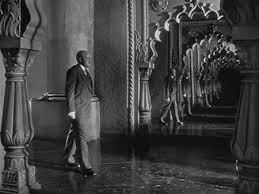
The opening shot of Touch of Evil is legendary. Its weaving, un-cut follow-shot of a car with a bomb in it and a Mexican drug enforcement official Michael Vargas (Charlton Heston. Yes. Charlton Heston) and his new wife (Janet Leigh) visually connects Vargas to the explosive crime that propels this story like a gliding dance. 

Touch of Evil isn't just dark, it's ugly. Welles seems to take impish glee in making each character in this morality play as unappealing as possible. Welles' crooked police detective Hank Quinlan is corpulent and filthy- grunting and lying his way through the case like an aging boar. 

Heston's Mexican makeup and Spanish accent (or distinct lack thereof) would be offensive even in 1958. Mercedes McCambridge is unrecognizable as a butch drug gang toughie. Even the lovely Janet Leigh (once again victimized in a motel) is tarnished when she makes a racial slur against one of her future tormentors.

The shot that best exemplifies Welles' desire to not just paint the ugliness of fate with plot but with image occurs in a small shop where Vargas borrows the phone. In one of Welles' iconic deep-focus shots, in the background we see Vargas have a brief phone conversation while in the foreground a pitifully deformed blind girl sits quietly waiting for someone to show her a kindness. It's visually arresting to the point we stop paying attention to Heston's phonecall.

The moral center of the film is a Mexican whorehouse madame/fortune teller played with ethnic disparity by Marlene Dietrich. She tells Quinlan, "Your future's all used up." But Welles' future was secure in Hollywood history- even if it's in a movie like Mank that seeks to un-seat his legacy.

But there's one other figure in the Citizen Kane trinity I'd like to talk about: Robert Wise.

The Set-Up (1949)

Robert Wise was the film editor on Citizen Kane. While critics fight over the contributions of Welles and Mankiewicz, Wise often gets left on the cutting room floor. But looking at Wise's subsequent work (he won four competitive Oscars without the presence of La Welles) it's clear that Wise had a highly developed cinematic eye. 1949 boxing drama The Set-Up is a perfect example of Wise's filmmaking talents that likely contributed to how Citizen Kane looked.

The Set-Up starts with a flowing establishing shot that moves along a cul de sac where a boxing venue is across the street from the shoddy hotel room of tragic fighter Stoker Thompson (Robert Ryan in fine physical form) and his long-suffering wife (Audrey Totter). While the plot quickly sets up the set-up, this movie is more about the denizens of this cheap, no-winner world. 

From unkind close-ups of the bloodthirsty fight viewers, to the men who get their faces punched in for a living and the money-grubbing creeps who make paydays off of them, Wise paints this portrait in ugly shades- setting the stage for future boxing films like Martin Scorsese's Raging Bull (1980). This movie is proof that while Wise clearly worked well with Welles and Jerome Robbins (West Side Story (1961)), he was a visual master all by himself.

RIP Ennio Morricone (July 6, 2020)

They called him Maestro, and the title was well-earned. In his career of over 55 years, Ennio Morricone's soundtracks helped define the films they were a part of- indelibly so. While he utilized different instruments to match the genres and periods of the films he composed for, you could always tell when you heard a Morricone score. 

In honor of his passing in July of this year, here are my favorite movies that the Morricone touch made golden:


A Fistful of Dollars (1964)
The Battle of Algiers (1966)
The Good, the Bad and the Ugly (1966)
Once Upon a Time in the West (1968)
Two Mules for Sister Sarah (1970)
Days of Heaven (1978)
La Cage aux Folles (1978)
The Thing (1982)
The Mission (1986)
The Untouchables (1987)
Cinema Paradiso (1988)
The Hateful Eight (2015)


I Do Watch Movies That Were Made in This Century

Thanks to the magic of Netflix red-envelope DVD service (yes, I still use it!), I was able to watch some of the much buzzed-about films of the last year or so.

Here are the ones that gave me the feels:

The Lighthouse (2019)

Director Robert Eggers made a splash with atmospheric creeper The Witch (2015) despite the fact I thought it needed more black goat. His next film, The Lighthouse, though, made me sit up and salute. It's basically a female gothic film with two dudes stuck in a lighthouse. Willem Dafoe gets to spout the most beguiling Melville-ian monologues and Robert Pattinson shows his nautical heinie. Madness never looked so salty in black-and-white. 

Portrait of a Lady on Fire (2019)

As the song from Broadway's The Wild Party goes, "I need a good-natured, old-fashioned Lesbian love story!" Portrait delivers just that. Set in 18th Century Brittany, the familiar story d'amour about an artist who falls in love with the subject they are hired to paint is given a sapphic twist. The performances from Noemie Merlant and Adele Haenel as the star-crossed lovers are nuanced and simple- and the rocky, oceanside setting is worthy of the greatest landscape painter. Director Celine Sciamma  achingly captures the longing of every artist (and probably non-artist) to render the fleeting fire of love so it can be re-lived again once it has gone.

Booksmart (2019)

Speaking of the ladies, Kaitlyn Dever and Beanie Feldstein play two high school nerdettes who on the eve of graduation decide it's finally time to follow good ol' Auntie Mame's advice and "Live!" Director Olivia Wilde exploits and circumvents the tropes of the typical male teen "one more night" movie to create a funny and touching flick that reminds us all what it feels like to be that awkward age, dancing with the friends we thought we would have in our lives forever.

Here's to your 2021 being full of movies that will live forever!


Tuesday, December 11, 2018

The Dietrich Effect

Dear LWM readers, I have a confession to make.

I've been cheating.

Yes, it's true. I have been cheating on my movie idol Joan Crawford with another movie idol. I've tried to keep my thoughts centered on Crawford's shoulders and eyebrows, but I have become obsessed with another set of eyebrows. And those pencil-thin works of art belong to none other than teutonic sex goddess, Marlene Dietrich.

Dietrich has always been one of my favorites. Her ability to draw focus by simply raising an eyebrow or blowing an erotic puff of smoke, her nonchalant accent both murdering and sensualizing her English dialogue, the distinctive angles of that camera-loving face- the Dietrich cinematic mystique is enthralling. I recently got the new box-set of her work with director Josef von Sternberg, and I've found my movie thoughts engrossed with the career of this tempestuous force of the silver screen.

The new box set contains Dietrich's earliest Hollywood product, and it's really interesting to watch how her acting style changed over time. In her first American film Morocco (1930) (The Blue Angel (1930) although shot first, wasn't released in America until after Morocco) Dietrich is still finding her way both in acting and with the English language. Legend has it that von Sternberg literally had her count moments and steps in between actions and dialogue. Her eye movements, her gestures, her dialogue- everything was planned out. Yet somehow her performance is electric with an intense freshness thanks to Dietrich's aggressively laissez faire screen presence and visible lust for that thing called movie stardom. Her musical numbers, in particular, flash and the famous tux kissing scene helped create the any-sexual persona that would dominate the rest of her career.

By the time Dietrich starred in her final film with von Sternberg, The Devil is a Woman (1935), her performance has gone from planned to crafted. She no longer has that bit of uncertainty counting beats. Every eyebrow motion and purse of the lips is part of the confetti-covered artwork that von Sternberg is making. It's beautiful to watch- but that spark of the unknown- the sexy danger of what Dietrich might do feels lost amongst the mantillas and masks. Von Sternberg's Galatea has become a statue again- an exquisite statue- but a statue nonetheless.

After Dietrich ended her artistic partnership with von Sternberg the debate heated up as to whether Dietrich needed von Sternberg, or von Sternberg needed Dietrich. The easy answer is Dietrich did just fine without von Sternberg. True she was probably never photographed as sumptuously as she was in Shanghai Express (1932) and The Scarlet Empress (1934), but from an acting perspective, her later works show a relaxed quality that von Sternberg's compulsively controlled direction didn't nurture. In Destry Rides Again (1939), A Foreign Affair(1948), Witness for the Prosecution (1957), Touch of Evil (1958), and Judgement at Nuremberg (1961), Dietrich proved she didn't need von Sternberg to create an indelible acting performance.

Even in slighter faire like Tay Garnett's Seven Sinners (1940), Dietrich is so devil-may-care as the Sadie Thompson-esque Bijou, she brings a wickedly romantic sparkle out of the normally frontier-y John Wayne. Dietrich was the essential secret ingredient no matter who directed her.

Now if only there were a movie with Dietrich and Crawford in it...


Saturday, January 6, 2018

Live in the Movie Moment

Hello Lance's Werthwhile Movie Fans!

I know it's been awhile since I've posted something scintillating, but I've made a resolution for 2018 to share my classic cinema burblings with all off you more often.

Sometimes I'm daunted by the amount of time I want to take talking about movies when the rest of my life is so consuming. There is not enough time in the day for me to be a television executive, a man about town, and write about why Darren Aronofsky's mother! nails all the classic Female Gothic tropes without bothering to make us care about his tortured heroine.

Today as I was trying to take a nap, my evil brain stayed awake and pestered me with the thought, "What if rather than expounding on films in movie-nut detail, I look for the little things?" Movies should be indulged in full, but often when we think of them, a single image or scene evokes all the feels.

So here is a list (in no particular order) of some of my favorite moments in film:

Dorothy Malone's frenzied dance while her father croaks on the stairs in Written on the Wind (1956).

Marilyn's "fuzzy end of the lollipop" speech in Some Like it Hot (1959). 


Gene Tierney watching Darryl Hickman drown after she gives him a rubdown in Leave Her To Heaven (1945).

The end credits of West Side Story (1961).

The helium-infused warehouse gun battle in Broadway Danny Rose (1984).

The scissor scene in The Furies (1950).

Martin Balsam going down the stairs in Hitchcock's Psycho (1960).

Peter O'Toole watching the approaching lone rider in Lawrence of Arabia (1962).


Olivia de Havilland hollering at the phone from her "small, private elevator" in Lady in a Cage (1964).

Gloria Swanson descending the staircase at the end of Sunset Boulevard (1950).

Those fucking twins in The Shining (1980).

Little Edie's Flag Dance in Grey Gardens (1985).

Bette Davis not watching her husband die of a heart attack in The Little Foxes (1941).

The Star Destroyer swallowing up the screen in the first scene of Star Wars (1977).

Parker Posey freaking out about the Busy Bee in Best in Show (2000).

Marlene Dietrich as a Mexican madame at the end of Touch of Evil (1958).

Judith Anderson fondling her old boss' nightie in Rebecca (1940).

Toshiro Mifune getting perforated at the end of Throne of Blood (1957).

Hattie McDaniels giving Scarlet over-the-shoulder side eye in the wagon when Scarlett prattles on about not being interested in someone she's totally interested in in Gone with the Wind (1939).


Robot Maria's sexy dance in Metropolis (1927).

Joan Crawford getting her cigarette lit by a pack of gents in Humoresque (1946).

Susan Kohner throwing herself on her mother's coffin in Imitation of Life (1959).

The kid trapped under the ice in Damien: Omen II (1978) (with honorable mention going to the reporter who gets attacked by satanic ravens and then a semi.)


Christopher Walken's watch scene in Pulp Fiction (1994).

Dustin Hoffman's live coast-to-coast un-masking in Tootsie (1982).

Peter Lorre screeching from his cell in Casablanca (1942).

Spock's death scene in Star Trek: The Wrath of Khan (1982).

Faye Dunaway orgasming to ratings-points in Network (1976).

Partygoers parachuting out of a doomed blimp in Madame Satan (1930).

Tallulah Bankhead trying to seduce John Hodiak while he reads the paper in Lifeboat (1944).

Glen Close losing her shit at the end of Dangerous Liaisons (1988).

Lana Turner taking a drive after she's been dumped in The Bad and the Beautiful (1952).


Here's hoping 2018 is full of magical movie moments.

Tuesday, February 23, 2016

Take It From His Cold, Dead Hand...

Have you ever wanted to own the broadsword from El Cid (1961)? How about an assortment of paintings of Charlton Heston from a variety of artists? What about his living room furniture? Well, you can have it all at the TCM Bonham's Charlton Heston Auction Event! On March 22nd the estate of Charlton Heston goes on sale and the selection of 322 lots ranges from Chuck's silverware to his laminated SAG card. Heston was a true movie star- and even if his politics became complicated (he went from a Democrat who marched with MLK Jr. to a fire-breathing NRA Reaganite) his screen presence could not be denied in the '50's and '60's.
Whether he was playing Moses in The Ten Commandments (1956), a Mexican lawyer in Touch of Evil (1958), a Jewish prince in Ben Hur (1959), or a monkey-hating astronaut in Planet of the Apes (1968), Heston always played himself- and it was always entertaining. Not as sensitive as Burt Lancaster, nor as energetic as Kirk Douglas, Heston relied on a righteous strength that flowed through his characters, elevating normal men to greater heights and deeds. Not to mention, he looked great in a loincloth. So check out the auction and you too can own a slice of Heston's legacy. Only take your stinking paws off the Omega Man suitjacket and frilled shirt you damned dirty apes!