Well, they say the third time is the charm- but I don't think they were referring to shelter-in-place. Three weeks in and I'm trying to figure out how to turn vintage cloth napkins into face masks.
Pandemic 2020: Making You Crafty.
When I wasn't folding cloth with rubber bands so I could go buy Prosecco, here are the movies I watched:
Hud (1963)
If I had to choose someone to be isolated with, Paul Newman would most definitely be at the top of the list. Even with a coronavirus mask on, those eyes would make my spine turn to custard and I wouldn't care if it was a Wednesday or a Friday. Every day would be Paulday.
In
Hud, a family of ranchers experience a pandemic of their own- Hoof and Mouth disease. But Hud (swagger-ific Newman) doesn't seem to care if the family's cattle and livelihood are about to be wiped out. He is too busy raising hell in honky-tonks and the bedrooms of bored housewives.
Patriarch Homer (a wonderfully aged Melvyn Douglas) does what he can to set Hud straight- but nothing seems to keep Hud from following his baser instincts. Will young and impressionable nephew Lon (gone-too-soon Brandon De Wilde) follow in his uncle's notorious bootsteps, or is there redemption to be found on the desolate Texas prairie?
The acting performances here are masterful earning Newman, Douglas, and Patricia Neal Oscar noms- with both Douglas and Neal taking home the statues. Also winning an Oscar for his stunning black-and-white cinematography was the legendary James Wong Howe.
Howe's Texas vistas are breathtaking, and his shots of small town life are bleakly tender. A precursor to such lonely, modern westerns as
The Last Picture Show (1971) and
Days of Heaven (1978),
Hud is a feast for the eyes any way you look at it.
The Farewell (2019)
If Ozu and Wes Anderson made a movie, it would be
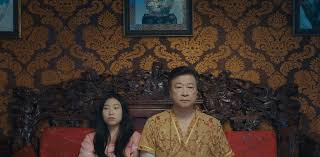
The Farewell. Awkwafina's Nai Nai (the utterly charming Shuzhen Zhao) has three months to live- but in true Chinese cultural fashion, the family has decided not to tell Nai Nai. So a wedding is concocted to bring the family together so that Nai Nai can get all the hugs and scoldings in before she drops dead.
There is space here for raucous family comedy and larger-than-life character, but director Lulu Wang takes it in a quieter, more touching direction. There aren't any explosive
Terms of Endearment blow-ups, just typically complicated familial confessions with an underlying tone of mortality. It's simple- and it works.
Awkwafina surprised me, as I was only familiar with her comic reputation from
Crazy Rich Asians (2018) and
Nora from Queens (2020) but she's quite good as the black sheep of the family despondent over the impending loss of the one relationship she could count on.
Wang's focus on heavily constructed shots and atmosphere-enforcing soundtrack overwhelm at times- but the images of fallow Changchun, China are an eerie foretelling of the empty spaces this pandemic has produced not only in China, but around the world.
The High and the Mighty (1954)
In times of disaster, sometimes it's fun to watch films about- well, disaster. And the granddaddy of the "plane danger" genre is 1954's
The High and the Mighty. Long before
Airport (1970) this doomed flight adventure was taking wing with audiences and making them question whether that six hour flight was really worth the air miles.
H&M takes us back to the golden age of flying when your seat was the size of a barcalounger, there were only 21 people on your flight, and you could smoke everywhere- even on the flight deck.
John Wayne as Whistlin' Dan (No, seriously. He whistles a LOT. A drinking game should be played where you quaff each time Dimitri Tiomkin's theme tune is heard) is a co-pilot with baggage and he along with Captain Robert Stack (who parodies this very character in
Airplane (1980)) are flying from Honolulu to San Francisco with a cabin filled with disaster movie stereotypes:
Newly married couple- Check! Couple ready for the divorce attorney- Check! Cuckolded married man ready to get revenge on the man who he thinks shtooped his wife- Check! Precocious kid who winds-up sleeping through the whole flight- Check! Insensitive portrayals of Asian, Italians, and Mexicans- Check!
The gang's all here- and with scenery-chewing performances from the likes of Claire Trevor, Sidney Blackmer, and Jan Sterling- you have the perfect group-viewing movie. Zoom it with your favorite cineastes- and don't miss the best line of the film, "I always thought your brain would fit nicely in a demitasse."
I could tell you all about my Netflix binge-viewing of zeitgeist darling
Tiger King (2020) or Dark Horse comic to series entry
The Umbrella Academy (2019)- but this is a movie blog- and this pandemic won't make me change my rigid blogging standards... but let's see what week 4 brings...
Stay safe faithful LWM readers!