Showing posts with label Faye Dunaway. Show all posts

Friday, July 29, 2016

Top 5 Cannon Films

Last week I watched a great indie documentary about a little film studio that could- Electric Boogaloo: The Wild, Untold Story of Cannon Films (2014). Throughout film history smaller studios run by ambitious visionaries have produced films that challenged the Hollywood status quo- creating memorable movies when the odds were against them. But no one turned out movies quite like Cannon.

Israeli film enthusiasts Menahem Golan and Yoram Globus came along in the late '70's and took over Cannon Films, turning it into a sometimes profitable schlock machine that cranked out some of the best-worst movies of the era. Their library is made-up of films that could all have a Hal Douglas voiceover in their trailer: Death Wish II (1982), The Last American Virgin (1982), Bolero (1984), Missing in Action (1984), Invasion U.S.A. (1983). 


The cheapness of their prodigious output was tolerated by audiences because of the levels of sex and gore that were forced into every screenplay. But eternal optimists, Golan and Globus always worked, wheedled, and pitched their next film in the hopes that it would be the one that would get them taken seriously. The documentary is a lot of fun as former stars, directors, and co-producers chart the rise and the fall of the Dynamic Duo of Duds- who may not have had any taste, but they sure had chutzpah.

Here are my Top 5 Cannon Films and while it's hard to say any of these are good, I can say they leave an impression.

The Apple (1980)

One of the Go-Go Boys' first films after they acquired Cannon, is this attempt to make the next Tommy (1975). What they made looks more like a Eurovision song contest on PCP. It is 1994, and two kids from the sticks, Bibi and Alphie (Catherine Mary Stewart and George Gilmour disrespectively), come to the big city to compete in a worldwide singing competition and get sucked into the dark underworld of sex, drugs, and euro-pop. Will their love be able to overcome lies, betrayal, and bad rock?

Everything in the movie is too-much- and at the same time not enough. Costumes, story, acting, songs, singing, dancing- all are done with obnoxious seriousness, without enough cash to make West Berlin look like futuristic America.

The movie is trying so hard to be a Biblical metaphor that critiques how the music industry grinds up people set in a futuristic society . It really is trying. See how hard it is trying. But it totally misses the mark, leaving us with a movie that causes one's jaw to drop- and not in the good way.

Look for character actress extraordinaire Miriam Margolyes as the Landlady... because they couldn't afford to give the landlady character an actual name...


Breakin' (1984)

I'm a white boy from Kansas. And when Breakin' came out in '84 the whole neighborhood lost its ever-lovin' mind. The dance moves, the music... the black people! Soon we were all wearing parachute pants from JC Penneys, making wiggy-wiggy-wiggy noises, throwing cardboard down on our yards, and trying our hardest to do headspins, moonwalk, and pop-and-lock. That, ladies and gentlemen was the power of Breakin'.

Now let me be clear. We were not reacting to the hackneyed plot about a group of breakdancers struggling for recognition, and the lily-white ballerina who helps them get their big break. That crack was whack. But we couldn't get enough of the music and dancing. And the rest of the country felt the same way. Breakin' hit the jackpot for Cannon with over $38 million in domestic receipts. The soundtrack of early hip-hop songs (including Ice T's first mainstream recording) hit #8 on the Billboard Top 200 charts. Cannon had a genuine hit.

But the problems with the film came from G & G's inability to truly capture American culture. While many of the stars of the film were famous breakdancers, the gritty urban culture that spawned the dance craze is covered over in neon, feather earrings, and leg-warmers. Lucinda Dickey who played Kelly (street name Special K- for real?) wasn't able to really do the dance moves and the authentic dancers really resented it. The attempt to shove an upper class white girl into a street movie was just one example of a film that was once again trying too hard to be popular.

Seven months later when Cannon made a sequel with the much maligned Electric Boogaloo in the title, the dance craze had lost its appeal- and mainstream hip-hop had moved on to more realistic grit and anger. But there was a golden time in that Summer of '84 when we all tried to be like Shabba-Doo and Boogaloo Shrimp.

Invaders from Mars (1986)

When I first saw the trailer for Tobe Hooper's re-make of the '50s classic Invaders from Mars, my 14 year-old-brain was freaked out. I mean when you have the director of The Texas Chainsaw Massacre (1974);  Dan O'Bannon, the writer of Alien (1979); and special-effects master Stan Winston working together, you should get some major scare-age. Throw in Karen Black, Louise Fletcher, Timothy Bottoms, Laraine Newman, and Bud Court, and you have a slam-dunk sci-fi horror movie. Well...

The movie's plot is a version of the typical Fifties horror film: young boy sees alien ship land in backyard, no one believes young boy's story, people begin behaving strangely, young boy has to figure out how to save his town and perhaps the world from an unseen alien threat. The themes of paranoia and a mistrust of those you think you know and love were apropos for the era of the Red Scare- and Reagan's '80's Cold War with Russia conjured up some of the same fears. In that way, the film is really creepy in how it makes us question the veracity of what we think we know by turning parents and teachers into threats to the truth.

What doesn't work in this film is the reveal of the alien threat. The special effects of the ghostly lit backyard and a spinning sandtrap that drags victims under are great in that the aliens are left to our imaginations. But once the alien drones are revealed, we laugh more than we scream. Hooper struggled with the low budget he was given and Winston actually only created two of the hobbling, toothy Audrey 2-esque alien monsters. So camera tricks had to be employed to make the impression that this was a terrifying invasion force.

Hooper was furious at being low-balled on his budget by the G-Boys, and Golan and Globus felt that they had been horn-swaggled by a supposed horror master. The result was yet another Cannon box office disappointment. But hey! I'll watch Louise Fletcher eat a lab frog anyday.

Tough Guys Don't Dance (1987)

There are a lot of movies that people label the "Worst Movie of All-Time". Personally, anything with Adam Sandler in it is in the running. But Tough Guys might actually be the crown-holder of the dubious distinction of worst movie ever. Golan and Globus were desperate to gain recognition as serious film producers, so in the mid-Eighties they used what capital they had to lure celebrated talent to their projects. Franco Zefferelli, John Cassavetes, and even French film auteur Jean-Luc Godard took the bait and worked with Cannon with less than stellar results. Authorial icon Norman Mailer wished to direct the film version of his noir-influenced 1984 novel and Cannon coughed-up the cash for him to do it. Mailer had only directed a handful of films in his career, but with the help of legendary Chinatown (1974) screenwriter Robert Towne, he hoped to create something notable. It's notable alright.

Tim Madden (Ryan O'Neal) is a blackout drunk who wakes up in a bloody car and finds a severed head in his marijuana stash. Madden begins flashing back over his lushy life to try and figure out who the head belongs to and who has committed this heinous act. His dying father (Lawrence Tierney) and his girlfriend (Isabella Rossellini slumming it) figure prominently in his soap opera-worthy musings, but the twists and turns of this mystery are as murky as Madden's memory.

A trailer for the film suggests that Cannon realized fairly quickly that this film was not going to be received seriously, so they attempted to take the campy route in its promotion. It still didn't work. The film bombed and became a cult favorite for its over-acting; lines like,"Cause you don't have a womb!"; and the famous Oh Man, Oh God! scene. Mailer would never direct again, and perhaps that was for the best.

Barfly (1987)

1987 also produced what was supposed to be another prestige project starring Mickey Rourke and Faye Dunaway as- well, as barflies. With a semi-autobiographical screenplay by poet and novelist Charles Bukowski, Barfly was meant to be a raw and edgy look at the wasted lives of wasted people. Mission accomplished.

Rourke is Henry Chinaski, a poet stuck in a bottle who goes from odd job to bar to rathole, opining about life in between barfights and blackouts. Along the way he meets Wanda (Dunaway), a kept woman who enjoys spending her lover's money on hooch and other men. Henry and Wanda are soon drinking and sleeping together- a co-dependent, enabling match made in Finlandia.

But Henry's work has been noticed by a publisher (Alice Krige), so she tracks him down and offers him a book deal and a chance to escape his plastered life. Will he take that chance? Or will he take Johnny Walker, Captain Morgan, and Jim Beam's offer?


The film is a total downer. But the performances by Rourke and Dunaway are raw, complicated, and disturbing. Rourke was still hot from his sexy success in 9 1/2 Weeks (1986), but shades of the messed-up performance he would later earn an Oscar nom for in The Wrestler (2008) are evident. Dunaway's post Mommie Dearest (1981) career-slide was not stopped by Barfly- although she was nominated for a Golden Globe for Best Actress. The film is ultimately a dark character piece that reeks of the apathy of alcoholism without the intervention it so desperately needs.

By the end of 1987 Cannon Films received what was probably their deathblow. They had
poured a lot of money (for them) into Superman IV: The Quest for Peace and Masters of the Universe. But both movies tanked- in large part because their special effects looked so cheap. Their reliably lucrative franchises Death Wish and Missing in Action both produced sequels that likewise bombed.

Golan and Globus held on another nine years, but were never able to make the film that would gain the acclaim or the box office they sought. But their passion to keep cranking out movies in the hopes of creating something special resulted in a body of work that stands out for its cult appeal- if not its cinematic excellence.


Friday, July 15, 2016

Top 5 New York, New York Movies

This week I've been busily showing my visiting sister and niece the Big Apple. Sure they get to see tourist sites like Times Square, One World Trade, Central Park, and Rockefeller Center- but they also get to experience those little spots that make New York unique- like PenelopeMarie's Crisis, and even a drag restaurant where Joan Rivers is still alive.

I'm in a New York state of mind, and I can't help but remember all those movies that have used New York City locations so effectively- essentially making me fall in love with a real city by watching celluloid fantasies. And coincidentally, the new Ghostbusters movie comes out today with lots of shots of Manhattan. Don't believe the haters. It's fun. Trust me.

So here they are- my Top 5 New York, New York movies!:

Sweet Charity (1969)

Charity (the one and only Shirley MacLaine) is a dancehall gal whose romantic life is as confused as she is. If she isn't getting thrown off a bridge in Central Park, she's being abandoned in a movie star's bedroom (with a bedspread made of three kinds of fur!), or dumped by her fiance (the recently RIP John McMartin) because her job is a little too risque for his taste. But through it all Charity's pluck endures and insures there is always another musical number right around the corner.

The plot is based on the Fellini classic Nights of Cabiria (1957) and tends to wander around town. But MacLaine's goofy screen persona and the fantastic songs like the opening number, "My Personal Property" really make Sweet Charity a pleasant trip. The biggest hit from the show, "Hey Big Spender" is a cabaret bar mainstay- and the West Side Story-esque visuals of "There's Gotta Be Something Better Than This" make you want to leap around on your rooftop like MacLaine, Chita Rivera, and Paula Kelly.

MacLaine croons the sweet "It's a Nice Face" to a passed out stranger in an elevator and "Rich Man's Frug" gives the mini-dress and the pony-step a real meltdown at The "God I wish this place actually existed" Pompeii Club. Charity isn't very deep- it's just plain old fun.

Much of director Bob Fosse's creative use of song and site benefits from being shot on location in New York City with Central Park, the Top of the Rock, Yankees Stadium, and Wall Street setting the stage for Charity's romance and dance numbers. It might be said that Charity's real love affair is with New York. Look for a brief cameo by future Harold and Maude (1971) star Bud Cort at the end.

Sweet Smell of Success (1957)

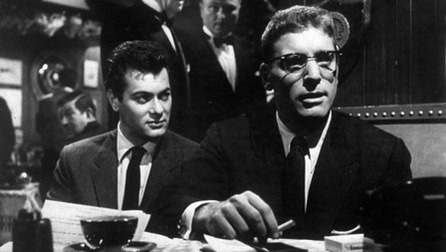
A sweetly titled movie that is not so sweet, Sweet Smell is the acid-toned story of young press agent, Sidney Falco (Tony Curtis), who is willing to do anything to get in good with Walter Winchell-esque Broadway columnist J.J. Hunsecker (Burt Lancaster- who co-produced as well as starred). But as always happens to these ambitious young thangs, Sidney gets much more than he bargained for when he waltzes with the devil.
The film is legendary for its dialogue- a verbal dance with tongues made of barbed wire. Ernest Lehman who wrote the short-story the piece is based on worked up the film script initially, but became deathly ill so famed playwright Clifford Odets finished the job. Lehman would later admit that the working environment with Lancaster & Co. was toxic, and nearly killed him. But with lines like, "The cat's in the bag, and the bag's in the river," it would seem the script's birth by fire was worth it. The Vanity Fair expose on the making of the film is well worth a read.

Lancaster and Curtis are terrific with both screen idols dropping their "good guy" images to play two of the slimiest characters ever teamed-up on the screen. The darkness of these two characters is mirrored by James Wong Howe's stunning chiaroscuro lighting scheme that makes the inside of popular bars and nightclubs look like depraved opium dens- all to the strains of a jazzy Elmer Bernstein score.

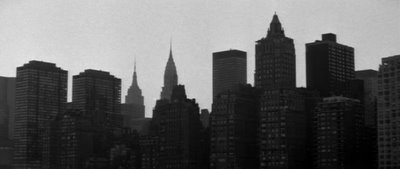
1950's Times Square is on full display here with the legendary intersection and real life locations like the Brill Building, 21 Club, and Toots Shor Restaurant providing the frenetic energy that drives the film (even though the interior of 21 was recreated on a Hollywood set). The director found it hard to get some of those shots as the screaming Tony Curtis fans frequently broke through barricades to get a piece of their matinee idol. Don't bite too hard girls. He tastes like "a cookie full of arsenic."

The King of Comedy (1982)

Director Martin Scorsese is a New Yorker born and bred- so it's easy to see why The City That Never Sleeps is a main character in many of his early films. While Taxi Driver (1976) is legendary for its NYC locations, I'm also fond of Scorsese's use of the city in his stab at the entertainment biz, The King of Comedy.

Rupert Pupkin (Robert De Niro before he stopped trying) is an aspiring comic. He's done the work. He's crafted his jokes. He's followed the careers of successful comics. Heck, he's even created a talkshow set in his apartment complete with cardboard cutouts for guests and a wallpaper audience. What more does he need to do to get a gig? In Rupert's mind, kidnap the most successful talkshow host in America (Jerry Lewis playing himself?) and make him put Rupert on his show.

King of Comedy is so great because while it winkingly highlights the impossibility of making it in the entertainment industry, it also shines a blacklight on the obsessed uber-fans that provide the fuel for our stars. Pupkin isn't just crazy for stalking Jerry Langford, he's crazy for wanting to be like him in the first place. De Niro does oddly-intriguing crazy well, and Rupert, while clearly insane, feels as sad as he does threatening.

The same cannot be said of his friend Masha. In the hands of Sandra Bernhard, this obsessed fan is every star's worst nightmare- a sex-crazed lunatic who has no regard for personal space or volume. Lewis as Langford plays the role of a lifetime as the world-weary, nasty comic- sick of fame, sick of fans, and sick of himself.

'80's Midtown Manhattan is on full display here with lots of West Side and Times Square grittiness to take the shine off the television talkshow. My favorite location is the former Paramount Building at 1633 Broadway- where I have worked for the last 16 years.

Manhattan (1979)

Woody Allen is the quintessential New York filmmaker. No other director (except for perhaps Scorsese) has had a bigger role in depicting New York City on the big screen. So it should come as no surprise that Allen's movie Manhattan is a visual loveletter to his favorite town.

The film opens with a black and white montage of New York underscored by Gershwin's "Rhapsody in Blue": The Manhattan skyline, Staten Island Ferry, 5th Avenue, Washington Square Park, Fulton Fish Market, Guggenheim Museum, Central Park. Allen narrates, "New York is my town- and it always will be." He has a confidence about this place- a confidence in its joys, letdowns, hypocrisies, and human truths.

Allen plays Isaac Mortimer Davis, a twice-divorced, 42-year-old TV comedy writer who is hopelessly entangled with a 17 year-old girl (Mariel Hemingway). It's creepy even without the events that would unfold later in Allen's personal life.

But Isaac also finds himself attracted to the woman that his best friend is having an affair with- the much more grown-up Mary (Allen's then muse, Diane Keaton). The two talk as the sun comes up over the Queensborough bridge- and one of the most iconic shots of New York City is born. The romantic entanglements ensue with the sort of hopeless optimism that has become Allen's trademark.

Allen skillfully uses New York City as a sort of picture frame for the film's various scenes. Whether it's the aforementioned dawn-breaking conversation in Sutton Place, or Allen and Keaton getting to know each other in the shadows of the Hayden Planetarium, or the final scene where Allen confronts his young paramour in the lobby of a New York apartment building, the city is more than a setting. It accents and reflects the internal desires of Allen's characters, drawing us into their city and their lives.

Allen has set some of his films in other towns, but there is an ease and a comfort to his New York work that sets it apart. You can tell Woody Allen loves New York- and he passes that love on to the audience.

Eyes of Laura Mars (1978)

I love a good feminist horror film. Some may scold me for using the term 'feminist' in relation to a thriller movie about a fashion photographer and a serial killer- but trust me Laura Mars is all about critiquing the male gaze. Laura (the uber fashionable Faye Dunaway) is a famous photographer along the lines of Helmut Lang who likes to take pictures of models in gruesome murder poses. The girls are scantily clad and are usually being killed. Laura assumes these "visions" are just her creative intuition, but when she begins experiencing spells where she sees through the eyes of an actual serial killer, and that she is the next target, she seeks help from skeptical New York detective John Neville (Tommy Lee Jones).

The conceit of a woman who loses her sight to see what a man sees, then duplicates that vision in her own art is a clever way of addressing the relationship between women, men, and media. So many of us are swept up by the images we see- without thinking that the source of these images (even if they are created by women) is often from a male perspective.

The makeup, the hair, the clothing, the advertising of these products- it's all created to please men. In Laura Mars, director Irvin Kershner hints that this image is destructive, and women can be complicit in how they are viewed by men and themselves. After all, Laura sees herself from her stalker's perspective.

All that deep-dive analysis aside, the film is a really fun thriller with Dunaway throwing herself into the role of terrified victim with wide-eyed relish. The fashion shoots are a scream as is Rene Auberjonois' performance as a flamboyantly gay manager. His Lloyd Bridges impersonation is to die for.

The film was shot in several New York locations including the apocalyptic fashion shoot in Columbus Circle, the warehouse photography studio along the Chelsea waterfront, Dunaway's slit-skirt trot along Canal and Greene Streets, and the model funeral at Westchester's own Ferncliff Cemetery- the final resting place for such luminaries as Joan Crawford, Judy Garland, and Madame Chiang Kai-shek. If you're going to be pursued by a crazy psycopath, there's no place chic-er than New York City.

What movies make you think of the Big Apple?


Friday, March 18, 2016

Top 5 Camp Classics!

It's the 60th Anniversary of The Ten Commandments and TCM Big Screen Classics is celebrating by releasing the film in theaters March 20th and 23rd. I'm going to celebrate by including the movie on my Top 5 Camp Classics List!


Camp movies, it might be said, are all in the eye of the beholder. The films included can be everything from drag farce, to epic misfires, to schlocky horror. Not everyone agrees that certain films are camp, and definitions can be a little hazy. But I'm going to take a crack at it anyway.

Successful camp often comes from a film that was produced very seriously- overly so to the point that it feels like "too much." This results in films that are failing so badly at their intended reactions that we find ourselves laughing at them. For me, true camp (with the exception of genre genius John Waters) is not made on purpose. It's the product of a director and/or actors who are not aware how their film is being received by the audience. In other words, camp is one of the most rare of genres because these gems of thwarted expectations are totally accidental.

Here are my Top 5 Camp Classics:

1. The Ten Commandments (1956)

Cecil B. DeMille made EPICS! From as early as the silent era, DeMille made big budget films that included casts of thousands and massive sets- some of which were so large, they were just left in the desert where they were built. DeMille's great ability was to create films that were so extravagant, they had to be seen to be believed. The studios were happy to indulge his cinematic flamboyance because in the '50's, a DeMille film was an event that could compete with the television- the biggest threat to the movie business at that time. And there was no bigger story for DeMille to tell than the story of Moses.

DeMille pulled out all the stops. He spent $13 million dollars on the production (that's $130 mill in today's dollars), shot on location in the Sinai, and a cast a vast army of actors led by: Charlton Heston, Yul Brynner, Anne Baxter, Edward G. Robinson, Yvonne De Carlo, Nina Foch, Cedric Hardwicke, Judith Anderson, and Vincent Price.

One look at the cast, and you can see why this serious epic has become a delightful piece of high camp. It's a who's-who of scenery chewers, each one greater at hamming it up than the next. And the bible-inspired dialogue thuds deliciously off of their tongues.
"You will be king of Egypt, and I will be your footstool!"

"Where's your Moses now?"

"Oh Moses, Moses, why of all men did I fall in love with a prince of fools?"
The lines can't be delivered with a straight face- but they are- desperately so. With its eye-popping costumes, sets, and special effects, the film is like a fabulous biblical theme park- it's so ridiculously gaudy, we can't wait to ride it again and again.
The Ten Commandments was a huge hit at the box office, currently ranking 6th in all-time box office receipts (adjusted for inflation). Ironically, Hollywood wised-up and sold its movies to television, and The Ten Commandments became an Easter staple in living rooms around the country. But nothing beats watching hirsute Chuck Heston part the Red Sea on the big screen.

Oh The Ten Commandments, you stubborn, splendid, adorable fool!

2. Female Trouble (1974)

As mentioned in my intro, John Waters is one of those rare directors who makes camp films on purpose. Much of this stems from The Pope of Trash's desire to poke convention in the eye with a handheld camera. With his muse Divine (Harris Glen Milstead's mascara-ed alter ego) Waters became the king of a whole new genre of underground cinema. His first shot at filthy stardom came with 1972's Pink Flamingos where he shocked viewers with a singing a-hole (no, not Ted Nugent- an actual a-hole that lip-synced)  and Divine eating dog crap on camera. Two years later, Waters applied his special brand of perversity to the story of juvenile delinquent Dawn Davenport (Divine).

From the first moment we see Dawn tramping around the Christmas tree hollering about cha-cha heels we know this girl is no good. So it comes as no surprise that Dawn rebels against marriage and motherhood by becoming a famous murder artist. Along with Divine, Waters' cast of regulars includes Mink Stole as Divine's obnoxiously twitchy daughter Taffy, porcine Edith Massey as the loud-mouthed-crammed-into-her-costume Aunt Ida, and David Lochary and Mary Vivian Pierce as fashionista perverts The Dashers.

Waters has no interest in conforming to film standards in order to tell a story or draw us into a make-believe world. The five cent budget, dialogue improvisation, handheld camerawork, and performers who don't look or act like actors leave the audience not with the idea that we've seen a film- but the most fucked-up home movie ever made. Waters would later clean-up his filmmaking and score a mainstream hit with Hairspray (1988), but I prefer my Waters dirty.

3. Lady in a Cage (1964)

Olivia de Havilland is one of the most memorable actresses of the studio system who starred in such great films as Gone With the Wind (1939), and The Heiress (1949). But by 1964, de Havilland did what many older actresses like Bette David and Joan Crawford did to make a quick buck- she starred in a low-budget horror movie. 


Lady in a Cage starts off with a strange, Saul Bass-esque montage of images- a young black girl rolling her roller skate over a passed out drunk, a dead dog lying in the street, people necking while an evangelist preaches over the radio about an anti-Satan missile. Mrs. Cornelia Hilyard (de Havilland) lives in a house along a busy street. But the calm and quiet of her "looks bigger-on-the-inside" home screens out the noisy outside world. Corny (that's what I like to call her) broke a hip recently and now has to get around with a cane, and an elevator. Yes, you heard right, an elevator.
To go from her bedroom to the living room, Corny has to get into an elevator that feels like it takes 20 minutes to go down one floor. She doesn't mind. She takes along her transistor radio and patiently waits to descend. But today is a bad day for Corny. Her gay son who lives with her has left for the weekend to commit suicide and due to a freak accident with a garbage truck out back, the power to Corny's house is knocked out- while she's suspended over the ground floor in her elevator.
And if that isn't bad enough, a group of drug-addled hippies (led by a young and very hairy James Caan) find out she's trapped and come to rob her home and create general mayhem. The plot is ludicrous, and for a good portion of the film you have to keep yourself from screaming, "JUST JUMP!!!" at the screen- but there's de Havilland. The poise and stature of this regal lady rises above the film and endows it with a gravitas it doesn't truly deserve.

When Corny decides to fight back with a war cry of, "Welcome to the Stone Age!" you abandon all logic and go along with her. I think this film is trying to make a commentary on how the chaos of the Sixties was invading our personal lives- but you'll be too busy watching De Havilland try to knock a phone off the hook with a homemade Grab-It to care.

4. Mommie Dearest (1981)

I have a love/hate relationship with Mommie Dearest. I mean, it's the film that effectively destroyed Joan Crawford's cinematic image forever, and I can't forgive it for that. But God it's fun to watch.

Faye Dunaway stars as Joan Crawford- or at least Dunaway's version of Joan Crawford. In Dunaway's hands, Crawford becomes a glamorous gorgon- a woman who is meticulously in control of everything around her- including her image. Whether she's jogging, putting on elbow cream, or chopping down rose bushes, Dunaway uses the dramatic gestures and voice of an ACTRESS to depict Crawford. Dunaway was obsessed with this role- to the point she felt that Crawford was haunting her. The line between actress and role feels frayed, as if Dunaway didn't just play Crawford but became her.

But is this what Crawford was really like? Even Christina Crawford whose book started this whole mess announced after seeing the movie, "That's not my mother." While Crawford had major difficulty differentiating between public and private, the idea that she was Mildred Pierce behind closed doors is hard to swallow- no matter how enthralling it might be to imagine. Whether Dunaway captures the real Crawford is hardly the point, though. What she does is create a fascinating caricature that is endlessly entertaining in its rejection of reality for grand explosions of love and anger and wire hanger frustration.

This film is a perfect example of accidental camp. The film was released as a serious drama addressing child abuse. But the crowds of gay men cackling at Dunaway's every line soon made it apparent that the audience was seeing it as something else.

5. Valley of the Dolls (1967)

What could possibly happen to three, attractive young women who meet in New York on their way to fame and fortune in the entertainment biz? In the hands of writer Jacqueline Susann, plenty. Based on the wildly successful novel, the film version of Valley of the Dolls follows Anne (Barbara Parkins), Neely (Patty Duke), and Jennifer (the late Sharon Tate) as they attempt to make it in this biz we call show. Successes and failures both professional and private abound and no one makes it out without substance abuse issues.
Along the way Broadway legend Helen Lawson (played by Queen of the scenery-chewers Susan Hayward) stands as a bitchy moral compass, a survivor who turns wig catastrophes into victory laps.

Valley of the Dolls has always been over-the-top, and it is that quality that turns this cinematic soap opera into camp. Over time, the film's desire to shock its audience has only increased that campiness. The sensationalism of drug abuse, sex scandals, homosexuality, and naked pictures turns into laughs as the culture we live in now accepts these aspects of the Hollywood story as de rigeur. The recently reported re-make seems silly to me. What are these girls going to do to shock a modern audience? Get an abortion on live television... on the moon? Part of the joy of this film is the kitsch of the Sixties, that like a fine wine will continue to improve with age. There's no need to make any new bottles of it.

So those are my favorite camp films. What are yours?