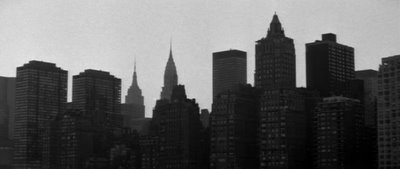
This week I've been busily showing my visiting sister and niece the Big Apple. Sure they get to see tourist sites like Times Square, One World Trade, Central Park, and Rockefeller Center- but they also get to experience those little spots that make New York unique- like
Penelope,
Marie's Crisis, and even a
drag restaurant where Joan Rivers is still alive.
I'm in a New York state of mind, and I can't help but remember all those movies that have used New York City locations so effectively- essentially making me fall in love with a real city by watching celluloid fantasies. And coincidentally, the new
Ghostbusters movie comes out today with lots of shots of Manhattan. Don't believe the haters. It's fun. Trust me.
So here they are- my Top 5 New York, New York movies!:
Sweet Charity (1969)
Charity (the one and only Shirley MacLaine) is a dancehall gal whose romantic life is as confused as she is. If she isn't getting thrown off a bridge in Central Park, she's being abandoned in a movie star's bedroom (with a bedspread made of three kinds of fur!), or dumped by her fiance (the recently RIP John McMartin) because her job is a little too risque for his taste. But through it all Charity's pluck endures and insures there is always another musical number right around the corner.
The plot is based on the Fellini classic
Nights of Cabiria (1957) and tends to wander around town. But MacLaine's goofy screen persona and the fantastic songs like the opening number, "My Personal Property" really make
Sweet Charity a pleasant trip. The biggest hit from the show, "Hey Big Spender" is a cabaret bar mainstay- and the
West Side Story-esque visuals of "There's Gotta Be Something Better Than This" make you want to leap around on your rooftop like MacLaine, Chita Rivera, and Paula Kelly.
MacLaine croons the sweet "It's a Nice Face" to a passed out stranger in an elevator and "Rich Man's Frug" gives the mini-dress and the pony-step a real meltdown at The "God I wish this place actually existed" Pompeii Club.
Charity isn't very deep- it's just plain old fun.
Much of director Bob Fosse's creative use of song and site benefits from being shot on location in New York City with Central Park, the Top of the Rock, Yankees Stadium, and Wall Street setting the stage for Charity's romance and dance numbers. It might be said that Charity's real love affair is with New York. Look for a brief cameo by future
Harold and Maude (1971) star Bud Cort at the end.
Sweet Smell of Success (1957)
A sweetly titled movie that is not so sweet,
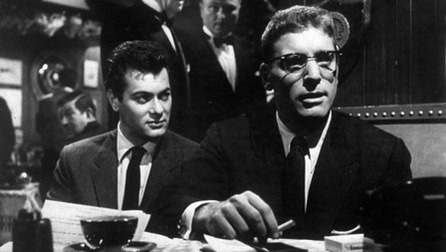
Sweet Smell is the acid-toned story of young press agent, Sidney Falco (Tony Curtis), who is willing to do anything to get in good with Walter Winchell-esque Broadway columnist J.J. Hunsecker (Burt Lancaster- who co-produced as well as starred). But as always happens to these ambitious young thangs, Sidney gets much more than he bargained for when he waltzes with the devil.
The film is legendary for its dialogue- a verbal dance with tongues made of barbed wire. Ernest Lehman who wrote the short-story the piece is based on worked up the film script initially, but became deathly ill so famed playwright Clifford Odets finished the job. Lehman would later admit that the working environment with Lancaster & Co. was toxic, and nearly killed him. But with lines like, "The cat's in the bag, and the bag's in the river," it would seem the script's birth by fire was worth it.
The Vanity Fair expose on the making of the film is well worth a read.
Lancaster and Curtis are terrific with both screen idols dropping their "good guy" images to play two of the slimiest characters ever teamed-up on the screen. The darkness of these two characters is mirrored by James Wong Howe's stunning chiaroscuro lighting scheme that makes the inside of popular bars and nightclubs look like depraved opium dens- all to the strains of a jazzy Elmer Bernstein score.
1950's Times Square is on full display here with the legendary intersection and real life locations like the Brill Building, 21 Club, and Toots Shor Restaurant providing the frenetic energy that drives the film (even though the interior of 21 was recreated on a Hollywood set). The director found it hard to get some of those shots as the screaming Tony Curtis fans frequently broke through barricades to get a piece of their matinee idol. Don't bite too hard girls. He tastes like "a cookie full of arsenic."
The King of Comedy (1982)
Director Martin Scorsese is a New Yorker born and bred- so it's easy to see why The City That Never Sleeps is a main character in many of his early films. While
Taxi Driver (1976) is legendary for its NYC locations, I'm also fond of Scorsese's use of the city in his stab at the entertainment biz,
The King of Comedy.
Rupert Pupkin (Robert De Niro before he
stopped trying) is an aspiring comic. He's done the work. He's crafted his jokes. He's followed the careers of successful comics. Heck, he's even created a talkshow set in his apartment complete with cardboard cutouts for guests and a wallpaper audience. What more does he need to do to get a gig? In Rupert's mind, kidnap the most successful talkshow host in America (Jerry Lewis playing himself?) and make him put Rupert on his show.
King of Comedy is so great because while it winkingly highlights the impossibility of making it in the entertainment industry, it also shines a blacklight on the obsessed uber-fans that provide the fuel for our stars. Pupkin isn't just crazy for stalking Jerry Langford, he's crazy for wanting to be like him in the first place. De Niro does oddly-intriguing crazy well, and Rupert, while clearly insane, feels as sad as he does threatening.
The same cannot be said of his friend Masha. In the hands of Sandra Bernhard, this obsessed fan is every star's worst nightmare- a sex-crazed lunatic who has no regard for personal space or volume. Lewis as Langford plays the role of a lifetime as the world-weary, nasty comic- sick of fame, sick of fans, and sick of himself.
'80's Midtown Manhattan is on full display here with lots of West Side and Times Square grittiness to take the shine off the television talkshow. My favorite location is the former Paramount Building at 1633 Broadway- where I have worked for the last 16 years.
Manhattan (1979)
Woody Allen is the quintessential New York filmmaker. No other director (except for perhaps Scorsese) has had a bigger role in depicting New York City on the big screen. So it should come as no surprise that Allen's movie
Manhattan is a visual loveletter to his favorite town.
The film opens with a black and white montage of New York underscored by Gershwin's "Rhapsody in Blue": The Manhattan skyline, Staten Island Ferry, 5th Avenue, Washington Square Park, Fulton Fish Market, Guggenheim Museum, Central Park. Allen narrates, "New York is my town- and it always will be." He has a confidence about this place- a confidence in its joys, letdowns, hypocrisies, and human truths.
Allen plays Isaac Mortimer Davis, a twice-divorced, 42-year-old TV comedy writer who is hopelessly entangled with a 17 year-old girl (Mariel Hemingway). It's creepy even without the events that would unfold later in Allen's personal life.
But Isaac also finds himself attracted to the woman that his best friend is having an affair with- the much more grown-up Mary (Allen's then muse, Diane Keaton). The two talk as the sun comes up over the Queensborough bridge- and one of the most iconic shots of New York City is born. The romantic entanglements ensue with the sort of hopeless optimism that has become Allen's trademark.
Allen skillfully uses New York City as a sort of picture frame for the film's various scenes. Whether it's the aforementioned dawn-breaking conversation in Sutton Place, or Allen and Keaton getting to know each other in the shadows of the Hayden Planetarium, or the final scene where Allen confronts his young paramour in the lobby of a New York apartment building, the city is more than a setting. It accents and reflects the internal desires of Allen's characters, drawing us into their city and their lives.
Allen has set some of his films in other towns, but there is an ease and a comfort to his New York work that sets it apart. You can tell Woody Allen loves New York- and he passes that love on to the audience.
Eyes of Laura Mars (1978)
I love a good feminist horror film. Some may scold me for using the term 'feminist' in relation to a thriller movie about a fashion photographer and a serial killer- but trust me
Laura Mars is all about critiquing the male gaze. Laura (the uber fashionable Faye Dunaway) is a famous photographer along the lines of Helmut Lang who likes to take pictures of models in gruesome murder poses. The girls are scantily clad and are usually being killed. Laura assumes these "visions" are just her creative intuition, but when she begins experiencing spells where she sees through the eyes of an actual serial killer, and that she is the next target, she seeks help from skeptical New York detective John Neville (Tommy Lee Jones).
The conceit of a woman who loses her sight to see what a man sees, then duplicates that vision in her own art is a clever way of addressing the relationship between women, men, and media. So many of us are swept up by the images we see- without thinking that the source of these images (even if they are created by women) is often from a male perspective.
The makeup, the hair, the clothing, the advertising of these products- it's all created to please men. In
Laura Mars, director Irvin Kershner hints that this image is destructive, and women can be complicit in how they are viewed by men and themselves. After all, Laura sees herself from her stalker's perspective.
All that deep-dive analysis aside, the film is a really fun thriller with Dunaway throwing herself into the role of terrified victim with wide-eyed relish. The fashion shoots are a scream as is Rene Auberjonois' performance as a flamboyantly gay manager. His Lloyd Bridges impersonation is to die for.
The film was shot in several New York locations including the apocalyptic fashion shoot in Columbus Circle, the warehouse photography studio along the Chelsea waterfront, Dunaway's slit-skirt trot along Canal and Greene Streets, and the model funeral at Westchester's own Ferncliff Cemetery- the final resting place for such luminaries as Joan Crawford, Judy Garland, and Madame Chiang Kai-shek. If you're going to be pursued by a crazy psycopath, there's no place chic-er than New York City.
What movies make you think of the Big Apple?