Showing posts with label Elizabeth Taylor. Show all posts

Saturday, March 26, 2016

Top 5 Tennessees!

On the 105th birthday of Pulitzer Prize-winning playwright Tennessee Williams, it is only fitting that I talk about my five favorite movies that he either wrote or that are based on his work. It might be more fitting to get him a bottle of bourbon and some Seconal, but I don't want to be an enabler.

1.) A Streetcar Named Desire (1951)

Williams' second hit play was also the second movie made of his work. The play's phenomenal success on Broadway and the Pulitzer Prize guaranteed its transfer to film. But nothing could have prepared Hollywood for the star of the play, Marlon Brando.
Brando's performance on stage was considered an atomic explosion in the acting world. Brando used his raw energy and sexuality to bring out the animalistic nature of Stanley Kowalski and stunned theatergoers in the process. His performance in the film version caused the same hub-bub for movie audiences. It is impossible to take your eyes off Brando. His physicality is so sure of itself, the way he enters a room, the way his eye gleams as if he knows you're watching him, the unadulterated explosions of rage that terrify and excite. It is impossible to fully appreciate the impact this performance had on Fifties audiences. For actors there was pre-Brando and post-Brando.

But the rest of the cast of Streetcar was no group of slouches either. Vivian Leigh as the psychically unraveling Blanche Dubois is ethereal. It's almost as if we are watching the end of Scarlett O'Hara- like Leigh is giving the final performance of the character that most defined her career. From the original Broadway cast, Kim Hunter is wonderful as Stella- a role that must be performed expertly or it comes off as inconsequential. And Karl Malden is wonderfully pathetic as Mitch, Blanche's suitor that was never meant to be. These three actors under the expert guidance of director Elia Kazan each won Oscars that year.

Normally you would think that the Academy must have been smoking something pretty intense not to give Brando Best Actor, but that year they gave Humphrey Bogart his only Oscar for The African Queen- and that's fine with me. Williams also lost the Oscar that year to A Place in the Sun, but Williams, unlike Brando, would never win an Oscar.

2.) Cat on a Hot Tin Roof (1958)

How do you find two people more beautiful to look at than Elizabeth Taylor and Paul Newman? You don't- and that's why watching them play Brick and Maggie in Cat on a Hot Tin Roof is so perfect. Brick and Maggie by all accounts should be screwing like rabbits. But they are not- and the reasons are emotionally complicated and deeply buried. But keeping up family appearances is important, so these two perfect-looking people continue to inhabit the same cage not screwing, until secrets erupt.
Cat was written in 1955 when it is was a big deal for a mainstream play to deal with homosexuality- even if it didn't directly confront the issue. Williams' original version of the play did lots of tap-dancing around Brick and Skipper's relationship- even more so when Kazan convinced Williams to re-work the third act. Many critics have called Richard Brooks and James Poe's Oscar-nominated screenplay "neutered" when it comes to gayness, but I disagree.

The sin that daren't speak its name goes unspoken- but the implications are so clear, it is impossible to imagine savvy audiences now and even then weren't aware of what was going on. The bond of love between Brick and Skipper doesn't need to be described in detail. The pain in Paul Newman's face when he is forced to confront his memories is adequate. And Maggie's betrayal is the behavior of a woman eliminating her sexual rival, not just someone who is starving for her husband's attention.

While the script certainly could have been more direct, directness was not Williams' style. Williams was the product of a society that concealed its "otherness," and his writing does the same. But Williams dared to make his audiences face the fact that sexual secrets existed and that they would not stay hidden forever. Besides, what do people expect? Skipper to show-up in a pink Cadillac and drive Brick off into the sunset with a couple of cosmos?

3.) Suddenly Last Summer (1959)

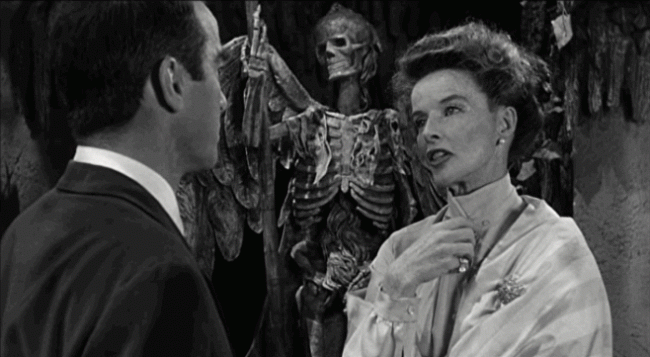
Williams was able to get away with a titch more in Suddenly Last Summer. Catherine (La Liz) is talkin' crazy- or so her aunt Mrs. Violet Venable (the imperious Katherine Hepburn) thinks. Vi is tired of Cat's ramblings about what happened to Vi's beloved son on their summer trip to Spain and asks Dr. Cukrowicz (Montgomery Clift) to give Cat a lobotomy- or Vi won't give a bunch of money to his cash-strapped hospital. But once Cat and Cuk lock eyes, there's no way he's going to chop out a chunk of her brain, so he endeavors to find another way to unearth the terrible memory her mind has hidden from her.

Offscreen friends Liz and Monty rekindled their on-screen chemistry that was famously on display in A Place in the Sun (1951) and Raintree County (1957) and the great Kate is pitch-perfect as a grande mother in deep denial. The Oscar-nommed art direction is fascinating with a Dr. Heidegger-esque garden that hides deathly statues. But the film feels a little fuzzy at times. Clift was still recovering from a devastating car accident and struggled with some of his scenes.
It seems director Joseph L. Mankiewicz was not very kind about it, because Hollywood legend has it that at the end of shooting Kate spat in Mankiewicz's face for his treatment of Clift.
The conflict on set was also present in the writing. Suddenly was based on a play by Williams and according to the credits, he worked on the screenplay. But in later years Williams denied working on the script and Gore Vidal took the credit claiming that Williams was too fucked-up to write the screenplay.

No matter who wrote it, here again we have hints at Sebastian's proclivities for "procuring" young men, but he is never completely outted. Sebastian (Julian Ugarte) is portrayed in flashbacks as a mama's boy who is using his cousin to attract young men on the beaches in Spain, and who winds-up paying a grisly price for it. But as with Cat on a Hot Tin Roof, nowhere do we have an open discussion about gayness.
In fact, the weird confession that Cat relates under the influence of truth serum is surreal enough to be a dream and not a truly accurate recounting of what happened in Spain. We never get a full image of Sebastian, and never hear his side of things. The film makes Sebastian and his sexuality a ghost haunting the proceedings- spoken of, but never fully seen.

4.) The Night of the Iguana (1964)

One would think that the rugged, masculine viewpoint of director John Huston would be incompatible with a Tennessee Williams play. But The African Queen (1951) director had a way of finding the soft parts of his male leads, so Huston and screenplay writer Anthony Veiller adapted Williams' play about a wayward reverend who winds up running cheap bus tours to Puerto Vallarta.

One fine day as he's being ogled by a young lady (Sue Lyon nee Lolita), Reverend Shannon (the beleaguered-looking Richard Burton) has a break-down and forces the bus and its occupants to stay at a beach-side hotel run by Maxine Fault (Ava Gardner smokin' and a drinkin'). The group led by Miss Judith Fellowes (Oscar-nommed Grayson Hall) is soon joined by a broke painter (the always wonderful Deborah Kerr) and her elderly, poetry-spewing father, named Nonno. Throw in a couple cute maraca-shaking cabana boys and you have a party.

This film is successful in conveying the chaos, confusion, and sadness of someone who has lost their way in life- but the movie often feels just as lost. All the leads are pros, however, and are able to dig beneath their glamorous screen personae to find painful truths. None of these characters (except for the cabana boys) seems to have it together and all are struggling with how to express themselves. It's not a bad depiction of what Williams himself was going through.

By 1961, Williams' most successful work was behind him and family, romantic and substance abuse issues plagued the depression-prone writer. It's interesting that his protagonist in Iguana that encapsulates his personal conflicts is a heterosexual man trying to choose (or not choose) between three women. But then again, there are those cabana boys...


5.) The Glass Menagerie (1973)

Williams' first play has been interpreted by many to be his most personal. The story revolves around Tom, a young dreamer who is finding it increasingly hard to live with his domineering, Southern belle mother and his disabled sister. One night a gentleman caller comes to visit the fragile Laura and everything comes to a head.
Many versions of this iconic play exist- it was first made into a movie with Kirk Douglas, Gertrude Lawrence , and Jane Wyman- a fine cast if there ever was one- although I'm skeptical that Douglas can emote the sensitivity essential to portraying Tom.

But one of my favorite versions is the TV movie made for ABC in 1973 starring Sam Waterston, Katherine Hepburn, and Emmy-winner Joanna Miles. Directed by The Lion in Winter helmer Anthony Harvey, this version uses some beautiful camerawork to convey the memory-play aspects of the piece. Tom walks through the dark streets of some far-away town when he sees his sister clad in a white nightgown flit through an alley. This begins his reminiscence of the life he left behind in St. Louis.

The actors are all perfectly cast and all earned Emmy noms that year. Waterston who was tailor-made for narrator roles (he's also Nick in The Great Gatsby (1974)) is wonderful as the conflicted writer, capturing Tom's frustration and sensitivity beautifully.
Hepburn is perfect as Amanda- bossy and manipulative- but passionate about her family- or at least her twisted view of it. The piano score by John Barry is wistful and sad, underscoring this tragic memory piece. If you missed it in your high school theater class, you can see it on You Tube.

When Tom wants to escape his life he runs to the movies. Lucky for us Williams' work was translated to the movie screen so we can escape too.

Friday, February 26, 2016

Lance's Werthwhile Top Oscar Losers


So The Oscars- or as I like to call it, My Superbowl- are fast approaching and everyone is busily prognosticating who will win which category. Will Leo finally get his man? Will Jennifer Lawrence win again because she showed up? How many times will people mispronounce Alejandro González Iñárritu's name?

Me? I'm more interested in what happens to the losers. Do they fight back the tears behind a maniacal grin until they get home and break expensive shit? Do they take out voodoo Scientology hits on the winners? Do they heave a sigh of relief knowing that in some categories (Best Actress I'm looking at you) the winners often disappear from the scene, unable to find roles that will top the performance they carted off the award for?

Oscar Losers is a much bigger club- and its members are pretty amazing. So here are my picks for Top Oscar Losers:

Best Picture- Sunset Boulevard (1950)
The Oscars of 1951 was a true clash of the titans with Sunset Boulevard up against All About Eve in all but one of the big 6 categories. The Best Actress category was a real Sophie's choice with Gloria Swanson up against Bette Davis and Anne Baxter. The joke was on all three of them when Judy Holliday nabbed the statuette for her fantastically ditsy work in Born Yesterday. All About Eve wound up taking Best Picture, Director, and Supporting Actor from Sunset. but did being the loser in those categories tarnish this great Hollywood classic?
Nope. Sunset Boulevard has endured as the definitive screen image of film obsolescence. Norma Desmond may be a silent film actress- but she represents all those elements of film that get left behind in the rabid advance of audience trends. She's the black and white film, VHS tape, 80's teen romance, Kodak celluloid, single-screen theater, Faye Dunaway- all those things that were once so much a part of the movies- but are now gone- relics tossed into the dustbin by the digital 3D superhero adventures that appear to replicate endlessly in multiplexes in malls around the country.
Sunset ends with an eternal, gauzy, fade-out of Norma's close-up, and All About Eve concludes with a shot of the new Eve reflected ad infinitum in a dressing mirror. Both seem to say that film is timeless, forever reaching across the years to speak to us... even if you don't win the Best Picture Oscar.

Best Director- Howard Hawks
Not only did film dialogue innovator Howard Hawks never win a competitive Oscar, but he was only nominated once! For so-so Sergeant York (1941)! The man who brought us such wonderfully lively comedies as Twentieth Century (1934), Bringing Up Baby (1938), His Girl Friday (1940), and Ball of Fire (1941) wasn't even nominated for any of those great films. And don't start with that old chestnut, "Comedies don't win Oscars." I know they don't. But It Happened One Night (1934), a comedy that won oodles of Oscars, came out the same year as Twentieth Century.
And Hawks was so proficient in many different genres: from early gangster flick Scarface (1932) to romantic dramas Only Angels Have Wings (1939) and To Have and Have Not (1944) to film noir The Big Sleep (1946) to sci-fi horror The Thing from Another World (1951) (he is uncredited, but it's pretty clear he had something to do with the dialogue) to sensitive western Red River (1948) to musical comedy Gentlemen Prefer Blondes (1953). The man could direct anything! Shouldn't that get him an Oscar?  The Academy threw him one of those honorary Oscars in 1975, two years before he croaked, but honestly, those honorary Oscars just scream, "We should have given you a real Oscar. Epic fail."

Best Actor- Richard Burton
There are those who say that Richard Burton was the finest actor of his time- and considering that included his most excellent English mates Peter O'Toole and Richard Harris, that is quite a distinction. But Mr. Elizabeth Taylor never won an Oscar despite being nominated seven times. Burton was one of those actors who brought an inborn, thinking-man's masculinity to his screen performances. Stage-trained, Burton used his intense focus and strong voice to project mastery over his scenes and characters. And when it worked best for him was when he was playing someone who was not really in control.

In 1966 Burton starred with his then wife Elizabeth Taylor in first-time film director Mike Nichols' screen adaptation of the Edward Albee play, Who's Afraid of Virginia Woolf? Much was made of the fact that Liz and Dick were playing a dysfunctional married couple- much like the public imagined their real-life marriage operated (it was super-dysfunctional). And while Taylor often gets more attention for plumping and uglying herself up for the role- Burton is extraordinary as George.
He is alternately powerful and weak and hides and exposes himself as the story of these two sad people unfolds. He hates and loves this woman, and himself, and watching him bring the story to its tragic end- knowing that it is destroying both of them- is devastating. His performance is such that it is hard to imagine anyone else playing the role. But that wasn't enough for the Oscar that year.
Fellow Brit Paul Scofield won for playing Thomas More in another stage-to-screen adaptation, A Man for All Seasons. Burton got some cinematic revenge three years later when he ordered Thomas More's execution as King Henry VIII in Anne of a Thousand Days. But he would lose the Oscar for that role to the king of the cowboys, John Wayne for True Grit. It seems like Dickie just couldn't catch a break.


Best Actress- Judy Garland
 There are iconic movie stars and then there is Judy Garland. This sensitive dynamo energized an era and whether she was singing "Over the Rainbow" or "Have Yourself a Merry Little Christmas" or "Come On Get Happy" Garland's voice and screen persona were unforgettable. But Garland fell into a common Hollywood rut. She was not really taken seriously. She was a musical star of great talent and fame- but she wasn't considered to be a serious actress because she danced and sang.
Not true. Aside from her unmistakable pipes, Garland was an expert at interpreting a song. What makes some of her greatest tunes unforgettable is her ability to evoke a pathos in songs that aren't obvious tear-jerkers. The best example of this was Garland's theme song "Over the Rainbow" where a childish tune about rainbows and bluebirds became wish-fulfillment for anyone longing for an escape to a better place. It was Garland's abilities as a song "actress" that made her performances unique.

In 1954, Garland staged a Hollywood comeback by throwing herself heart and soul into George Cukor's A Star is Born. The story about a young woman's rise to fame in Hollywood all while the husband who discovered her descends into alcoholism was not new. The original film in 1937 starring Janet Gaynor and Frederic March was a hit and the story seemed destined for re-visiting (its about to be re-visited again helmed by Bradley Cooper). But with Cukor and Garland this version became a musical highlighting the music of Ira Gershwin. Garland had a lot riding on this project. Four years earlier she had been summarily fired from MGM for erratic behavior, and this film would be her return to the silver screen after years of success on the concert circuit.
Watching Garland you get the sense that she is accessing every bit of her personal history to bring Vicki Lester, nee Esther Blodgett to life. Her degrading makeup session to fix what is wrong with her face seems far too close to home for L.B. Mayer's "little hunchback." And her performance of "The Man Who Got Away" not only evokes the sadness of lost love, but the survival mode that accompanies it. This number is a musical foreshadowing of the loss of Esther's husband to suicide- a scene she does beautifully without singing a single word.
From her hospital room where she had delivered her last child, Garland, along with everyone else, heard the Academy Award for Best Actress go to Grace Kelly for The Country Girl- a movie I've never heard anyone talk about. Judy got a juvenile Oscar in 1940 after The Wizard of Oz which was basically a studio marketing award- and she was nominated again in 1962 for Judgment at Nuremberg, but would never win a competitive Oscar- the man who truly got away.

Best Supporting Actor- Claude Rains
Holy cats, Claude Rains was in everything! Looking at the list of movies he made, it's amazing how many good films the English actor appeared in. From his first hit The Invisible Man (1933) to his final big screen appearance as King Herod in The Greatest Story Ever Told (1965) Rains brought a fascinating moral complication to both his heroic and dastardly roles. He was nominated for Best Supporting Actor four times: Mr Smith Goes to Washington (1940), Casablanca (1942), Mr. Skeffington (1944), and Notorious (1946), but he could have easily been nominated an additional two times for Now, Voyager (1942) and Lawrence of Arabia (1962).
Particularly in Mr. Smith and Casablanca, his characters meld charm and grace with an untrustworthy quality. We aren't entirely sure Senator Paine or Louis are good guys or not. In Notorious, we know Mr. Sebastian is a Nazi Spy- but his Old World appeal makes you want to hang out with him- just don't drink the coffee. Rains was always a pleasure to watch because he played with the ambiguity of good and evil rather than the black-and-white of it. It's a shame he was invisible to Oscar voters throughout his career.

Best Supporting Actress- Thelma Ritter
Hattie McDaniels famously said she'd rather get paid to play a maid than to be a maid- and considering how many times character actress extraordinaire Thelma Ritter played a domestic helper, you'd think she might say the same. Ritter started her film career in an uncredited role in the Christmas staple Miracle on 34th Street (1947), and three years later she was nabbing her first Oscar nomination as Birdie, Margot Channing's sassy dresser/maid/confidante in All About Eve. In Hitchcock's Rear Window (1954), she is a chatty massage therapist. In the romantic comedy Pillow Talk (1959) she is Doris Day's tipsy housekeeper. In the Misfits (1961) she is a lonely Reno boarding house owner who goes along for the ride with Marilyn Monroe and Clark Gable.
Glamour was not Ritter's thing, With her gravelly voice, and her pointed commentary, she was always the earthy gal on the outside looking in, letting fools know when they were fools. It was a refreshing read that put memorable sparks in the films she appeared in. Ritter was nominated six times for Best Supporting Actress but never made it to the top of the Oscar pile. After her fourth nomination she said, "Now I know what it feels like to be the bridesmaid and never the bride."
Don't worry, Thelma. The Oscar Losers Club is proud to have you.

So those are my Top Oscar Losers. What are yours?