On the 105th birthday of Pulitzer Prize-winning playwright Tennessee Williams, it is only fitting that I talk about my five favorite movies that he either wrote or that are based on his work. It might be more fitting to get him a bottle of bourbon and some Seconal, but I don't want to be an enabler.
1.) A Streetcar Named Desire (1951)
Williams' second hit play was also the second movie made of his work. The play's phenomenal success on Broadway and the Pulitzer Prize guaranteed its transfer to film. But nothing could have prepared Hollywood for the star of the play, Marlon Brando.
Brando's performance on stage was considered an atomic explosion in the acting world. Brando used his raw energy and sexuality to bring out the animalistic nature of Stanley Kowalski and stunned theatergoers in the process. His performance in the film version caused the same hub-bub for movie audiences. It is impossible to take your eyes off Brando. His physicality is so sure of itself, the way he enters a room, the way his eye gleams as if he knows you're watching him, the unadulterated explosions of rage that terrify and excite. It is impossible to fully appreciate the impact this performance had on Fifties audiences. For actors there was pre-Brando and post-Brando.
But the rest of the cast of
Streetcar was no group of slouches either. Vivian Leigh as the psychically unraveling Blanche Dubois is ethereal. It's almost as if we are watching the end of Scarlett O'Hara- like Leigh is giving the final performance of the character that most defined her career. From the original Broadway cast, Kim Hunter is wonderful as Stella- a role that must be performed expertly or it comes off as inconsequential. And Karl Malden is wonderfully pathetic as Mitch, Blanche's suitor that was never meant to be. These three actors under the expert guidance of director Elia Kazan each won Oscars that year.
Normally you would think that the Academy must have been smoking something pretty intense not to give Brando Best Actor, but that year they gave Humphrey Bogart his only Oscar for
The African Queen- and that's fine with me. Williams also lost the Oscar that year to
A Place in the Sun, but Williams, unlike Brando, would never win an Oscar.
2.) Cat on a Hot Tin Roof (1958)
How do you find two people more beautiful to look at than Elizabeth Taylor and Paul Newman? You don't- and that's why watching them play Brick and Maggie in
Cat on a Hot Tin Roof is so perfect. Brick and Maggie by all accounts should be screwing like rabbits. But they are not- and the reasons are emotionally complicated and deeply buried. But keeping up family appearances is important, so these two perfect-looking people continue to inhabit the same cage not screwing, until secrets erupt.
Cat was written in 1955 when it is was a big deal for a mainstream play to deal with homosexuality- even if it didn't directly confront the issue. Williams' original version of the play did lots of tap-dancing around Brick and Skipper's relationship- even more so when Kazan convinced Williams to re-work the third act. Many critics have called Richard Brooks and James Poe's Oscar-nominated screenplay "neutered" when it comes to gayness, but I disagree.
The sin that daren't speak its name goes unspoken- but the implications are so clear, it is impossible to imagine savvy audiences now and even then weren't aware of what was going on. The bond of love between Brick and Skipper doesn't need to be described in detail. The pain in Paul Newman's face when he is forced to confront his memories is adequate. And Maggie's betrayal is the behavior of a woman eliminating her sexual rival, not just someone who is starving for her husband's attention.
While the script certainly could have been more direct, directness was not Williams' style. Williams was the product of a society that concealed its "otherness," and his writing does the same. But Williams dared to make his audiences face the fact that sexual secrets existed and that they would not stay hidden forever. Besides, what do people expect? Skipper to show-up in a pink Cadillac and drive Brick off into the sunset with a couple of cosmos?
3.) Suddenly Last Summer (1959)
Williams was able to get away with a titch more in
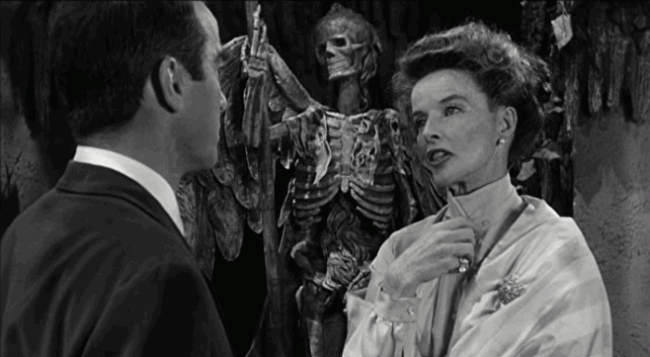
Suddenly Last Summer. Catherine (La Liz) is talkin' crazy- or so her aunt Mrs. Violet Venable (the imperious Katherine Hepburn) thinks. Vi is tired of Cat's ramblings about what happened to Vi's beloved son on their summer trip to Spain and asks Dr. Cukrowicz (Montgomery Clift) to give Cat a lobotomy- or Vi won't give a bunch of money to his cash-strapped hospital. But once Cat and Cuk lock eyes, there's no way he's going to chop out a chunk of her brain, so he endeavors to find another way to unearth the terrible memory her mind has hidden from her.
Offscreen friends Liz and Monty rekindled their on-screen chemistry that was famously on display in
A Place in the Sun (1951) and
Raintree County (1957) and the great Kate is pitch-perfect as a grande mother in deep denial. The Oscar-nommed art direction is fascinating with a Dr. Heidegger-esque garden that hides deathly statues. But the film feels a little fuzzy at times. Clift was still recovering from a devastating car accident and struggled with some of his scenes.
It seems director Joseph L. Mankiewicz was not very kind about it, because Hollywood legend has it that at the end of shooting Kate spat in Mankiewicz's face for his treatment of Clift.
The conflict on set was also present in the writing.
Suddenly was based on a play by Williams and according to the credits, he worked on the screenplay. But in later years Williams denied working on the script and Gore Vidal took the credit claiming that Williams was too fucked-up to write the screenplay.
No matter who wrote it, here again we have hints at Sebastian's proclivities for "procuring" young men, but he is never completely outted. Sebastian (Julian Ugarte) is portrayed in flashbacks as a mama's boy who is using his cousin to attract young men on the beaches in Spain, and who winds-up paying a grisly price for it. But as with
Cat on a Hot Tin Roof, nowhere do we have an open discussion about gayness.
In fact, the weird confession that Cat relates under the influence of truth serum is surreal enough to be a dream and not a truly accurate recounting of what happened in Spain. We never get a full image of Sebastian, and never hear his side of things. The film makes Sebastian and his sexuality a ghost haunting the proceedings- spoken of, but never fully seen.
4.) The Night of the Iguana (1964)
One would think that the rugged, masculine viewpoint of director John Huston would be incompatible with a Tennessee Williams play. But
The African Queen (1951) director had a way of finding the soft parts of his male leads, so Huston and screenplay writer Anthony Veiller adapted Williams' play about a wayward reverend who winds up running cheap bus tours to Puerto Vallarta.
One fine day as he's being ogled by a young lady (Sue Lyon nee Lolita), Reverend Shannon (the beleaguered-looking Richard Burton) has a break-down and forces the bus and its occupants to stay at a beach-side hotel run by Maxine Fault (Ava Gardner smokin' and a drinkin'). The group led by Miss Judith Fellowes (Oscar-nommed Grayson Hall) is soon joined by a broke painter (the always wonderful Deborah Kerr) and her elderly, poetry-spewing father, named Nonno. Throw in a couple cute maraca-shaking cabana boys and you have a party.

This film is successful in conveying the chaos, confusion, and sadness of someone who has lost their way in life- but the movie often feels just as lost. All the leads are pros, however, and are able to dig beneath their glamorous screen personae to find painful truths. None of these characters (except for the cabana boys) seems to have it together and all are struggling with how to express themselves. It's not a bad depiction of what Williams himself was going through.
By 1961, Williams' most successful work was behind him and family, romantic and substance abuse issues plagued the depression-prone writer. It's interesting that his protagonist in
Iguana that encapsulates his personal conflicts is a heterosexual man trying to choose (or not choose) between three women. But then again, there are those cabana boys...
5.) The Glass Menagerie (1973)
Williams' first play has been interpreted by many to be his most personal. The story revolves around Tom, a young dreamer who is finding it increasingly hard to live with his domineering, Southern belle mother and his disabled sister. One night a gentleman caller comes to visit the fragile Laura and everything comes to a head.
Many versions of this iconic play exist- it was first made into a movie with Kirk Douglas, Gertrude Lawrence , and Jane Wyman- a fine cast if there ever was one- although I'm skeptical that Douglas can emote the sensitivity essential to portraying Tom.
But one of my favorite versions is the TV movie made for ABC in 1973 starring Sam Waterston, Katherine Hepburn, and Emmy-winner Joanna Miles. Directed by
The Lion in Winter helmer Anthony Harvey, this version uses some beautiful camerawork to convey the memory-play aspects of the piece. Tom walks through the dark streets of some far-away town when he sees his sister clad in a white nightgown flit through an alley. This begins his reminiscence of the life he left behind in St. Louis.
The actors are all perfectly cast and all earned Emmy noms that year. Waterston who was tailor-made for narrator roles (he's also Nick in
The Great Gatsby (1974)) is wonderful as the conflicted writer, capturing Tom's frustration and sensitivity beautifully.
Hepburn is perfect as Amanda- bossy and manipulative- but passionate about her family- or at least her twisted view of it. The piano score by John Barry is wistful and sad, underscoring this tragic memory piece. If you missed it in your high school theater class, you can see it on
You Tube.
When Tom wants to escape his life he runs to the movies. Lucky for us Williams' work was translated to the movie screen so we can escape too.