Showing posts with label Walt Disney. Show all posts

Thursday, December 8, 2016

The Notorious LVB

Classical music giant Ludwig van Beethoven turns 246 today and what better way to celebrate his musical contribution to society than to look at how his music was used in movies?


Here are my top 5 movies that creatively use Beethoven music!

Fantasia (1940)


Walt Disney's experimental, animated, feature-length classical music video was a big risk when it came out in 1940. Disney had success with his cartoon shorts and Snow White and the Seven Dwarfs (1937) and Pinocchio (1940) proved there was a market for full-length cartoons. But Fantasia's melding of animation and classical music in an anthology style had not been tried before. So Disney put Leopold Stokowski on the conductor's stand and churned out eight cartoons with a soundtrack of popular works that included great composers like Bach, Tchaikovsky, Stravinsky, and Schubert.

Beethoven's contribution was his "Pastorale" from Symphony no. 6. The lilting, sweeping tune beautifully underscores a flock of pegasi as they soar through the ancient Grecian sky, one young fledgling in particular having difficulty (and fun) trying out his new wings.

As the piece progresses we join two herds of centaurs (no- it's not centauri)- one male, and one female- who frolic near a verdant pond, hooking up as the music swells. Well, they hook up as much as one can in a Disney film. The scene is sensuous, the animated movement as smooth and graceful as the music that serenades these young horse/people as they discover first love.

Fantasia's first release was a bit of a bomb- mainly because with WWII in full-swing in Europe, that market was pretty much closed to Hollywood films. But in subsequent releases and with a robust home video market, Fantasia has rebounded to become one of the top 3 Disney films.

I don't know if before Fantasia people imagined cartoons when they listened to classical music, but after- it's impossible to close your eyes and not imagine Mickey in his sorcerer's cap fighting off all those brooms when you listen to Dukas' The Sorcerer's Apprentice.

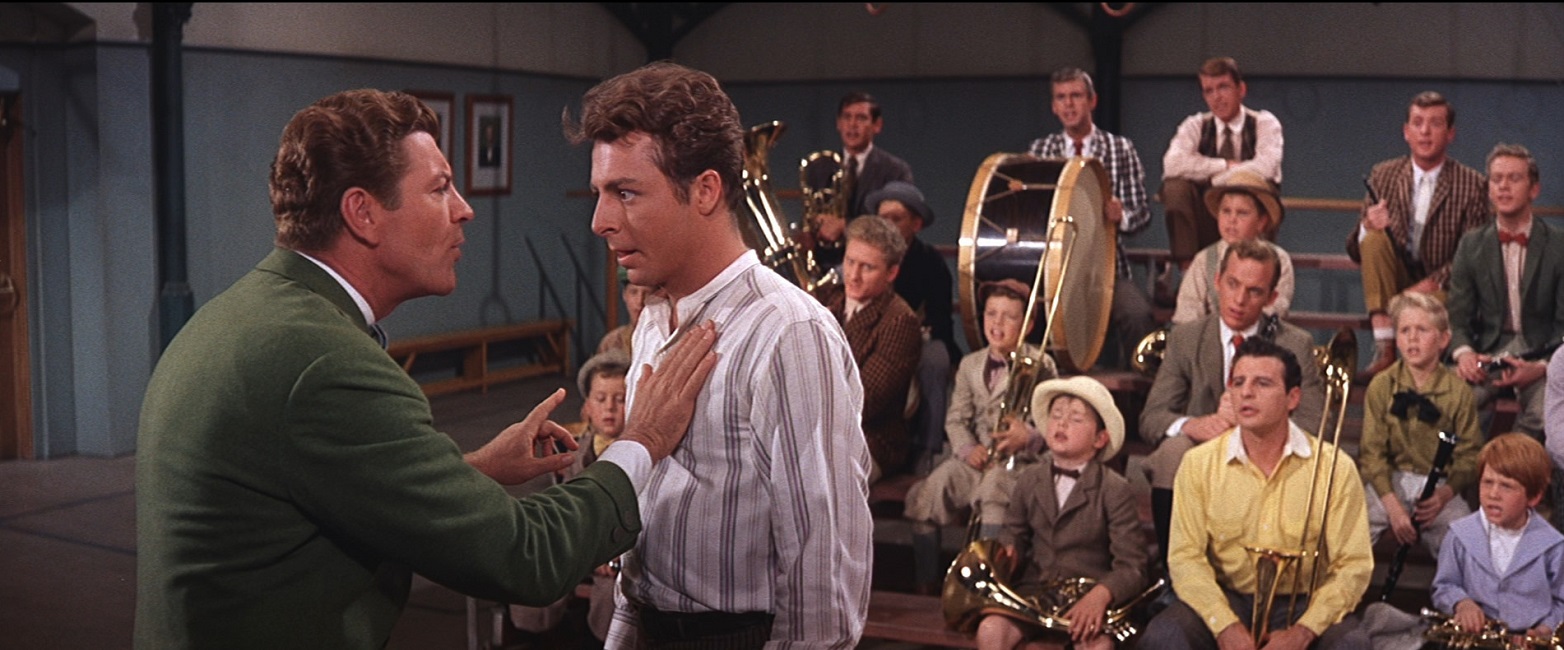
The Music Man (1962)

There is a lot of music in The Music Man. Most of it was composed by Tony-winning Meredith Willson. But there is one song he didn't write. Professor Harold Hill (Robert Preston serving lovable scamp realness) has pioneered a new form of music education called "The Think System." Rather than practice with your band instrument, you think about the song until you will instinctively know how to play it. Of course, Professor Hill intends to be several towns away before the River City-zens realize they've been bamboozled into paying for a bunch of band uniforms and equipment that their kids can't play. But when Prof. Hill is snared by the law (and love) he has to prove that his system works. Will Beethoven's Minuet in G issue forth from the instruments of the River City Boys Band?

Music Man is a wonderful piece of musical Americana that while admiring saintly Midwestern ideals, has a great deal of pleasure poking fun at Hawkeye morality.

Portraying the cultural revolution of 1912, the musical was popular in part because it sweetly mirrored the generational changes that were taking place in the 1950's. In fact, at the 1958 Tony's Music Man beat the other musical that dealt with the volatile shift in our American culture- West Side Story.

Personally, I think the Tony's got it wrong that year.

A Clockwork Orange (1971)

Nothing tops off an evening of violence and sexual abuse quite like a Beethoven tune- or at least that's how our lil' droogie Alex (the sadistically impish Malcom McDowell) feels in Stanley Kubrick's A Clockwork Orange.

We get a tour of Alex's room and his thoughts as he plays Beethoven's Symphony No. 9, reveling in the bliss that the music brings to him. It's a deliberate juxtaposition to show this vicious beast soothed by classical music- a thug who has no respect for human life, but reveres the beauty of classical music. It gives depth to a character that could have just been a one-dimensional sociopath.

After being treated by the Ludovico Technique to rid Alex of his nastier tendencies, however, Alex discovers that the Ninth Symphony was playing in the background of the films used to implant revulsion for acts of sex and violence.

So now the very first strains of his beloved music make poor Alex violently ill. When he is kidnapped by one of his former victims, Ludwig Van becomes a weapon against Alex instead of an ecstatic escape. Alex's pleasure from inflicting pain becomes pain inflicted from a former pleasure. It's just the sort of sick twist that Kubrick appreciated.

Saturday Night Fever (1977)

Everyone needs a good entrance song. Whether it's Pomp and Circumstance or  "Bitch I'm Madonna", we all like an anthem to play when we walk into a room. Tony Manero is no different. The strutting disco king (John Travolta in his Oscar-nominated performance) of Saturday Night Fever is a man with many insecurities. But when he enters the club and hits the dancefloor, he is the master of all he surveys. Director John Badham underscores Travolta's entrance scene  with "A Fifth of Beethoven"  a disco re-working of Beethoven's Fifth Symphony by Walter Murphy and the Big Apple Band.

It's an interesting choice. Does Beethoven give heft to disco, or does disco make Beethoven more cool? A similar question can be asked about Saturday. Does Badham's heartfelt exploration of urban youth disillusion and ennui make disco deeper, or does disco make this story more accessible to the Seventies audience?

Either way "A Fifth of Beethoven" was so successful it spurred an interest in "popularized" classical music resulting in K-Tel's Hooked on Classics series- my first exposure to the likes of Beethoven.


Misery (1990)

Rob Reiner's Misery has plenty of instances of dark humor- like an obsessed fan (played with unfettered relish by Oscar-winner Kathy Bates) who names one of her pigs after the beautiful heroine of her favorite novel series, Misery. But nothing tops Reiner's use of Beethoven's "Moonlight Sonata" in the infamous hobbling scene.

Kidnapped author Paul Sheldon (a perfectly tortured James Caan) awakens after being drugged  to the strains of Liberace playing the "Moonlight Serenade" and Annie (the aforementioned literary pig-namer) standing over him with a sledgehammer. What ensues is known as hobbling, and it's gag-inducing- but the scene is even more surreal as Beethoven's music underscores the graphic torture.

More than just a juxtaposition between light music and the violent scene, the choice of classical music also mirrors Annie's character- a woman who calmly and smoothly glides around the room like a Beethoven tune- before hammering your ankles into absurd angles.

I wonder how ol' Beethoven would have felt about being such a memorable part of these flicks?


Friday, April 29, 2016

Where Have All the Bad Guys Gone...?

As I spent this week in London with my beloved, we toured some Tudor mansions, ate meat pies in a pub, and curled up on a couch together to watch a movie from the vastly superior European Netflix catalogue. I usually let my partner choose the flicks we watch because his taste is much more specific than mine, so while it wouldn't have been my first pick, we cuddled together and watched Disney's villainess prequel, Maleficent (2014).


Maleficent isn't my cup of tea- and my reviewing it would only make me sound like an annoying film snob, but the movie did make me think about a bigger cinematic issue: Why do movies keep un-villainizing our most cherished villains?

The character of the wicked fairy Maleficent in Walt Disney's original animated classic Sleeping Beauty (1959) is a wonder to behold. Silkily voiced by the superb Eleanor Audley (who also did the voice of the wicked stepmother in Cinderella (1950) and was Oli-vah's snooty mother in TV's Green Acres) and animated with a rich fluidity, Maleficent slid onto the screen amidst a sickly green cloud with her chin held high and her disdain for all the princess-normative nonsense on full display.

Maleficent was left off the guest list for the christening of little Princess Aurora... on purpose. So she shows up to the blessed event anyway and curses the baby to die on her sixteenth birthday- in her eyes, a perfectly reasonable response to such a public slight. Emily Post would have suggested nothing less. Maleficent was evil and unrepentant about it. And it made her glorious. So much so, that I felt bad when she got a sword in the heart at the end.

But these days, you can't have someone just be evil. Maleficent in 2014 (played with high-cheekbone realness by Angelina Jolie) has to be a wild fairy who was wronged by a duplicitous lover, so she holds a grudge and curses his kid. That grudge gets all complicated, however, when she spends some time with dazzling Aurora (properly blond Elle Fanning) and regrets cursing her, ultimately risking her life to save her. What? Maleficent lives happily ever after with Sleeping Beauty? Whatever happened to the grim in Grimm's Fairy Tales?

And it's not just this movie. Other iconic baddies have had prequels made about their sad beginnings in the attempt to explain how come they are so nasty. Darth Vader isn't a pitiless, power-hungry Sith Lord. In the tedious Star Wars prequels he's an annoying young man who throws a tantrum because the Jedis won't let him marry his sweetheart and who loses his shit over not being able to save his mom.
This doesn't make him embrace the fragility of life and cherish every moment. Nope. He goes and kills a bunch of kids and then all of his Jedi pals before burning to a crisp and being turned into the wheezing, metal monster we all know and love.

What about Oz's Wicked Witch of the West? It wasn't enough that she should be a green, vengeful witch who wants to get the pig-tailed girl (and her little dog too) who crushed her sister under a house. In the disastrous Oz the Great and Powerful (2013), Theodora (Mila Kunis playing her That 70's Show character in a pointy hat), jealous of Oscar's (the horribly miscast James Franco) attention to other women, is tricked into biting an apple to lose her feelings for him- but instead is turned into the broom-flying green baddie we are more familiar with.
Once again, being hurt and rejected by a man doesn't result in nights spent in front of the TV with a pint of Ben & Jerry's. Romantic disappointment for women equals murderous personality change.

This is just the tip of the villain origin story iceberg. Snow White's Wicked Queen, Hannibal Lecter, and Norman Bates have all gotten modern makeovers that delve into their pasts to explain the evil characters that previously appeared on the screen.

What's wrong with someone just being evil? Do we really have to be spoon fed an origin story to confirm why our big screen meanies are so mean? Maybe it's our attempt to explain evil in our fictional worlds, when we can't in the real one. Maybe we think if we can get a grasp on why Darth Vader used his death grip without a care, we'll understand the likes of Osama Bin Laden, ISIS, and Boko Haram. Or maybe studio execs just like to squeeze every dime they can out of film franchises. Either way, I am comfortable with Maleficent cursing newborns while wearing fabulous cloaks just cause she wants to.

For this classic film lover, it's good enough to just be bad


.

Saturday, April 16, 2016

Top 5 London Pics!

Next week I'm off to London to see my beau, and since you can't cross the Pond with me- I'm giving you some English realness by listing my Top 5 Films set in London:


1.) Mary Poppins (1964)

For a kid who used to dream of being British (I answered the phone in an English accent) Mary Poppins was sheer heaven. I was enchanted by the flowering tree-lined streets, the houses shaped like ships, the seemingly endless rooftop horizon, and the kite-filled sky of London. I wanted to move in with the Banks family on Cherry Tree Lane and jump into chalk sidewalk paintings, dance with chimney sweeps, and have a tea party on the ceiling. No Kansas wheatfields for me. I wanted sooty London.

As I grew up and realized that I was not a long-lost Windsor prince, I also figured out that the London of Mary Poppins wasn't real. The film was shot on all four of Disney's soundstages a half a world- and fifty years away from the London of 1910 that the film idealizes. But the fantastical world of Mary Poppins was real in a sense, because it was based on actual Edwardian/Georgian neighborhoods, parks, and buildings- the most obvious being grand old St. Paul's Cathedral.

In order to teach Jane and Michael Banks a lesson in charity, Mary (the "Ha-Ha in your face Audrey Hepburn!" Oscar-winner of 1965, Julie Andrews) produces a snowglobe that contains St. Paul's Cathedral- but instead of snow, small white angles recreate the birds that flock around the domed structure.

As she sings "Feed the Birds" we are magically transported inside the globe to see a withered old woman (Jane Darwell) who sells bags of breadcrumbs to passersby for "tuppence a bag." The animation mixed with the physical set gives the sensation of a dream, and one can't help but feel that you are standing at the steps of the great cathedral looking up at the arches and statues, surrounded by flying birds. That cinematic moment is so memorable that even today, the website for Saint Paul's has a page with a video clip from the movie. Chokes me up every time.

When I finally made my first trip to London, I didn't see any chimney sweeps, but I did hang out with a couple builders and see some colorful auras while on ecstasy. Saint Paul's was beautiful- and even if I did avoid the flocks of birds (pigeons and I don't get along), I looked for the little old lady to give some tuppence to.


2.) Sweeney Todd: The Demon Barber of Fleet Street (2007)


From 1960's Disney animation to CGI-generated scenery we go. I know I'm going to get some flack from theater-folk who HATED this movie, but I thoroughly enjoyed Tim Burton's take on Stephen Sondheim's classic musical. The titular Sweeney (Johnny Depp) returns to London with revenge on his mind after being wrongly imprisoned at the hands of wicked Judge Turpin (the terribly missed Alan Rickman).

With the help of former neighbor and meatpie shop owner Mrs. Lovett (the queen of odd, Helena Bonham Carter), he opens up a barbershop whose customers leave with much more than a shave and a haircut. The scenery is mostly computer-generated, but the view of a dark, and grimy Victorian London is darkly lush and seductive, and won an Oscar for Best Art Direction.

I know, I know. Burton cut the opening song from the musical "The Ballad of Sweeney Todd"- but rather than sing the backstory up front, Burton let it unfold throughout the film. Yes, I know Johnny Depp does not have the  pipes of stage Sweeney Len Cariou. He has at best a rock-styled voice from a garage band that performs at local proms. But Depp broods and simmers pretty well. And of course Helena is no Angela Landsbury. But nobody is- and Angie's too old to do the movie- so I think Helena does a fine job playing the deceitful Mrs. Lovett.

I think what really matters about Sweeney Todd is its grisly, dark humor, and the cutting lyrics to Sondheim's brilliant score. And who better to do macabre humor than Tim Burton? The montage of Sweeney at the height of his barbering career cleverly follows the rhythm of the song with bone-crunches adding a sick musical punctuation as each customer exits the chair.

Perhaps the most fun comes from the performance of "A Little Priest" where Sondheim's brilliant lyrics take centerstage amidst the overindulgent film edits, crusty pies, and cleavers.


Perhaps I'll do a Sweeney Todd tour of London while I'm there...

3.) Sabotage (1936)

Before he came to Hollywood, a thinner Alfred Hitchcock made some exciting films for independent British film companies. One of the most interesting is this gem about a plot to blow-up London. Scotland Yard detective Sergeant Ted Spencer (John Loder) goes undercover to investigate an act of sabotage that left London without power.

He befriends the lovely Mrs. Verloc (the gal with the glorious eyes, Sylvia Sidney) and her young brother Stevie (Desmond Tester) in order to keep tabs on her husband Karl (Oscar Homolka) who Spencer suspects of being involved with the English/German terrorist group. Will Spence find out what the next plot is and stop it in time? I'm not going to say.

The film is a smorgasbord of Hitchock's signature obsessions: birds, Germans, the wife married to someone she doesn't really know, and the movies. The film is also taut with the suspense that was Hitchcock's stock in trade. The famous bus scene where little Stevie is unknowingly transporting a bomb in a film can is unforgettable, the tension building to an unendurable level.

Loosely based on Joseph Conrad's The Secret Agent, the film is tight and suspenseful with Sidney giving a performance that makes you wonder why she's not well-known today- you may remember her best as the always smoking Juno in Beetlejuice (1988). She is captivating on screen  but reportedly did not get along with Hitchcock, so she never appeared in his films again. Of course, Hitch moved on to blond leading ladies by the time he went to Hollywood anyway. And if you're looking for the famous Hitchcock cameo on the streets of London, don't bother. For some reason, he didn't pop into this film. Maybe he didn't like riding the London bus.

4.) Konga (1961)

We've seen King Kong climb the Empire State Building. We watched giant ants tear up the sewers of Los Angeles. Godzilla has trampled all over Tokyo and New York City. London felt a little ignored by giant movie monsters, so in 1961, they made Konga


Producer Herman Cohen was the successful B-Horror Movie schlockmeister behind such classics as I Was a Teenage Werewolf (1957). In 1959 for reasons I can't unearth, the Detroit native moved to England and continued churning out the very best in terrible horror movies, including two with Joan Crawford: Berserk (1967) and the not-to-be-forgotten Trog (1970). 


So Cohen's resume made him the perfect producer to make the story of a mad scientist who develops a growth serum and injects it into his favorite lab chimp- who soon grows from little monkey to man in a monkey suit. As Dr. Decker's (Michael Gough) ambitions and paranoia grow, so does his monkey and soon Konga is breaking through the roofs of houses and doing his master's will... until he doesn't. Konga grabs ahold of Dr. Decker and makes Big Ben his own personal stripper pole. But as Kong could tell Konga, it never turns out well when a monkey climbs a national landmark.

The monster movie is a beloved genre- and like its kin, Konga questions unfettered Atomic Age science and the reckless act of mucking around with nature. Cohen sluts it up a little by adding a blond lab assistant, but essentially he follows the mad scientist/monster paradigm, creating laughable acting, dialogue, and effects along the way.

Frequent Cohen collaborator Michael Gough snarls his was through the picture making Dr. Decker as unlikable as possible. Funny to think that at the end of his career Gough would star as the beloved Alfred in the Tim Burton Batman (1989). From monkeys to bats. That's showbiz!

5.) Beautiful Thing (1996)

Ah, gay London! I'll never forget the night at Heaven danceclub when I went home with a gent who told me he was Prince Andrew only to find out we weren't going to Windsor Castle and I was not about to make it with a member of the royal family. Gay princes aside, being gay in London has the same pitfalls as anywhere else, and that's why Hettie Macdonald's Beautiful Things is so universal.

Jamie (Glen Berry) is the product of Thamesmead, a South London working class project where the square concrete apartments are so close together, there is little to hide. And Jamie has lots to hide. He has a crush on his studly schoolmate Ste (Scott Neal). Ste's family life is abusive and after one particularly rough beating, he winds up at Jamie's house under the care of Jamie's wacky ma (EastEnders regular Linda Henry.)

As Ste lies in Jamie's bed, open and vulnerable, Jamie opens up too, and exposes his feelings for Ste by giving him a kiss. As any gay teen knows, this sort of thing can go horribly wrong, and Ste overwhelmed with guilt and shame, runs for the hills. But Beautiful Thing doesn't leave it there. Like the Mama Cass soundtrack that wafts from the neighbor's record player, this film embraces difference and hope. Rather than tell another gay tragedy, Beautiful Thing finds a happy ending for these two young men.

When the film came out it caused quite a stir- but not just because it was a gay romance. Beautiful Thing emerges from the dark AIDS era with an optimistic sense of  the joy and possibility of gay love. And if the scene of Jamie and Ste slowdancing in the courtyard to "Dream a Little Dream of Me" doesn't make your eyes moist, you need to get Restasis.

That's all for me London post, mates. I'll be back quicker than you can say, "Churchill's knickers!"

Chin-chin and all that rot!