Screenwriters in Hollywood are often not given the props they so richly deserve. So when a screenwriter earns the status of being "talked about", you know that screenwriter is a major talent. William Goldman is one of those screenwriters. His resume is a list of must-sees: Butch Cassidy and the Sundance Kid (1969), Papillon (1973), The Stepford Wives (1975), All the President's Men (1976), Marathon Man (1976), Magic (1978), The Princess Bride (1987), and Misery (1990). His talents were so respected that even if he wasn't involved in a project, directors cut out entire scenes from "finished" movies based on one phonecall from Goldman.
William Goldman passed away last night at the age of 87.
Perhaps he can give God some re-writes for our current situation...
Showing posts with label Misery. Show all posts
Friday, November 16, 2018
Sunday, March 19, 2017
The List is Life
Everyone on Facebook has been creating a list of their favorite movies by year of release, and I figure it's my responsibility to make my list and give it to all of you lucky movie fans. And if you think I'm just doing through the '80's- you don't know Lance.
2016- La La Land
2015- The Revenant
2014- The Grand Budapest Hotel
2013- American Hustle
2012- Skyfall
2011- Midnight in Paris
2010- The Kids Are Alright
2009- Inglourious Basterds
2008- In Bruges
2007- La Vie en Rose
2006- Pan's Labyrinth
2005- King Kong
2004- Sky Captain and the World of Tomorrow
2003- Kill Bill: Volume One
2002- Chicago
2001- Dancer in the Dark
2000- Crouching Tiger, Hidden Dragon
1999- Election
1998- Gods and Monsters
1997- L.A. Confidential
1996- Fargo
1995- Dead Man Walking
1994- Bullets Over Broadway
1993- The Nightmare Before Christmas
1992- Unforgiven
1991- The Silence of the Lambs
1990- Misery
1989- Crimes and Misdemeanors
1988- Dangerous Liaisons
1987- Fatal Attraction
1986- The Mission
1985- The Color Purple
1984- Amadeus
1983- Krull
1982- Tootsie
1981- Superman II
1980- Airplane!
1979- Alien
1978- Grease
1977- Star Wars
1976- Network
1975- Grey Gardens
1974- Young Frankenstein
1973- Paper Moon
1972- Cabaret
1971- Harold and Maude
1970- The Boys in the Band
1969- Midnight Cowboy
1968- The Lion in Winter
1967- Valley of the Dolls
1966- Who's Afraid of Virginia Woolf?
1965- The Sound of Music
1964- Goldfinger
1963- The Birds
1962- The Manchurian Candidate
1961- West Side Story
1960- The Apartment
1959- Some Like it Hot
1958- Cat on a Hot Tin Roof
1957- The Bridge on the River Kwai
1956- Invasion of the Body Snatchers
1955- Marty
1954- On the Waterfront
1953- From Here to Eternity
1952- The Bad and the Beautiful
1951- A Streetcar Named Desire
1950- Sunset Boulevard
1949- Adam's Rib
1948- Bicycle Thieves
1947- Possessed
1946- Gilda
1945- Mildred Pierce
1944- Laura
1943- Casablanca
1942- Now, Voyager
1941- Meet John Doe
1940- The Philadelphia Story
1939- The Women
1938- A Woman's Face
1937- Stella Dallas
1936- My Man Godfrey
1935- The Informer
1934- It Happened One Night
1933- Baby Face
1932- Shanghai Express
1931- City Lights
1930- All Quiet on the Western Front
1929- The Hollywood Revue of 1929
1928- Sadie Thompson
1927- Metropolis
And past that- you'll need a true movie expert.
Labels:
Alien,
Amadeus,
Bullets Over Broadway,
Dangerous Liaisons,
Fargo,
Grand Budapest Hotel,
La La Land,
Midnight Cowboy,
Misery,
Network,
The Boys in the Band,
The Color Purple,
The Revenant,
Tootsie
Thursday, December 8, 2016
The Notorious LVB
Classical music giant Ludwig van Beethoven turns 246 today and what better way to celebrate his musical contribution to society than to look at how his music was used in movies?
Here are my top 5 movies that creatively use Beethoven music!
Fantasia (1940)
Walt Disney's experimental, animated, feature-length classical music video was a big risk when it came out in 1940. Disney had success with his cartoon shorts and Snow White and the Seven Dwarfs (1937) and Pinocchio (1940) proved there was a market for full-length cartoons. But Fantasia's melding of animation and classical music in an anthology style had not been tried before. So Disney put Leopold Stokowski on the conductor's stand and churned out eight cartoons with a soundtrack of popular works that included great composers like Bach, Tchaikovsky, Stravinsky, and Schubert.
Beethoven's contribution was his "Pastorale" from Symphony no. 6. The lilting, sweeping tune beautifully underscores a flock of pegasi as they soar through the ancient Grecian sky, one young fledgling in particular having difficulty (and fun) trying out his new wings.
As the piece progresses we join two herds of centaurs (no- it's not centauri)- one male, and one female- who frolic near a verdant pond, hooking up as the music swells. Well, they hook up as much as one can in a Disney film. The scene is sensuous, the animated movement as smooth and graceful as the music that serenades these young horse/people as they discover first love.
Fantasia's first release was a bit of a bomb- mainly because with WWII in full-swing in Europe, that market was pretty much closed to Hollywood films. But in subsequent releases and with a robust home video market, Fantasia has rebounded to become one of the top 3 Disney films.
I don't know if before Fantasia people imagined cartoons when they listened to classical music, but after- it's impossible to close your eyes and not imagine Mickey in his sorcerer's cap fighting off all those brooms when you listen to Dukas' The Sorcerer's Apprentice.
The Music Man (1962)
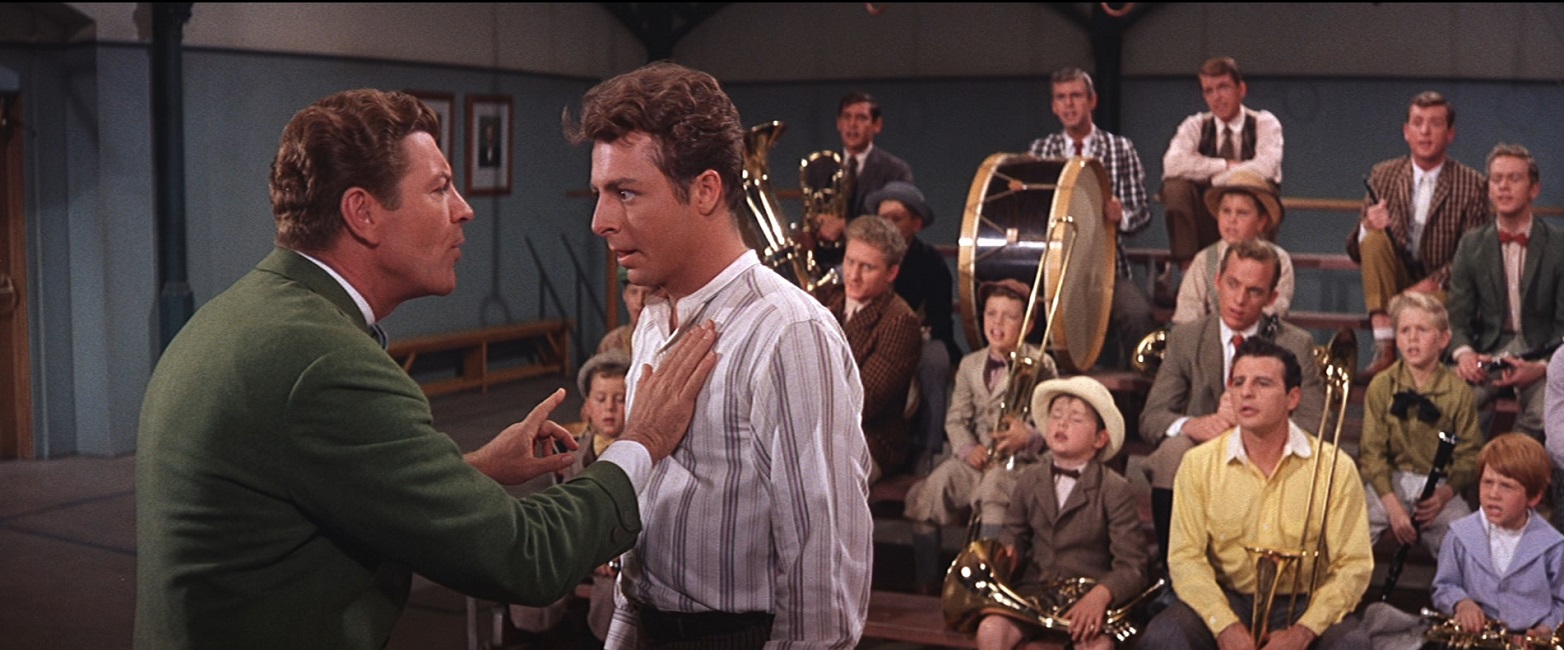
There is a lot of music in The Music Man. Most of it was composed by Tony-winning Meredith Willson. But there is one song he didn't write. Professor Harold Hill (Robert Preston serving lovable scamp realness) has pioneered a new form of music education called "The Think System." Rather than practice with your band instrument, you think about the song until you will instinctively know how to play it. Of course, Professor Hill intends to be several towns away before the River City-zens realize they've been bamboozled into paying for a bunch of band uniforms and equipment that their kids can't play. But when Prof. Hill is snared by the law (and love) he has to prove that his system works. Will Beethoven's Minuet in G issue forth from the instruments of the River City Boys Band?
Music Man is a wonderful piece of musical Americana that while admiring saintly Midwestern ideals, has a great deal of pleasure poking fun at Hawkeye morality.
Portraying the cultural revolution of 1912, the musical was popular in part because it sweetly mirrored the generational changes that were taking place in the 1950's. In fact, at the 1958 Tony's Music Man beat the other musical that dealt with the volatile shift in our American culture- West Side Story.
Personally, I think the Tony's got it wrong that year.
A Clockwork Orange (1971)
Nothing tops off an evening of violence and sexual abuse quite like a Beethoven tune- or at least that's how our lil' droogie Alex (the sadistically impish Malcom McDowell) feels in Stanley Kubrick's A Clockwork Orange.
We get a tour of Alex's room and his thoughts as he plays Beethoven's Symphony No. 9, reveling in the bliss that the music brings to him. It's a deliberate juxtaposition to show this vicious beast soothed by classical music- a thug who has no respect for human life, but reveres the beauty of classical music. It gives depth to a character that could have just been a one-dimensional sociopath.
After being treated by the Ludovico Technique to rid Alex of his nastier tendencies, however, Alex discovers that the Ninth Symphony was playing in the background of the films used to implant revulsion for acts of sex and violence.
So now the very first strains of his beloved music make poor Alex violently ill. When he is kidnapped by one of his former victims, Ludwig Van becomes a weapon against Alex instead of an ecstatic escape. Alex's pleasure from inflicting pain becomes pain inflicted from a former pleasure. It's just the sort of sick twist that Kubrick appreciated.
Saturday Night Fever (1977)
Everyone needs a good entrance song. Whether it's Pomp and Circumstance or "Bitch I'm Madonna", we all like an anthem to play when we walk into a room. Tony Manero is no different. The strutting disco king (John Travolta in his Oscar-nominated performance) of Saturday Night Fever is a man with many insecurities. But when he enters the club and hits the dancefloor, he is the master of all he surveys. Director John Badham underscores Travolta's entrance scene with "A Fifth of Beethoven" a disco re-working of Beethoven's Fifth Symphony by Walter Murphy and the Big Apple Band.
It's an interesting choice. Does Beethoven give heft to disco, or does disco make Beethoven more cool? A similar question can be asked about Saturday. Does Badham's heartfelt exploration of urban youth disillusion and ennui make disco deeper, or does disco make this story more accessible to the Seventies audience?
Either way "A Fifth of Beethoven" was so successful it spurred an interest in "popularized" classical music resulting in K-Tel's Hooked on Classics series- my first exposure to the likes of Beethoven.
Misery (1990)
Rob Reiner's Misery has plenty of instances of dark humor- like an obsessed fan (played with unfettered relish by Oscar-winner Kathy Bates) who names one of her pigs after the beautiful heroine of her favorite novel series, Misery. But nothing tops Reiner's use of Beethoven's "Moonlight Sonata" in the infamous hobbling scene.
Kidnapped author Paul Sheldon (a perfectly tortured James Caan) awakens after being drugged to the strains of Liberace playing the "Moonlight Serenade" and Annie (the aforementioned literary pig-namer) standing over him with a sledgehammer. What ensues is known as hobbling, and it's gag-inducing- but the scene is even more surreal as Beethoven's music underscores the graphic torture.
More than just a juxtaposition between light music and the violent scene, the choice of classical music also mirrors Annie's character- a woman who calmly and smoothly glides around the room like a Beethoven tune- before hammering your ankles into absurd angles.
I wonder how ol' Beethoven would have felt about being such a memorable part of these flicks?
Here are my top 5 movies that creatively use Beethoven music!
Fantasia (1940)
Walt Disney's experimental, animated, feature-length classical music video was a big risk when it came out in 1940. Disney had success with his cartoon shorts and Snow White and the Seven Dwarfs (1937) and Pinocchio (1940) proved there was a market for full-length cartoons. But Fantasia's melding of animation and classical music in an anthology style had not been tried before. So Disney put Leopold Stokowski on the conductor's stand and churned out eight cartoons with a soundtrack of popular works that included great composers like Bach, Tchaikovsky, Stravinsky, and Schubert.
Beethoven's contribution was his "Pastorale" from Symphony no. 6. The lilting, sweeping tune beautifully underscores a flock of pegasi as they soar through the ancient Grecian sky, one young fledgling in particular having difficulty (and fun) trying out his new wings.
As the piece progresses we join two herds of centaurs (no- it's not centauri)- one male, and one female- who frolic near a verdant pond, hooking up as the music swells. Well, they hook up as much as one can in a Disney film. The scene is sensuous, the animated movement as smooth and graceful as the music that serenades these young horse/people as they discover first love.
The Music Man (1962)
There is a lot of music in The Music Man. Most of it was composed by Tony-winning Meredith Willson. But there is one song he didn't write. Professor Harold Hill (Robert Preston serving lovable scamp realness) has pioneered a new form of music education called "The Think System." Rather than practice with your band instrument, you think about the song until you will instinctively know how to play it. Of course, Professor Hill intends to be several towns away before the River City-zens realize they've been bamboozled into paying for a bunch of band uniforms and equipment that their kids can't play. But when Prof. Hill is snared by the law (and love) he has to prove that his system works. Will Beethoven's Minuet in G issue forth from the instruments of the River City Boys Band?
Portraying the cultural revolution of 1912, the musical was popular in part because it sweetly mirrored the generational changes that were taking place in the 1950's. In fact, at the 1958 Tony's Music Man beat the other musical that dealt with the volatile shift in our American culture- West Side Story.
Personally, I think the Tony's got it wrong that year.
A Clockwork Orange (1971)
We get a tour of Alex's room and his thoughts as he plays Beethoven's Symphony No. 9, reveling in the bliss that the music brings to him. It's a deliberate juxtaposition to show this vicious beast soothed by classical music- a thug who has no respect for human life, but reveres the beauty of classical music. It gives depth to a character that could have just been a one-dimensional sociopath.
So now the very first strains of his beloved music make poor Alex violently ill. When he is kidnapped by one of his former victims, Ludwig Van becomes a weapon against Alex instead of an ecstatic escape. Alex's pleasure from inflicting pain becomes pain inflicted from a former pleasure. It's just the sort of sick twist that Kubrick appreciated.
Saturday Night Fever (1977)
Everyone needs a good entrance song. Whether it's Pomp and Circumstance or "Bitch I'm Madonna", we all like an anthem to play when we walk into a room. Tony Manero is no different. The strutting disco king (John Travolta in his Oscar-nominated performance) of Saturday Night Fever is a man with many insecurities. But when he enters the club and hits the dancefloor, he is the master of all he surveys. Director John Badham underscores Travolta's entrance scene with "A Fifth of Beethoven" a disco re-working of Beethoven's Fifth Symphony by Walter Murphy and the Big Apple Band.
It's an interesting choice. Does Beethoven give heft to disco, or does disco make Beethoven more cool? A similar question can be asked about Saturday. Does Badham's heartfelt exploration of urban youth disillusion and ennui make disco deeper, or does disco make this story more accessible to the Seventies audience?
Either way "A Fifth of Beethoven" was so successful it spurred an interest in "popularized" classical music resulting in K-Tel's Hooked on Classics series- my first exposure to the likes of Beethoven.
Misery (1990)
Rob Reiner's Misery has plenty of instances of dark humor- like an obsessed fan (played with unfettered relish by Oscar-winner Kathy Bates) who names one of her pigs after the beautiful heroine of her favorite novel series, Misery. But nothing tops Reiner's use of Beethoven's "Moonlight Sonata" in the infamous hobbling scene.
Kidnapped author Paul Sheldon (a perfectly tortured James Caan) awakens after being drugged to the strains of Liberace playing the "Moonlight Serenade" and Annie (the aforementioned literary pig-namer) standing over him with a sledgehammer. What ensues is known as hobbling, and it's gag-inducing- but the scene is even more surreal as Beethoven's music underscores the graphic torture.
More than just a juxtaposition between light music and the violent scene, the choice of classical music also mirrors Annie's character- a woman who calmly and smoothly glides around the room like a Beethoven tune- before hammering your ankles into absurd angles.
I wonder how ol' Beethoven would have felt about being such a memorable part of these flicks?
Friday, March 11, 2016
Top 5 Based-on-a-Book Movies
This weekend the venerable old Landmark Loew's Jersey Theatre is showing three classic movies that were based on popular books: The Postman Always Rings Twice (1946), Stand by Me (1986), and To Kill a Mockingbird (1962). Great books do not always make great movies. For every Gone With the Wind (1939) you have The Bonfire of the Vanities (1990). Screenplay adapters have to understand what makes a book resonate and translate it to the visual medium of film. Here are five movies that I think got it right- even if they didn't strictly follow the source material:
1.) Mildred Pierce (1945)
Everybody knows how much I adore this movie. Crawford is transcendent (and yes, sympathetic) and gives one of the greatest performances of her career. But interestingly enough, the movie is quite different from the book. Author James M. Cain was already a hit writer when he penned Mildred Pierce in 1941. His previous book The Postman Always Rings Twice and serialized Double Indemnity were both thrillers that swirled around crime and infidelity. Sexy stuff for the mid-Thirties. But Mildred Pierce was not a crime novel. It was a melodrama following the titular Mildred's dissolving first marriage and her struggles to give her daughters all the things she didn't have- resulting in a legendary spoiled brat. So why does the movie version of Mildred Pierce open with Monte Beragon (the slick Zachary Scott) getting filled full of lead?
It would seem that the makers of Mildred Pierce were worried that Cain's previous work and the successful movie version of Double Indemnity a year earlier had created an expectation in the audience for a crime story. Not to mention that violence sells, so why not try and meld together a film noir and a women's film? Enter the crime bookends at the beginning and end of Mildred Pierce.
Director Michael Curtiz did an amazing job weaving together the two genres and cinematographer Ernest Haller creates a wonderful visual juxtaposition between where Mildred began and the dark place she wound up using the contrasting lighting tropes of noir and melodrama. That genre-blending is one of the reasons Mildred Pierce has stayed with us so long... and there's the slapping scene.
2.) A Clockwork Orange (1971)
Stanley Kubrick has a freak side. Sure, you see an orgy or two in his Eyes Wide Shut (1999), but nothing can top the vicious sexuality on display in A Clockwork Orange. Anthony Burgess' 1962 book that the film is based on was likewise provocative. The tale of Alex and his gang of no-goodniks takes place in a not-to-distant dystopian England where rape and violence proliferate the city's streets, and no one proliferates quite as much as Alex and his droogs. But this book wasn't just radical for its sex and violence. It is also challenging in its stance that the measures society takes to try and fix human behavior could be just as barbaric as the crimes themselves.
The movie version of Clockwork brings Burgess' ideas to startling life through the lens of one of the cinema's greatest visual artists. It's one thing to read about a gang rape. It's another to see it- and it's yet another to see it as if it's a surreal work of art. There are several rape scenes in the film (and one consensual sped-up lovefest) and none of them are filmed realistically. The violence and terror of rape are there, but they are abstracted.
The rape of a girl takes place on an abandoned stage to the strains of Beethoven. The rape of another woman is committed by men in phallic harlequin masks, who cut strategic holes in her pantsuit, all while singing the title tune from Singin' in the Rain'. A feisty older woman is attacked in her cat and erotic art-covered home with an enlarged penis sculpture. Kubrick re-imagines the rapes of Burgess' novel as violent art pieces instead of realistic acts of violence.
In the second half of the film as young Alex pays for his crimes, he is subjected to an experimental behavioral psychology "cure" for criminal thoughts called the Ludovico Technique. Alex is strapped to a chair in a theater, his eyes pried open by some nasty eye clamps, and is subjected to the cruelest images of rape and violence. The treatment works- but leaves poor Alex unable to defend himself in the real world- or to even enjoy his beloved Ludwig Van.
Unpacking a Kubrick film will take much more space and time than this blog can handle- but a good starting point is to think about the link between the distorted images of sex and violence depicted in Kubrick's film, and the more realistic images Alex is subjected to in the theater for his treatment. Kubrick has taken Burgess' material and skillfully applied it to the cinematic medium- making the ideas visual while at the same time confronting the medium presenting those visuals.
And then there's the Clockwork fan who made Alex's bedspread.
3.) Misery (1990)
As far as I'm concerned, Stephen King is this century's (or is it last century's?) Charles Dickens. The man's consistent stream of fascinating horror books that create unforgettable characters who leap from the page into our nightmares is truly unique in the publishing world. One of my favorites was 1987's Misery. I will never forget reading it in one sitting during a weekend in my snowed-in one-room apartment. I don't recommend reading Stephen King books if your physical environment matches the story's. Just don't.
At the time, most of King's books were made into movies, and Misery was no exception. A mere three years after the book was published, Rob Reiner shot the film version starring James Caan and relative newcomer, Kathy Bates. Caan plays Paul Sheldon, author of a hit romance book series who is tired of selling out.
On a self-imposed writer's exile in Colorado to finish the last book in his Misery Chastain cycle, his car skids off a snowy road and he comes-to broken, but alive in a room in the house of his "number one fan", Annie Wilkes (Kathy Bates.) Annie goes from savior to torturer when she discovers the galley of the new book and demands that Paul re-write it so her favorite character doesn't die, or else...
Bates was inspired casting. She so perfectly embodies the homespun schizoid Annie, that you would think it was written for her. Bates is able to balance the lonely outcast with the manic curse-filled psycho to the point we are almost sad that Paul has to dispatch her. She found the dark humor that King had placed in Annie, and it would earn Bates her first Oscar nom and to date- only win.
King has a thing for people who are stuck or trapped (think Cujo, Rita Hayworth and Shawshank Redemption, The Shining, The Mist, and Gerald's Game.) In a novel, it gives his main characters time to ruminate on themselves and their lives, as well as figure out a way to get un-trapped, but in a movie, it's a dangerous choice to set a film in one location. Reiner handles the obstacle of the one-room location with a tight, fast script by Oscar-Winner William Goldman that builds tension to scream-worthy levels.
There are occasionally breaths of fresh air as we go outside the room to follow Buster and Virginia (the adorably matched Richard Farnsworth and Frances Sternhagen) as they search for the missing Paul. But mainly, we are trapped in that room with Paul, desperately trying to figure out how to escape, dreading the sound of Annie's key turning in the lock.
4.) The Stepford Wives (1975)
Ira Levin was hot stuff in the late '60's and early '70's. His books Rosemary's Baby (1967) and The Stepford Wives (1972) were hits and the release of the film version of Rosemary's Baby in 1968 was a smash success. Levin tapped into the Women's Movement in this country in a creative way- depicting women who were trapped in supernatural situations that reflected a growing dissatisfaction with traditional marriage. The Stepford Wives addressed Women's Lib and how the male-dominated culture constructed women and their views of themselves.
In the film version, Joanna Eberhart (Katharine Ross) and her family move to a Connecticut town with the hopes of escaping the New York rat race. Everything seems idyllic- too much so. The wives of Stepford are all immaculately dressed, beautifully put together, and willing to make their husbands happy at any cost. Joanna isn't having any of this, and decides with her friend Bobbie (the hilarious Paula Prentiss) to find out what is in the water of Stepford that makes women such lovely doormats.
Not to be a spoiler queen, but it ain't the water that's the problem in Stepford, it's the men.
Critics of the movie (and they include feminist author Betty Freidan) felt that the movie dumbed down feminism and fetishized the image of the perfect woman. I hate to argue with the author of The Feminine Mystique, but she was totally missing the point. The image of the perfect wife in The Stepford Wives isn't attractive. It's terrifying.
The soft-focus perfection and robotic repetition of domestic patter about recipes and household cleaners is unsettling- not appealing. The final scene of the wives of Stepford walking through the supermarket isn't one of tranquil beauty- it is ghastly- almost like a uniformed fascist brigade that is looking for the softest two-ply.
The movie has become a camp classic due to its fashion and outdated vision of femininity- but I think it is a well-made social-issue horror movie- one that uses visuals instead of explicit ideology to spread its terror. And I think in a world where many women become more and more plastic, there is something to be learned in a movie about a town full of synthetic women.
5.) Breakfast at Tiffany's (1961)
Ah, Breakfast at Tiffany's- one of the great romance films from the end of the studio era where a carefree fashionista and an earnest writer fall in love living in the same New York apartment building. But if the movie had been made more faithful to Truman Capote's 1958 novella, it would have looked quite different. To begin with, Capote's main characters were a little rougher than their cinematic counterparts. In the novel, Holly Golightly is not a lovable pixie who gets through life having men give her money for the powder room. She's a hooker. Unrepentantly so. She has a foul mouth and admits to sleeping with men and women. This has little effect on neighbor Paul Varjack's interest in her, though, because in the book, Paul is a gay man.
A literary stand-in for Capote, Paul is fascinated by Holly, but has no intention of marrying her. So it should come as no surprise that the rainy happy ending with Cat reunited with the two lovers doesn't exist in the book. In the book Holly and Paul part ways- and Cat disappears. And the wonderful character of "2E" Failenson that Patricia Neal has such delicious fun with doesn't even exist. There is a Mr. Yunioshi in the book but he is played by a real Japanese man.
So why all the changes? Simple. It was 1961. There was no way a movie could be made about a bisexual prostitute and her gay friend. The Production Code was beginning to wane- but not that much. The language in the book alone wouldn't be seen on American movie screens for another eight or nine years. So director Blake Edwards took a darkly funny story, removed the questionable parts, and made it more funny funny by throwing in a charming romance and Mickey Rooney in yellow-face (a funny fail). But the film does retain some of the sad undercurrent from the book with Audrey Hepburn's sensitive portrayal of a lost girl and Henry Mancini and Johnny Mercer's unforgettable Best Song Oscar-Winner "Moon River."
What "book-to-movie" films do you love?
1.) Mildred Pierce (1945)
Everybody knows how much I adore this movie. Crawford is transcendent (and yes, sympathetic) and gives one of the greatest performances of her career. But interestingly enough, the movie is quite different from the book. Author James M. Cain was already a hit writer when he penned Mildred Pierce in 1941. His previous book The Postman Always Rings Twice and serialized Double Indemnity were both thrillers that swirled around crime and infidelity. Sexy stuff for the mid-Thirties. But Mildred Pierce was not a crime novel. It was a melodrama following the titular Mildred's dissolving first marriage and her struggles to give her daughters all the things she didn't have- resulting in a legendary spoiled brat. So why does the movie version of Mildred Pierce open with Monte Beragon (the slick Zachary Scott) getting filled full of lead?
Director Michael Curtiz did an amazing job weaving together the two genres and cinematographer Ernest Haller creates a wonderful visual juxtaposition between where Mildred began and the dark place she wound up using the contrasting lighting tropes of noir and melodrama. That genre-blending is one of the reasons Mildred Pierce has stayed with us so long... and there's the slapping scene.
2.) A Clockwork Orange (1971)
Stanley Kubrick has a freak side. Sure, you see an orgy or two in his Eyes Wide Shut (1999), but nothing can top the vicious sexuality on display in A Clockwork Orange. Anthony Burgess' 1962 book that the film is based on was likewise provocative. The tale of Alex and his gang of no-goodniks takes place in a not-to-distant dystopian England where rape and violence proliferate the city's streets, and no one proliferates quite as much as Alex and his droogs. But this book wasn't just radical for its sex and violence. It is also challenging in its stance that the measures society takes to try and fix human behavior could be just as barbaric as the crimes themselves.
The movie version of Clockwork brings Burgess' ideas to startling life through the lens of one of the cinema's greatest visual artists. It's one thing to read about a gang rape. It's another to see it- and it's yet another to see it as if it's a surreal work of art. There are several rape scenes in the film (and one consensual sped-up lovefest) and none of them are filmed realistically. The violence and terror of rape are there, but they are abstracted.
The rape of a girl takes place on an abandoned stage to the strains of Beethoven. The rape of another woman is committed by men in phallic harlequin masks, who cut strategic holes in her pantsuit, all while singing the title tune from Singin' in the Rain'. A feisty older woman is attacked in her cat and erotic art-covered home with an enlarged penis sculpture. Kubrick re-imagines the rapes of Burgess' novel as violent art pieces instead of realistic acts of violence.
In the second half of the film as young Alex pays for his crimes, he is subjected to an experimental behavioral psychology "cure" for criminal thoughts called the Ludovico Technique. Alex is strapped to a chair in a theater, his eyes pried open by some nasty eye clamps, and is subjected to the cruelest images of rape and violence. The treatment works- but leaves poor Alex unable to defend himself in the real world- or to even enjoy his beloved Ludwig Van.
Unpacking a Kubrick film will take much more space and time than this blog can handle- but a good starting point is to think about the link between the distorted images of sex and violence depicted in Kubrick's film, and the more realistic images Alex is subjected to in the theater for his treatment. Kubrick has taken Burgess' material and skillfully applied it to the cinematic medium- making the ideas visual while at the same time confronting the medium presenting those visuals.
And then there's the Clockwork fan who made Alex's bedspread.
3.) Misery (1990)
As far as I'm concerned, Stephen King is this century's (or is it last century's?) Charles Dickens. The man's consistent stream of fascinating horror books that create unforgettable characters who leap from the page into our nightmares is truly unique in the publishing world. One of my favorites was 1987's Misery. I will never forget reading it in one sitting during a weekend in my snowed-in one-room apartment. I don't recommend reading Stephen King books if your physical environment matches the story's. Just don't.
At the time, most of King's books were made into movies, and Misery was no exception. A mere three years after the book was published, Rob Reiner shot the film version starring James Caan and relative newcomer, Kathy Bates. Caan plays Paul Sheldon, author of a hit romance book series who is tired of selling out.
Bates was inspired casting. She so perfectly embodies the homespun schizoid Annie, that you would think it was written for her. Bates is able to balance the lonely outcast with the manic curse-filled psycho to the point we are almost sad that Paul has to dispatch her. She found the dark humor that King had placed in Annie, and it would earn Bates her first Oscar nom and to date- only win.
King has a thing for people who are stuck or trapped (think Cujo, Rita Hayworth and Shawshank Redemption, The Shining, The Mist, and Gerald's Game.) In a novel, it gives his main characters time to ruminate on themselves and their lives, as well as figure out a way to get un-trapped, but in a movie, it's a dangerous choice to set a film in one location. Reiner handles the obstacle of the one-room location with a tight, fast script by Oscar-Winner William Goldman that builds tension to scream-worthy levels.
There are occasionally breaths of fresh air as we go outside the room to follow Buster and Virginia (the adorably matched Richard Farnsworth and Frances Sternhagen) as they search for the missing Paul. But mainly, we are trapped in that room with Paul, desperately trying to figure out how to escape, dreading the sound of Annie's key turning in the lock.
4.) The Stepford Wives (1975)
Ira Levin was hot stuff in the late '60's and early '70's. His books Rosemary's Baby (1967) and The Stepford Wives (1972) were hits and the release of the film version of Rosemary's Baby in 1968 was a smash success. Levin tapped into the Women's Movement in this country in a creative way- depicting women who were trapped in supernatural situations that reflected a growing dissatisfaction with traditional marriage. The Stepford Wives addressed Women's Lib and how the male-dominated culture constructed women and their views of themselves.
In the film version, Joanna Eberhart (Katharine Ross) and her family move to a Connecticut town with the hopes of escaping the New York rat race. Everything seems idyllic- too much so. The wives of Stepford are all immaculately dressed, beautifully put together, and willing to make their husbands happy at any cost. Joanna isn't having any of this, and decides with her friend Bobbie (the hilarious Paula Prentiss) to find out what is in the water of Stepford that makes women such lovely doormats.
Not to be a spoiler queen, but it ain't the water that's the problem in Stepford, it's the men.
Critics of the movie (and they include feminist author Betty Freidan) felt that the movie dumbed down feminism and fetishized the image of the perfect woman. I hate to argue with the author of The Feminine Mystique, but she was totally missing the point. The image of the perfect wife in The Stepford Wives isn't attractive. It's terrifying.
The soft-focus perfection and robotic repetition of domestic patter about recipes and household cleaners is unsettling- not appealing. The final scene of the wives of Stepford walking through the supermarket isn't one of tranquil beauty- it is ghastly- almost like a uniformed fascist brigade that is looking for the softest two-ply.
5.) Breakfast at Tiffany's (1961)
Ah, Breakfast at Tiffany's- one of the great romance films from the end of the studio era where a carefree fashionista and an earnest writer fall in love living in the same New York apartment building. But if the movie had been made more faithful to Truman Capote's 1958 novella, it would have looked quite different. To begin with, Capote's main characters were a little rougher than their cinematic counterparts. In the novel, Holly Golightly is not a lovable pixie who gets through life having men give her money for the powder room. She's a hooker. Unrepentantly so. She has a foul mouth and admits to sleeping with men and women. This has little effect on neighbor Paul Varjack's interest in her, though, because in the book, Paul is a gay man.
A literary stand-in for Capote, Paul is fascinated by Holly, but has no intention of marrying her. So it should come as no surprise that the rainy happy ending with Cat reunited with the two lovers doesn't exist in the book. In the book Holly and Paul part ways- and Cat disappears. And the wonderful character of "2E" Failenson that Patricia Neal has such delicious fun with doesn't even exist. There is a Mr. Yunioshi in the book but he is played by a real Japanese man.
So why all the changes? Simple. It was 1961. There was no way a movie could be made about a bisexual prostitute and her gay friend. The Production Code was beginning to wane- but not that much. The language in the book alone wouldn't be seen on American movie screens for another eight or nine years. So director Blake Edwards took a darkly funny story, removed the questionable parts, and made it more funny funny by throwing in a charming romance and Mickey Rooney in yellow-face (a funny fail). But the film does retain some of the sad undercurrent from the book with Audrey Hepburn's sensitive portrayal of a lost girl and Henry Mancini and Johnny Mercer's unforgettable Best Song Oscar-Winner "Moon River."
What "book-to-movie" films do you love?
Subscribe to:
Posts (Atom)