Showing posts with label Dustin Hoffman. Show all posts

Monday, March 5, 2018

Top 5 Movies to Watch When You're Unemployed

If any of you faithful readers have been wishing I would have more time to write blog posts, your wish was my former employer's command! I'm currently unemployed.

Being out of a job isn't all bad. I mean, there are the late night panic attacks about what I will do if I can't pay my rent and have to sleep on a weathered Amazon cardboard box on Hobo's Row on 31st St., and belt-tightening measures like canceling cable and buying wine in a box instead of a bottle- but it's not all bad. Like Burgess Meredith in the famous Twilight Zone episode, I have time enough at last to watch all the movies my DVD collection and Netflix can provide.

Here are my Top 5 movies about folks who are out of work- and tips on how to get by until that next great opportunity arrives:

Sullivan's Travels (1941)

Hot shot movie director John L. Sullivan (Joel McCrea) is tired of making light-hearted Hollywood fare. He wants to make the great American movie about the great American novel O Brother, Where Are Thou? (Yes, the Coen Brothers paid homage to that fictitious title by naming their Depression-era musical after it.)

Sully plans to tell the truth about America's forgotten man, and promptly gets a costume designer to fix him up in the latest hobo chic to join the unfortunate rail-riding men who can’t get a job or a break. After ditching the press corps and picking up a game starlet (the always well-coiffed Veronica Lake) Sullivan learns that life on the other side of the tracks is a desperate struggle for survival where laughs are as hard to come by as pieces of pie.


Sullivan is writer/director Preston Sturges' most ambitious picture. While he was known as a master of farce, this film questions the very validity of comedy. In a society that had struggled through the Great Depression and was on the brink of the Second World War,  Sullivan's Travels asks, how can we laugh when there is so much ugliness in the world? Sturges' answer- Because that's how we'll make it through.

Unemployment Tip #1- Take time to have fun. It helps. It really does.

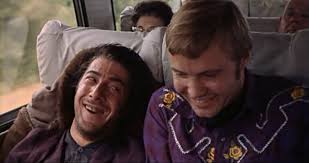
Midnight Cowboy (1969)

This movie is one of my favorite dramas. Joe Buck (Best Actor Nominee Jon Voight) leaves his dish-washing gig in po-dunk Texas and heads to the big city to be famous as- well, as a cowboy. It's hard to say what the naive Buck intends to do to make it in the Big Apple so he resorts to hustling with what he thinks is a Park Avenue sugar mama (Sylvia Miles in an Oscar-stealing turn), a religious nutjob (a decidedly non-Disney John McGiver), and a yearning student in a porn theater (a young Bob Balaban).

None of these tricks is enough for him to get by- so he goes back to the condemned building he shares with pathetic grifter Ratso (Dustin Hoffman in a gut-wrenching Oscar -nommed performance- even if he's been a real heel of late.) They are a pair of losers without jobs, but they still hold on to their palm-tree shaded dreams.

Unemployment Tip #2- Friends are super important when you're out-of-work. They can raise your spirits and help you make the contacts you'll need for your next big break.

Tootsie (1982)

I didn't plan on having two Dustin Hoffman entries in this category, but apparently he likes to play guys who are out of work in NYC. Tootsie stars Hoffman as Michael Dorsey, an actor who can't get anyone to hire him. They don't understand his art says Michael. You're a pain in the ass to work with says his agent (Sydney Pollack who also directed). Michael decides to show everyone by auditioning for a role in a soap opera as a woman- a gamble that pays off when he is not only cast, but becomes the next 'It' girl.

Michael gets tired of his double D life when he falls in love with co-star Julie (Jessica Lange who won Best Supporting Actress the same year she was also nominated for Best Actress for Frances.) How he solves his gender conundrum is one of my favorite movie moments and earned the film ten Oscar nominations.

Unemployment Tip #3- Think outside the box. The next great job might not be exactly what you did previously.

Up in the Air (2009)


At the height of the most recent recession, who in Hollywood said, "Let's make a movie about a guy who fires people for a living?" Director/Writer Jason Reitman- and with six Oscar nominations, including Best Picture, Best Director, and Best Adapted Screenplay, he was right. Up in the Air opens with a montage of corporate downsizer Ryan Bingham (Best Actor Oscar nominee and all-around suave king George Clooney) canning people. It's hard to say if it's more funny or devastating.

As Bingham flies around the country handing out pink slips like Altoids and pronouncing advice to his new protege Natalie (another Oscar nominee, Anna Kendrick), he begins to see the empty futility of his "What's in your backpack?" life and falls in love with his airport bootycall (yes, another Oscar nominee- Vera Farmiga.) The film expertly walks the tightrope between cynical and schmaltzy, making the point that life is full of chances- whether they come in the form of that uncomfortable call to the HR office, a fleeting airline lounge conversation, or a cinematically-timed epiphany.

Unemployment Tip #4- You're not alone. Lots of people lose their jobs. Talk to some of them and find out what they did to get to their next chapter.

Two Days, One Night (2014)


Marion Cotillard is one of the most thrilling actresses working today, and this dark Belgian gem proves it. Sandra (Cotillard) is a single mother who after taking time off for a nervous breakdown, returns to her job at a solar panel plant.

Unfortunately, her co-workers did such a great job of covering for her, the company has decided her position is redundant and with her gone, they can give a bonus to the remaining workers. Sandra begs for another chance and her sadistic boss tells her that if she can convince her co-workers to give up their bonuses, she can keep her job.

The rest of the film is her desperate quest to connect with her associates over a weekend and save her job. It's heartbreaking. Cotillard is so raw and fragile and frantically compelling. Each small bit of hope she digs up, brings us to the edge of our seats. She earned an Oscar nom for the effort, but that was also a job she lost.

Unemployment Tip #5- Be persistent. Sometimes you can't take 'no' for an answer.

So, if you're out of work (like moi) know that movies can show you how to get your next big break- or at least entertain you in the meantime.


Sunday, February 7, 2016

Lance's Werthwhile Top 5- Dramas

Hello Werthwhile followers!

If there's one question I get when I'm out and about more than any other- well more than, "How do you stay looking so young?"- it is "What are your top ten favorite movies?"
I wish I could answer that. I am a fan of so many movies for so many different reasons, that it's just hard to narrow it down to ten. My favorite movies are like my children. I couldn't pick one or two above the others. I couldn't live with myself if I had to tell one of my kids, "You're the best-est!"  and another, "You're ugly."

But I can't deny you wonderful folks my wise cinema guidance, so I've decided to break the Top 10 Movie Favorites Idea down to Top 5 and into genres so that it's easier for you to swallow. Now these lists are not definitive. There will always be a buttload of good movies that I don't talk about- and if you ask me after I've had three vodka tonics, I could give a totally different list. I also might be saving a couple gems for a future category. But one thing you can be sure of, you won't go wrong with any of the five that I talk about

So to start us off- let's go with the category of Lance's Werthwhile Top 5 Dramas!

1.) The Color Purple (1985)
Have you heard of this director named, Steven Spielberg? As prolific as Hitchcock and as superb a showman as DeMille, Spielberg, whether loved or loathed, is one of the most recognizable living American directors. He has been making movies since 1971, some of which (Jaws (1975), Raiders of the Lost Ark (1981) , and E.T. the Extra-Terrestrial (1982)) have become cultural touchstones and the gold standard for popular American film. Heck! He even shot an episode of Night Gallery (1970) with Joan Crawford!

Many people are grossed-out by Spielberg's over-sentimental story-telling and schmaltzy cinematic tricks. But I'm a sucker for it. If a movie makes me choke up and bawl- it has somehow hit all the right movie g-spots in me- and I think that's what good movies should do. The Spielberg movie that makes me cry on cue three times is my favorite- The Color Purple.

Based on the equally stunning novel by Alice Walker, the film follows Celie (Whoopi Goldberg), a young black woman in rural Georgia in the early 1900's. Celie's life is a steady stream of tragedy: raped by her father, her children taken away from her at birth, married off  to an abusive husband, and her beloved sister driven away from her in a hail of stones. But Celie somehow endures and falls in love with juke joint chanteuse Shug Avery (Margaret Avery), giving her life a shimmy she never knew. The film is full of stunning vistas, touching moments, and great performances. The Quincy Jones score is evocative and beautiful- and makes me get all tear-y when I hear it on my i-Pod. In short- it's a typical Spielberg masterpiece.

The film was highly touted and the lesbian love scene (however slight it was compared to the book) caused a loud hub-bub. When the film earned eleven Academy Award nominations, it was assumed it would make Oscar history. It did- by being the most nominated film to not win a single award. It's  too bad- because I personally prefer Color Purple to Out of Africa. Oh well. Spielberg went on to make plenty of successful movies, Whoopi launched a movie career, and Oprah- well she's Oprah.

2.) Midnight Cowboy (1969)
Lots of film folk point to Easy Rider (1969) as being the film that changed American movies- ushering in a new, independent era. But there is a better movie released at the same time, that I think can easily be called the first shot fired in a new American cinema, John Schlesinger's Midnight Cowboy. 
Joe Buck (Jon Voight) is a young country boy with dreams of fame and fortune in the big city. Wearing his cowboy hat, boots, and fringed jacket, Joe gets off a bus at Port Authority with the intention of taking Manhattan by storm with his good looks and charm. Instead, he meets washed-up con-artist and grifter Ratso Rizzo (Dustin Hoffman) who puts him up in an abandoned apartment building that is days away from the wrecking ball- much like these two disillusioned, lost men. The performances from Voight and Hoffman are unforgettable. Hoffman went from playing a confused, clean-cut college grad in The Graduate (1967) to a dilapidated, coughing derelict- proving he was one of the most exciting young actors of the time.

The film was shot in New York City with the grit, grime, and sleeze of the real city oozing out of the frame. The film doesn't shy away from the unsavory acts that some people had to do to get by- which originally earned it an X Rating from the MPAA. Schlesinger (who was a Brit) was able to take the realism coming out of foreign films at the time and apply it to an iconic American city- and the iconic American Dream- and expose both for the disappointment that they can be. The film took home three Oscars including Best Picture. I dare you to watch it and not hum the ear-worm theme song "Everbody's Talkin'" by Nilsson for the next three days,

3.) Network (1976)
People often say this or that film is prescient. Network is prescient. Directed by Sidney Lumet and written by Paddy Chayefsky, the film starts with bad news. Veteran news anchor Howard Beale (Peter Finch whose untimely death meant he won the first posthumous competitive Oscar) is told his sagging program ratings have made him disposable. Beale then announces on live television that he is going to kill himself on his final telecast. The ratings skyrocket and Beale becomes a sort of cultural televangelist flailing against the government, industry, and pop culture.

What makes this film such a great crystal ball is that it shows the ridiculous lengths a corporate-run news industry will go to to get ratings. It foreshadows not only the 24 hour news channels that build every story up to epic, life-threatening proportions until the next story comes along, but also the reality entertainment craze that has us watching the mental breakdowns of housewives, bachelors, and Kardashians everywhere.

The film is flawlessly paced with a career-best performance from William Holden and fantastic turns by Faye Dunaway, Ned Beatty, and Beatrice Straight. Straight won a Best Supporting Actress Oscar for what amounts to five minutes of screentime, but the film lost Best Picture to Rocky. I will be peeved about that forevs.

4.) Caged! (1950)
When I say the words "women's prison film" you probably think of scantily clad women showering and shiv-ing each other in front of butch guards. Caged! is so much more than that. Marie Allen (a pre-Sound of Music Baroness Eleanor Parker) is arrested for driving the getaway car for her armed-robber hubby. It's a bad day for her because her husband is killed and in her pre-lock-up physical, she discovers she's pregnant. It only gets worse from there.

Caged! is different from the typical women's prison film because the elements of bitch-ery and lesbianism aren't played for shocks or laughs. They are real parts of the prison system that ultimately degrades the women it is supposed to rehabilitate.
The cast in this movie are not pretty ingenues who have had their hair styled to look "unfortunate." This cast is chock full of character actresses with lined, scarred faces and bodies that look as if they have led lives on the wrong side of the tracks. It's a form of realism that you don't see often in films of this era especially with actresses.
Parker is a revelation, slowly losing her humanity until she becomes one of the animals in the zoo. Hope Emerson as the ward boss is a physical mountain who dominates her scenes with her hands on her hips and a lipstick scowl on her face. The great Agnes Moorehead rounds out the cast as a progressive prison warden whose hopes for these girls keep getting dashed by the system. Both Parker and Emerson were nominated for Oscars for their work.
Don't get me wrong. There are some good laughs here with gems lines like, "Line-up tramps!" But when I saw this film for the first time at Film Forum, my jaw hurt from hanging open. It's my favorite unexpected find.

5.) Meet John Doe (1941)
When people rattle off their favorite Frank Capra films, It's a Wonderful Life (1946) and Mr. Smith Goes to Washington (1939) often top the list. But I'm most fond of another Capra classic called Meet John Doe. Ann Mitchell (Barbara Stanwyck) is a newspaper writer who's given a pink slip. She's so mad, she writes her final column about a "John Doe" letter she received from a man who due to all the ills of the world has vowed to kill himself on Christmas Eve (Capra must love Christmas) by throwing himself off the roof of city hall. There's just one problem. There is no John Doe. Clever Ann made up the letter herself. When the readership of the paper explodes over the column, Ann and the paper have to come up with someone to play Mr. Doe to keep the papers selling.
Enter Gary Cooper as an ex-baseball player who has fallen on hard times and is willing to play the part for enough money to buy a donut and get back on the rails with his hobo pal, The Colonel (irrepressibly gruff Walter Brennan). With his down-to-earth, homespun rhetoric, John Doe becomes a symbol for the American Everyman, igniting a political movement he doesn't wish to be part of.

Capra was always obsessed with American society- its politics and influences, and John Doe deftly illustrates not only the needs of the people, but how those needs can be used by greedy politicians to gain power. He seems to say we need a populist movement- but the very existence of such a movement means those needs will be ground-up within the political machine. He offers no jingoistic answers here- and in fact warns us to fear anyone who speaks in slogans and political platitudes. "Make America Great Again!" anyone?

Stanwyck does what she does best- playing a feisty gal who can turn on the waterworks when it's called for. Cooper's skill at playing a simple man is done so beautifully in this picture, you can't help but love him. We all want to be Stanwyck clutching him on top of that snowy city hall, begging him not to jump.


So those are my Top 5 Dramas. What are yours?


Sunday, January 24, 2016

Winter Storm Jonas Film Festival

Ah... A good old fashioned blizzard! If Facebook is any indication, many NY'ers went out to see what happens to the view when two feet of snow is dumped on it. But for me, there's no better time to hunker down with some of your favorite comfort foods, a blanket, and a glass of something boozey to watch movies. Also, you don't have to put on your pants for a couple days.


My Winter Storm Jonas Film Festival started Friday night with Tootsie (1982). This film is one of those eternal pleasures. No matter how many times you watch Dustin Hoffman's Dorothy Michaels character chastise, chest clutch, or stammer, it's always a warm, funny time.
Hoffman wanted to elevate this character beyond the obvious joke of an actor who dresses like a woman to get a part. Much like Jack Lemon in another cross-dressing classic Some Like it Hot (1959), Hoffman eschews camp for an acceptance of the behavioral and physical differences between the two sexes, inhabiting a female character instead of parodying it. Dorothy is so enjoyable I find myself disappointed when Hoffman reveals himself on live television.
Like Julie (the captivating Jessica Lange), "I miss Dorothy." Terri Garr, Charles Durning, Dabney Coleman, Sydney Pollack, Doris Belack, George Gaynes, Geena Davis, and a pre-world-weary Bill Murray are all so wonderful you are willing to forgive the sometimes cringe-y Stephen Bishop soundtrack. This time around while watching an interview with Dustin Hoffman on the Blu-ray edition, I learned that Sydney Pollack was not the original director. He inherited the project after Hal Ashby left. My imagination is piqued by what the quirky director of Harold and Maude (1971) would have done with Tootsie.

Next up was British drama/romance The Crying Game (1992). This is one of those movies that infected the cultural zeitgeist in large part because of its big reveal. But I've never gotten around to seeing it. I mean, I know that the girl is actually a guy- so surprise over. Nothing to see here- except Jaye Davidson's weiner. Well, not exactly. Neil Jordan's political drama turned romance turned gay/trans drama seems to be hiding as much as Davidson's Dil. Motives and desires are shrouded among the many layers of translucent scarves that surround Dil's apartment. Stripped down, the movie parallels the fight over national identity with that of sexual identity. Stephen Rea has reason to question his Irish patriotism and his attraction to Dil.
The problem is that by the end of the film, I'm not sure he finds an answer to either of these conflicts. But then again, in 1992 there was no Good Friday Agreement of 1998 to ease tensions in Northern Ireland and no Caitlyn Jenner to publicly address trans issues. So perhaps within its ambiguous decisions, The Crying Game, is a perfect reflection of its time. It also unconsciously continued my men dressed as women film festival. So I had to move on to a different vision of womanhood.

Switchblade Sisters (1975) is sheer, Seventies sexploitation crap. But that's what makes it fun. No need to fuss over the plot or negative images of women. Switchblade Sisters shows what happens in a girl gang when a new girl shows up to challenge the leader. Of course it leads to prison catfights where robes open up exposing breasts, para-military black Maoists shooting-up a food truck, and two chicks having a winner-takes-all hair-pulling/knife fight for control of the gang, The Jezebels.
Everyone in this movie looks like somebody else- like the casting agent hoped the audience would think there were stars in this picture. Monica Gayle looks like Sissy Spacek with an eyepatch, Asher Brauner looks like Josh Brolin, and Don Stark looks like a younger version of Mr. Pinciotti from That 70's Show- wait- Don Stark is the younger version of the guy who plays Mr. Pinciotti from That 70's Show. 
Stark's character Hook is on the receiving line of one of the few bon mots of the film, "Everybody knows your crank could hook a tuna." There are movies that are so bad they're good. This one is so bad it's worth a couple laughs... if you've been drinking.


I finished my snowy movie weekend by throwing on some boots and tromping out to an actual movie theater to see Oscar-nommed, Carol (2015). I love director Todd Haynes. He makes movies that need to be seen on the big screen with an aestheticism that rivals classic directors like Douglas Sirk and Vincente Minnelli. And in this sense, Carol is a triumph. Set during the Christmas holiday of 1951, Carol tells the classic "love at first sight" story, but with two women. Therese (Rooney Mara) is a shopgirl in the toy section of a department store. Carol (Cate Blanchett) is a married well-to-do gal looking for a doll for her daughter.
Looks exchanged over a toy train propel the story over a fraught relationship. One of the great challenges of film is its ability to project the ecstatic feelings of first love and thwarted desire through visuals. Most films have lots of witty dialogue, grasps and clutches, and protestations of eternal longing. Haynes takes a different, largely visual approach. In a time when the open expression of a same-sex attraction was verboten, it is the little things that signaled affection. A longing glance, a lingering touch, the view of your loved one sleeping, fragmented images of a hand or face. The love between Carol and Therese is subtle and lovely. The attention to period-specifics is obsessively beautiful.
Unlike Haynes' Far From Heaven (2002) the colors seem muted, trying to keep the love blossoming in front of us from drawing too much attention. Carol isn't terribly complicated plot-wise- and lacking the obvious dramatics is more of a tone-poem than Far From Heaven, but it is a graceful addition to the Haynes canon. And it concludes my estrogen-infused movie-viewing marathon.  Maybe the next time it snows I'll get sucked into a John Wayne movie-hole.

What did you watch during Winter Storm Jonas?