Showing posts with label Call Me by Your Name. Show all posts

Sunday, March 10, 2019

The Gays of Future Past: Different from the Others (1919)

This week I watched a movie that really got my film geek juices flowing! It's that perfect junction between film and history that makes me want to sit down and write a blog post. Aren't you lucky?

The film is Different from the Others (1919) and the fact that I was able to see it at all is a miracle. Different is credited as one of the first films to sympathetically depict homosexuality. It was co-written by and stars well-known German sexologist Magnus Hirschfeld and was intended as a sort of PSA against the German law Paragraph 175 which made it illegal for men to bonk men.

In the film, famous violinist Paul Korner (Conrad Veidt one year before he would rocket to fame in The Cabinet of Dr. Caligari (1920) and many years before he would be immortalized playing Major Strasser in Casablanca (1942)) falls in love with starstruck pupil Kurt (Fritz Schulz) and soon the two are inseparable.

This comes to the attention of call-boy turned blackmailer Franz (Reinhold Schunzel... which sounds like a tasty German breakfast pastry) who threatens Paul with exposure of his illegal lifestyle if he doesn't cough up some marks.

Hirschfeld appears as himself to explain to Paul (and the audience) that there are many facets of human sexuality- and that homosexuality is as natural and as moral as heterosexuality... IN 1919!!! ONE HUNDRED YEARS AGO!!! We've literally been trying to explain this to everybody since men wore spats!

Different was assumed lost because once the Nazis took power every available copy was burned along with Hirschfeld's entire Institute of Sexual Research library in Berlin. But luckily a copy was found in the Ukraine in the 1970's so now we can see this unique attempt by a film to try and sway public and political opinion. It's like the Philadelphia (1993) of 1919.

The film that exists is just a fragment. There are numerous title cards and still photos to explain what we can't see. But what is here is remarkable. There are no passionate makeouts or man-on-man sexfests. The passion and longing are kept to glances and touch- and the good ol' indicators of homosexuality are refined culture, effeminate hand gestures and hands on hips... and kicky silk dressing robes.

I was struck by how similarly gays are filmed in some recent releases: The effeminate, bookish out gay kid in Love, Simon (2018); the longing glances that make up for any actual gay sexual activity in Bohemian Rhapsody (2019) (and if the trailer for Rocketman (2019) is any indicator, there will be lots of gay eyeball-only action for Taron Egerton too); the one-night hand-holding that takes the place of more carnal intimacy in Boy Erased (2018). 

While we do have Call Me by Your Name (2017)God's Own Country (2017)and Todd Haynes to put the sex in gay sexuality, it feels to me that there has been some neutering of the gay experience in popular Hollywood product.

It is ironic that a movie that was made when being gay was literally illegal, shares so much in common with gay movies made in today's more permissive culture.

We're here. We've been here. Get used to it.


Monday, May 7, 2018

God's Own Country or Brokeback Yorkshire

I love the English. There's just something about that accent that turns my spine to custard. So it's no surprise that I love gay English movies. Maurice (1987), Beautiful Thing (1996), Weekend (2011), and Handsome Devil (2016) not only provide plenty of eye and ear candy, but there's something about how the emotionally reserved English tell stories about gayness that feels so poignant and vital.
You may add God's Own Country (2017) to that list.

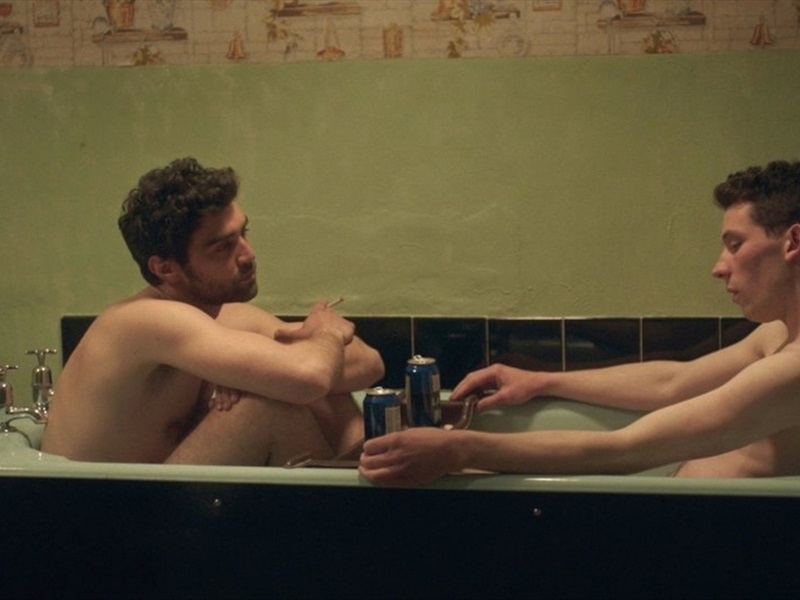
GOC takes place in West Yorkshire where the only thing tougher than the topography and the accent is the people. Johnny (the lanky and somber Josh O'Connor) is right well fooked. He is trapped working on his family's struggling cow and sheep farm. His mother left the scene years ago and his dad is a grouchy, cane-wielding overlord (Ian Hart) taken care of by his hard-nosed Nana (Gemma Jones). And if all that's not bad enough, Johnny's in the closet. Not known for its thriving gay community, West Yorkshire is as much a prison for Johnny's heart as his body. In spite of all that, Johnny's not much of a sympathetic character.

The first glimpse we have of dear Johnny is him unloading last night's alcohol into the toilet. He's an asshole drunk who shouts like a bully and sulks like the world's worst teenager. With all the ardor of a dog in heat, he screws a local in a cow trailer- spit and shoves filling-in for romantic gestures. Johnny believes his love life to be as grim as everything else around him, so there is no chance that he will fall in love with these brief conquests. Until Gheorghe.

The family hires a Romanian immigrant to help with lambing season. Gheorghe (the striking Alec Secareanu) is a man of few words and a tender knack for birthing lambs. Johnny and Gheorghe are sent off to the far reaches of the farm to manage the flock and in no time, Johnny attempts his typical backroom style hook-up.

But Gheorghe will not be treated as a conquest and is powerful enough to force Johnny to let down his walls and let him inside. For the first time Johnny experiences soul-stirring passion with another man- but is there any hope for these two lovers in this place?

Directed by Francis Lee the film is beautiful in its bleakness and brevity. Images of touching and glances communicate more than any of the character dialogue. This unadorned quality leaves an air of fresh reality, with no grand speeches or orchestral flourishes to sweeten this difficult love story.

GOC came out in January, 2017 at the Sundance Film Festival and was overshadowed by the other big gay movie in the festival, Call Me by Your Name. GOC and CMBYN are interesting films for comparison. Where CMBYN feels like an inevitable romance in a rarefied Italian countryside, GOC is at times a painful struggle in an unforgiving landscape. What CMBYN hides in dialogue, GOC reveals in silence. Where CMBYN uses fruit allegory and eschews images of the object of desire, GOC strips down the male form unashamedly. Even though I think CMBYN sucked all the air out of the gay film room last year, it's great that the film industry is making such diverse views of gay life- and doing it so well. It has indeed gotten better.

Thursday, April 19, 2018

Peaches Can't Say No: Call Me by Your Name

I'm still on my admittedly late to the game post-Oscars/funemployment movie viewing jag. I've gone through Three Billboards Outside Ebbing, Missouri (2017) (all hail Frances McDormand and Sam Rockwell) and Coco (2017) (cried like a little nino), but the movie I want to write about today is the much-buzzed-aboot Call Me by Your Name (2017).
I love to talk about adaptations. Nothing sets me off on a tear faster than the comment, "I liked the book better." It's like comparing elephants and whales. They're both awesome mammals- but you can't just throw a humpback whale on the Serengeti and expect it to face off with Jumbo. The mediums of literature and film while connected, are separate, unique experiences, and with the reader's active imagination in play, books very often come out on the winning end of this needless entertainment cagematch. All the same, it's interesting to see what screen adapters do to a book to make it ready for the multiplex.

In the case of CMBYN, I was informed I would love the book.
I didn't.
Don't get me wrong. I'm as geeked to read a gay love story as any other card-carrying homosexual- but Andre Aciman's novel about the sexual awakening of a seventeen-year-old in his family's Italian vacation villa left me wanting to give young Elio a cold shower. One minute Elio's love for visiting grad student Oliver is erotically absolute. The next he claims he couldn't care less if he never saw his handsome face or inhaled his swimtrunks again. It's terrifyingly accurate. It was like reading some of my diary entires from that adolescent age where everything was immensely important and I loved and then hated people at the drop of a hormone. On the one hand, I was impressed by the emotions Aciman captured but on the other, mortified by the immaturity of the badminton game that is a teenager's romantic inner life.

The book was so mired in Elio's conflicted inner monologue, I was curious how Oscar-winner James Ivory would pull-off an adaptation that wouldn't have me shouting, "It gets better, Elio!" at the screen. Ivory and director Luca Guadagnino are successful at making Elio more palatable, but in the process sand away the sharp edges of first love.

Guadagnino made a splash in the indie movie scene with his Tilda Swinton starrer I Am Love (2009). His handling of that tale of a life-altering love affair in Milan made him the perfect candidate for CMBYN. Guadagnino instinctively understands Italy and shoots the countryside as if it is both fresh and ancient at the same time. His camera frequently moves from the manmade to the naturemade, leaving that feeling of permanent impermanence. Time moves in a languid way, making us feel like, "There's always next Summer." And it is that casual quality that short-circuits the tortured passion of Aciman's novel.

Where Aciman's highly passionate text builds Elio's desires to unendurable levels, Guadagnino's camera pulls back. He often shoots the two lovers from a distance, denying us the feeling of intimacy and desire that the traditional closeup can evoke.

I expected some sort of visual exploration of the body that is the focus of Elio's desire, but even his first peek of Oliver's tushy is shot from across the room. I get that part of this camera strategy is to emphasize the distance between these two future lovers, but there were times it felt like Guadagnino's camera was a blasé observer rather than a titillated participant.

There is a laid back, "whatever happens" pace to the romance that belies the fiery passions that made the book enervating beyond the point of comfort. "Will it be bike-riding, swimming, or fucking this afternoon, old chap?"

Sometimes they choose swimming.


A perfect example of what I'm talking about is the infamous peach scene. In the book, after Elio date rapes a peach, his lover proves his passion for him by eating it. Now maybe the filmmakers thought putting something as graphic as eating a jizz-filled stone fruit on the screen would earn them the dreaded NC-17, but I think it could have been figured out (even though I would have had to cover my eyes). What we are left with is a peach-dodge and tears. Crying at various points in the film succeeds in elevating this special relationship, but it can't replace the primal passion that should be paired with it.

I would be remiss if I didn't mention the touching monologue given by Elio's father (the delightfully versatile Michael Stuhlbarg.) It is a beautiful parental acceptance of a child. Add it to Mahershala Ali's speech in Moonlight (2016) as evidence that Hollywood is finally portraying kinder Father-Gay Son relationships.

So if I'm being forced to choose between the book and the movie- I go with the movie- but mainly cause you can't see Armie Hammer's butt in the book.