Does anyone else think of their fathers in terms of movie stars? Maybe it's because the first movie I remember seeing with my dad was
Escape from Alcatraz (1979), but I always felt that my dad had a Clint Eastwood vibe to him. Eastwood was lean, quiet, and direct. His eloquence came from action.
He seemed to be a man raised from the earth, who sought out justice- or at least his idea of it. That is my dad. I mean, my dad never shot up Mexican towns (that were actually in Italy), snarled a catch-phrase while pulling out a handgun, or drove a pick-up truck with an orangutan. But he did give hell to sports teams on the TV, come up with a quick a speech before a spanking, and his pick-up truck usually had four kids in the back. Whatever the reason, I can't help but think of my dad when I watch a movie with Clint Eastwood.
In honor of Father's Day, here are my Top 5 cinematic fathers to compare your dads to:
Home from the Hill (1960)
Would you be surprised if I told you that Vincente Minnelli directed an East Texas melodrama exploring the nature of father-son relationships and the expectations of masculinity? That doesn't have any musical numbers? Well he did.
Home from the Hill is the story of the Hunnicutt family: big-booted, woman-chasing patriarch, Captain Wade (the always watchable Robert Mitchum); long-suffering turned to ice-queen mother, Hannah (the also always watchable Eleanor Parker); conflicted son, Theron (the always tanned George Hamilton); and illegitimate son, Rafe (the always- well whatever George Peppard always is.) The plot is pure Texas mythology with wild pig hunts, barbecues, and squalid affairs making life on the prairie a hoot and a holler.

In another director's hands, this film could be all about how a boy becomes a man under the watchful eye of his father. But Minnelli doesn't buy that idea at face value. Theron is more sensitive than his dad and questions the manly shadow he's expected to cast alongside his legendary father's. Mitchum without doing or saying anything exudes the kind of easy masculinity that so many of us sons can never achieve- and watching Hamilton's slight build try to fit in his boots is uncomfortable- as it should be.
Minnelli's genius ability to compose space that reflects character and theme is on full display here. Mitchum's den holds all the accouterments of the world's most exciting man- stifling all who enter. Theron's more studious space is a counterpoint to the boarshead and bear rugs just downstairs. Minnelli expertly makes these personal spaces speak volumes about their inhabitants- and their incongruity- their separateness existing beneath the same roof.
The exquisite balance between performance and filmwork makes
Home worth coming back to.
And the barbecue will make you super hungry!
Big Fish (2003)
There is nothing more enchanting than a good story teller, and Tim Burton has woven some doozies in his time. With
Big Fish, Burton tosses away the cartoon-ish trappings of his film work and tells the story of a man who has spent a lifetime telling tall tales and his son who is desperate to believe them.
Ed Bloom (Albert Finney) loves to tell a good story- his favorite repeatable yarn dealing with a giant fish in the local lake that he has been having run-ins with his whole life. Ed is also dying. His only son Will (Billy Crudup) and his pregnant bride (Marion Cotillard) come to help Will's mom (Jessica Lange) take care of Ed as he weakens. Everyone loves Ed and his stories, his eyes wickedly glinting at his new daughter-in-law as she sits on his bed. Who wouldn't wickedly glint at Marion Cotillard?
But Will is tired of the stories. Will wants to know his father- the real man- not the folk tale legend (played as a youth by Ewan McGregor) who met giants, discovered hidden towns that didn't wear shoes, faced- off with a witch (Helen Bonham Carter), wooed the girl of his dreams with a football field of daffodils, and finally caught that old monster fish in the lake.
But what if we are the stories we tell? What if the truth is there- and the story leads us to the discovery of that truth in a way that simply flipping through a photo album or answering questions about dusty papers can't? Perhaps a life well-lived is a story well-told.
Just the cast list is reason enough to see this movie. They are all gems. But Burton really makes a unique film in the context of the rest of his canon. He does an amazing job of weaving in the fantastic without making it overwhelm the simple story of a son re-connecting with his father. He innately understands that the joys of the imagination are not just for children. It is the most adult movie he's ever made- and I challenge anyone not to cry at the end.
Tree of Life (2011)
I know that this movie is one of those love it or hate it situations- but I love it... most of it. Director Terrence Malick tends to infuriate some with his specialized way of filming his stories. But I have always been drawn to his use of image over dialogue. And
Tree of Life is no exception. The timeline for
Tree is malleable and flips back-and-forth from modern day to 1950's Texas to the beginning of the universe to death. That's a lot to cover- and quite honestly, I could have done without the Discovery Channel-esque "How the World Began" section. But Malick uses the story of Jack (dependably moody Sean Penn), a man haunted by the suicide of his brother and his relationship with his father (Brad Pitt) to visually explore the things that we take and those that are given to us throughout our mortal journeys.
What really grabbed me about this movie was Malick's use of the tactile. Closeups on young Jack's hands tracing his brother's hand on the other side of the window or how a father touches a son's head. The film is so beautiful in how it communicates this human contact in a simple, connective way. It shows deep bonding without a lot of "I love you, kiddo" dialogue.
Pitt is very much responsible for the success of that image of a father and sons. The way Pitt touches his children is so tender and natural- it brought tears to my eyes. I at once felt the warm joy of those touches- while simultaneously running through my memories for the times my dad tousled my hair. Pitt is a father of- God I've lost count of the number of his brood- but he was clearly able to tap into that feeling of elation and pride of being with his kids. It radiates from him in the scenes with his cinematic sons like a soft light. It's magical.
The film won the Palm d'Or at Cannes and was nominated for three Oscars including Best Director and Best Picture, so clearly CGI dinosaurs notwithstanding, the film struck a chord. The image of the neighborhood children running through the mist of an insecticide truck in the twilight is durable marking our childhoods as moments of wonder shrouded by hindsight.
Bicycle Thieves (1948)
I love the post-war neorealism film genre. The almost gothic look of these films shot in the rubble of war-torn Europe made a profound setting for stories of survival and change. Like flowers sprouting out of decimated churches and homes, the characters in these movies were survivors learning how to get along in a world that had gone mad- and was now trying to right itself. Vittorio De Sica's
Bicycle Thieves is a perfect example of the best this genre has to offer.
Antonio (Lamberto Maggiorani) is desperate to find work to support his family in post-WWII Rome. He finally is able to get work as a poster paster (say that five times fast) but he needs a bike to be able to get around town quickly. His wife Maria (Lianella Carell) pawns her dowry (Sheets. You could pawn sheets.) so that Antonio can get a bike and start making money. But no sooner does he start work, then someone steals his bike- and Antonio and his young son Bruno (Enzo Staiola in his film debut) begin a desperate hunt all over Rome for the thief and the bike.
The relationship between these two is central to the film. As the father struggles to do whatever it takes to survive, he also has to teach his son the difference between right and wrong. Some of those choices are reflected in little Bruno's eyes as he watches his father grapple with a new, lawless world. Is it better to steal than starve? Is there anything thicker than blood? Can a father lose his son's love and respect?
The realistic shooting style was all the rage in Europe- as much a product of necessity as artistic style- and De Sica perfectly captures a sense of the real Roman streets and people at the time.
There is no attempt made to clean-up dirty faces or knees- or to pretty up the buildings ravaged by war. De Sica shoots Rome as it was- poverty-stricken, proud, and struggling to find a new identity. The fresh and spontaneous performances from mostly non-actors are all superb in drawing us into a filmed reality. It was a reality that most modern audiences probably can't imagine. But thanks to directors like De Sica, we have movies to remind us.
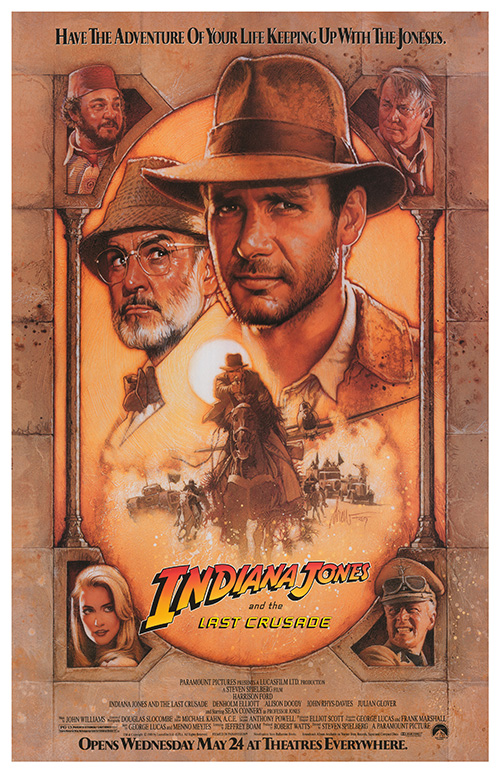
Indiana Jones and the Last Crusade (1989)
There are moments when I wish I could be in the pitch meetings for famous movies.
Some pitch guy: So we've had mega blockbuster success with Indiana Jones. We had him search for the Ark of the Covenant and fight Nazis, and then we sent him to India to find some magic rocks and fight an Indian cult-
George Lucas (eating a burrito): I still don't know what we were smoking on that one.
Steven Spielberg: Ssh, George! And stop eating. Continue pitch guy.
Some pitch guy: So for this next movie why don't we have Indy fight the Nazis again- but this time he does it with... his Dad!
George and Steven: No.
Some pitch guy: But he's looking for the Holy Grail.
George and Steven: No.
Some pitch guy: But what if the dad is played by Sean Connery?
George and Steven: Brilliant!
Steven: Great idea, George!
George: Thanks, Steven! Glad we thought of it. Pitch guy, I need 24 chalupas. Do a Taco Bell run.
Keeping a successful franchise going isn't as easy as our current Marvel Universe makes it seem- but the Indiana Jones movies have always been great fun to watch (with the exception of number four. I pretend number four never happened). In the third entry,
The Last Crusade, Indy (Harrison Ford, of course) is busy teaching college when he is informed that his father (the afore-mentioned Connery) has disappeared while searching for the Holy Grail. So Indy slaps on his fedora and bullwhip and goes out to rescue him. Along the way he runs into the Third Reich again, and literally, Hitler.
The movie is full of the biblical lore, beautiful period design, exotic locales, and non-stop action that made the previous movies so successful. But what sets this one apart is the interaction between the two Joneses.
Ford and Connery while playing two people often at odds with each other, seem to be having a blast. The relationship they create is funnily combative with just the right amount of treacle- enough to not make either of these guy's guys gag. Both of them are such big stars that they could eat up all the screenspace- but they don't. They share the film with what looks like pleasure, creating a father-son relationship that highlights what each can learn from the other. And can't we all benefit from being tied to our dads in a fiery castle every now and then?
If those aren't enough father figures for you, check out the
Charlie Chaplin silent classic The Kid (1921) at The Film Forum this Sunday.
Happy Father's Day, Pops.