Being sick with the flu sucks. Being sick with the flu over a weekend
really sucks. So when you're stuck in your home with nowhere to go but to the medicine cabinet to chug Vick's Nyquil or slather yourself in Vapo-Rub, why not watch a movie... or two... or three? I was sick this weekend myself, so I thought I'd review the movies I watched, just in case any of these might appeal to you- whether you're sick or well.
1.) We Need to Talk About Kevin (2011)
I don't know about you, but when I get sick, I can get a bit gloomy. So sometimes my taste will head for the dark side of things. I'd heard great buzz about
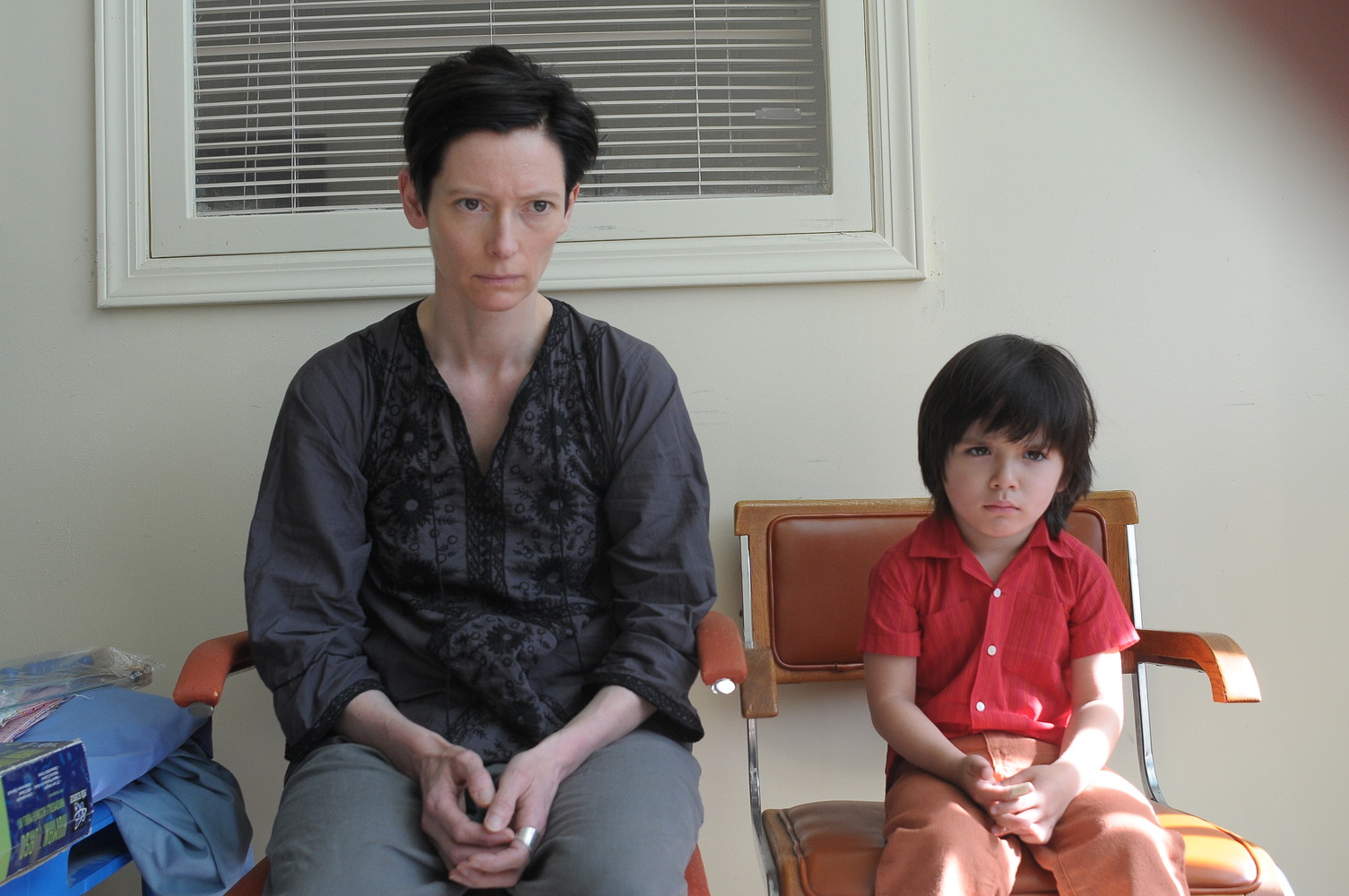
We Need to Talk About Kevin - and Tilda Swinton is such a weird treat to watch, I figured it would be a good one to watch while I sucked at my chicken noodle soup. Mmmm...Mmmm... Holy shit this movie is dark.
Told in fragmented memories in non-linear fashion,
Kevin is the story of Eva Khatchadourian (Swinton), a wife and mother whose life has been drastically altered by a catastrophic event that has left her alone in a crappy house- the pariah of the town.
As the pieces of this puzzle fall into place we learn that Eva's son Kevin (creepy, creepy Ezra Miller) has committed an atrocity that has left lives shattered. What makes this movie so interesting (aside from its clever use of non-linear storytelling) is its focus on Eva. Because, you see, Eva didn't really enjoy being a mother. Played with Tilda's expert sense of coolness, Eva misses her life as a well-known travel author as her child screams, and screams, and screams. She finds peace standing next to a jackhammer in the street.
However, when daddy comes home (John C. Reilly in his typical role as lovable, but clueless dope) the baby stops crying immediately- ooing and cooing to daddy's delight. As the child grows, little Kevin comes close to a real-world version of Damien- torturing his mother any chance he gets. By the time he is a teenager in the form of Ezra Miller, it is clear that Kevin is an unrepentant asshole.
I like that director Lynne Ramsay is not trying to explain the childhood killers we so frequently read about. No causal links are drawn here. Kevin is not a sweet baby turned evil by his mother's admission that her life was better when he wasn't there cause she could be in "France." That wicked gleam in his eye was there from birth. What we focus on instead is a woman trying to deal with a motherhood that destroys instead of fulfilling her.
Swinton is such a master at playing a multi-faceted ice queen in films like
Michael Clayton (2007) (and a literal one in
The Narnia Chronicles)
that this role works right in her sweet spot- a woman who would have been better off not being a mother and must struggle to find some new way to exist.
2.) The Pianist (2002)
So apparently chilling teen violence wasn't enough to quench my fever-influenced movie taste. I moved on to Roman Polanski's depressing WWII drama set in the Warsaw ghetto. Adrien Brody is pianist Wladyslaw Szpilman, a promising Polish pianist whose life is upended when the Germans invade Poland in 1939. Wlady and his Jewish family soon get to experience all the indignities, tortures, and death that the Nazis were notorious for.
Wlady is able to escape the Jewish ghetto but is then sentenced to a life in hiding- going from safehouse to safehouse until Warsaw falls apart and he creeps, scavenger-like from bombed-out structure to bombed-out structure trying to survive. Adrien Brody won an Oscar for his role- which reminded me in some ways of Leonardo DiCaprio's like-awarded performance in
The Revenant. It feels like a game of "torture the actor" as Brody becomes more and more debilitated- his performance a physical exertion for survival.
The Pianist is based on the true story of Szpilman, but it may just as well have been based on Polanski's story of survival in German-occupied Poland. The level of detail is so visually rich- images of death and destruction pulled from Polanski's own memory. The color palette of the film is muted in greys, a gloom that descended on the country of Poland that fateful day in 1939. Polanski likes to play with conversations overheard from other rooms. It is an integral part in
Rosemary's Baby (1968) and
The Tennant (1976) and he uses it here too.
As Wlady cowers, locked in a room waiting for liberation, the sounds from the apartments and the world outside filter in through the walls, making the real world unreal to one who had been purposefully and cruelly cut-off from it. I have my issues with Polanski as a person, but I can't begrudge him the Best Director Oscar he won for
The Pianist. He had an opportunity to imbue a film with his own harrowing story of survival- and he did it beautifully.
3. From the Terrace (1960)
After my fever broke, I was in the mood for something a little less depressing than the Holocaust, so I turned to an old pot-boiler starring the ever so handsome Paul Newman. When we think of the classic '50's melodrama we usually think of Douglas Sirk- and rightly so. But director Mark Robson had his share of big screen-sized soap operas with
Peyton Place (1957) and
Valley of the Dolls (1967). Terrace doesn't approach the kitsch greatness of either of those movies- but then neither of those flicks has Paul Newman in his prime in his boxer shorts.
Newman is Alfred Eaton, son of a steel mill owner who arrives back from the war to find his mother a hopeless philandering drunk (Myrna Loy at her tipsiest) and his father still mad because his favorite son died and he's left with Alfred to bring into the family business. With such a wonderful home life, it's no wonder Alfred strikes out on his own and falls in love with Mary, a girl beyond his class (Newman's real-life wife Joanne Woodward). Alfred's luck seems golden when by chance he rescues a young boy who falls through the ice, only to find the son's grandfather is a wealthy Wall Street scion who immediately takes to Alfred and gives him the chance to be a bigshot.

In true potboiler fashion, this great situation can't last and soon Mary is slutting it up with her ex-fiance cause Alfred is spending too much time at the office. Then Alfred meets a young woman (Ina Blain- Most-Promising Newcomer Golden Globe Winner who quickly disappeared from the limelight) who opens his heart to the possibilities of a truer love and Alfred has to choose between his unfulfilled Golden Life or his brown-eyed chippie.
The film was based on a hit book written by John O'Hara- but it's a schtick we've all seen before. What makes the movie watchable is Newman and Woodward. You can't take your eyes off Newman- his ease on screen is hypnotic. Did I mention there's a scene where he's just in boxer shorts? Woodward is delicious as a dissatisfied lover who is not a good girl- but not a caricature of a bad one.
This was shot in Cinemascope so the use of bright colors is disarming with a red dress or flower arrangement leaping off the screen practically screaming "LOOK! It's Cinemascope!!!" And they used a strange silver wash in Woodward's hair that might have been used to suggest the maturity of this young woman... or maybe they were just trying to make blonde pop even more.
Of the three,
From the Terrace is probably the best movie to recuperate to because it requires such little emotional investment. But I'm feeling better- so maybe depressing movies about teen psychotics and Nazis are also good pills to swallow.