The John Turner and Geoffrey Parsons lyrics to a song written by Charlie Chaplin enjoin us to, "Smile though you're heart is aching. Smile even though it's breaking." I've always felt that prescription might be a titch overly-optimistic in dealing with real heartache, and when I and my family experienced a great tragedy last week, I wondered whether smiling was even an option.
But from the moment I landed back in the arms of Mother Kansas and my family, I discovered that we all instinctively chose humor as a way to deal with our grief. I wasn't in our old kitchen more than ten minutes before someone pointed at my belly and asked if it was a boy or girl. My rejoinder about reflections from bald foreheads, and volume levels on hearing aids quickly had us all smiling- nay- laughing. In a matter of moments we had launched into the familial repertoire of fart and poo jokes including modern updates like
Poo Pourri. Grief was softened by the simple kind of humor we didn't have to think about.
This discovery led me to ponder what movies might be just the right level of low comedy to help us forget our troubles and "smile through the fear and sorrow."
Here are my Top 5 Tear-Curing Movies:
The Music Box (1932)
There are those that prefer The Three Stooges, and those that prefer The Marx Brothers. But for my money, the best of the early comedy teams was Stan Laurel and Oliver Hardy- Laurel and Hardy if you're nasty. The simplicity of these two characters- one a self-righteous know-it-all, and one a bumbling softie- allowed them to be placed in a myriad of situations and produce comic results every time. Whether they were prepping a boat for their new fishing venture, tromping through the Sahara with the Foreign Legion, or trying to go to a lodge meeting in Chicago without their wives knowing, these two performers consistently produced comedy gold.

In this Academy Award-winning short, Stan and Ollie have to deliver a piano to a house... on top of a long flight of steps. Nothing goes right for these two movers and whether it's their own horse, a sassy nanny, a bombastic music professor (the hair-tugging Billy Gilbert), or even the steps themselves, it feels like the world is against these two. But Laurel and Hardy never stop. They keep heaving and ho-ing that piano until it is delivered. "Service with a smile."
This short is iconic, partly because these two everyman characters are so universal- their bungling and pride so recognizable in all of us. Visually, the image of two men engaged in a near-impossible task that they won't quit at speaks to us on a Sisyphean level of the comedy to be found in our own trials. Which is a fancy way of saying
The Music Box will always be funny.
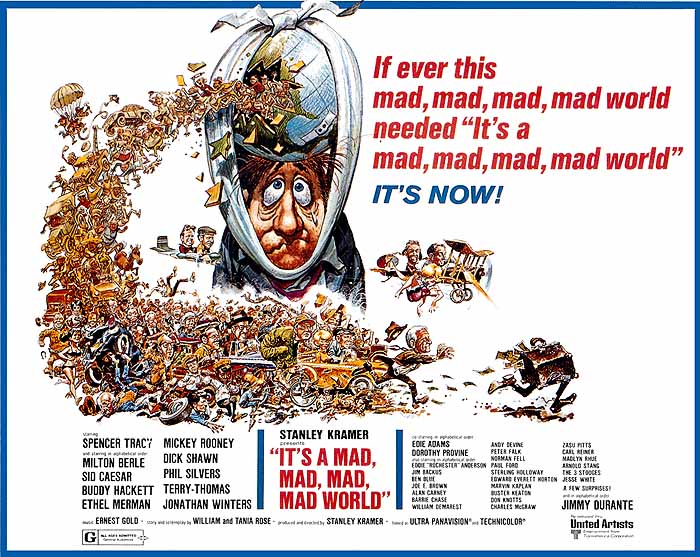
It's a Mad, Mad, Mad, Mad World (1963)
Is that enough Mads?
Stanley Kramer was a well-known producer/director who had made his name directing very serious, socially relevant movies:
The Defiant Ones (1958),
Inherit the Wind (1960), and
Judgement at Nuremberg (1961). But in 1963, Kramer did something no one expected- He made a hit comedy.
Mad follows the stories of five groups of motorists who come across accident victim Smiler Grogan (Jimmy Durante in the first of an onslaught of classic comedian cameos in this film) who literally kicks the bucket (setting us up for the level of comedy to come), but not before he reveals the hiding place of a stash of ill-gotten cash in Santa Rosita State Park. The rest of the film is a madcap chase across California to get the money and get rich. Included in the pursuit is soon-to-retire lawman Capt. T.G. Culpepper (Spencer Tracy) whose loyalty to law and order is sorely tested.

The cast is a who's-who of Hollywood comedians: Sid Caesar, Milton Berle, Buddy Hackett, Jonathan Winters, Terry-Thomas, and Phil Silvers along with comedic actors: Ethel Merman, Mickey Rooney, Dick Shawn, Jim Backus, Eddie Rochester Anderson, Edie Adams, and Dorothy Provine. The aforementioned cameos are equally impressive with appearances by Jack Benny, Joe E. Brown, Andy Devine, Edward Everett Horton, Buster Keaton, Jerry Lewis, and The Three Stooges.
If this number of funny notables seems overwhelming, it is. The film is a series of Borscht Belt sketches strung together by California blacktop. But it doesn't matter. It's hysterical.
Lending poignancy and gravitas to the proceedings is Tracy, who isn't really thought of as a comedic actor despite his brilliance in the Hepburn-Tracy delicacies of the 40's and 50's. Tracy leavens the rampant scenery chewing going on around him with Culpepper's world-weariness and crisis of conscience.
The final scene of the film is legendary and proves that the remedy for pain and suffering can be as simple as a banana peel.
Blazing Saddles (1974)
In an irreverent comedy environment filled with Adam Sandler, Seth MacFarlane, and South Park fare, we sometimes forget that there was a time when line-crossing comedy was rejected by Hollywood. But in 1974, birthday boy Mel Brooks (he turned 90 on Tuesday!) directed what was then considered a comedy shock-fest.
Blazing Saddles is a spoof on the classic Western movie genre- but it's something more than that. The little town of Rock Ridge is right in line with the advancing railroad and land-hungry Attorney General Hedley (not Hedy!) Lamarr (Harvey Korman) decides that the best way to get rid of the denizens of Rock Ridge so he can buy up their property is to send them a new sheriff... who is Black.
Enter Sheriff Bart (Cleavon Little) who, with the assistance of washed-up gunslinger The Waco Kid (Gene Wilder) wins the respect of the town and takes on Hedley's gang of thugs (including Slim Pickens as flatulant Taggart, Alex Karras as monosyllabic Mongo, and the divinely tired Madeline Kahn as teutonic songbird Lili Von Shtupp) to save the day.
Amidst the
schnitzengruben and fart jokes,
Saddles does something really controversial- it takes on the issue of race. More than just throwing around the N-word, Brooks uses it to make us see how ridiculous racism is.
Little does a wonderful job of playing a class clown who uses humor to break down the racial divide, becoming as big a Western hero as John Wayne- who incidentally turned down a role in the movie because the material was too blue- but famously said he'd be the first one in line to see it.
Murder by Death (1976)
Neil Simon is f-ing funny. Well-known for his television writing for Sid Caesar and hit Broadway comedies like
Barefoot in the Park and
The Odd Couple the man knows how to pen a joke and create wacky characters. So it should come as no surprise that Simon's
Ten Little Indians spoof full of characters that are spoofs of famous detectives is a hoot. The world's greatest detectives have been summoned to the castle of Mr. Lionel Twain (the inimitable Truman Capote) to solve a murder that hasn't happened yet. Will the next murder be their own?
The list of actors playing these send-up sleuths is enough to make you titter: Peter Falk as Sam Diamond along with Eileen Brennan as his Girl Friday; David Niven and the sublime Maggie Smith as Dick and Dora Charleston; Peter Sellers as Sidney Wang (yes, he's doing yellowface- but he's really funny anyway); James Coco as Belgian Milo Perrier and a young James Cromwell as his chaffeur; glorious Elsa Lanchester as Jessica Marbles and her nurse (who Jessica actually takes care of) played with elderly puckishness by the eternal Estelle Winwood.
Filling out the cast are Alec Guinness as a blind butler named Bensonmum and a deaf mute maid played by Nancy Walker.
With a set-up like that, the laughs are guaranteed.
The Cannonball Run (1981)
As a kid growing up in the '70's in the Midwest I was exposed to lots of cars. And not just in my dad's garage- but on TV and in the movies. Nothing spelled overt masculinity like the General Lee on
The Dukes of Hazzard or Burt Reynold's Firebird in
Smokey and the Bandit (1977). So when a movie came out about a cross-country car race, I was required to see it in order to maintain my manhood. Lucky for me,
Cannonball had just as much comedy as it had testosterone.
JJ McClure (the mustachioed wonder himself Burt Reynolds) and his pal Victor Prinzim (corpulent clown Dom DeLuise) are bound and determined to win the illegal road race called the Cannonball- even if they have to pretend to be paramedics so they can drive above the speed limit without being bothered by all those smokeys. But these two jokers aren't alone.
There is plenty of competition- and I mean plenty. Roger Moore, Dean Martin, Sammy Davis Jr., Adrienne Barbeau, Terry Bradshaw, Mel Tillis, Jackie Chan, Bert Convy, and Jamie Farr all hit the road to win the prize and out drive and outsmart each other. Barroom brawls, boob jokes, and a long-fingered proctologist (played by wonky-eyed Western star Jack Elam) ensue.
One of my favorite parts of
Cannonball is the compulsory
blooper reel during the final credits. There's nothing better than watching Reynolds and DeLuise unable to maintain a straight face around each other. It makes you wonder how they were ever able to finish the movie.
Wherever you are, Little Brother, I hope you have unlimited access to the movies that make you laugh.