Monday, July 11, 2016

Not Just Another Elderly Romance- 45 Years

I love being surprised. When I first heard about Andrew Haigh's (he of Weekend (2011) fame) film 45 Years (2015) I thought, "Oh. A British romantic drama starring Oscar-nommed Charlotte Rampling. I'll have to watch that... someday." Well, someday came around yesterday- and boy am I glad I didn't wait 45 years to see it.

Rampling is Kate Mercer, a woman looking forward to her 45th anniversary party with her husband Geoff (Tom Courtenay). But before the joyous occasion, Geoff receives a letter informing him that the body of Katya, the woman he loved before he met Kate, has been discovered frozen in a glacier in Switzerland. This news sends seismic waves through what appeared to be a stable marriage as Kate suspects that Geoff has never gotten over the girl who disappeared before his very eyes oh so many years ago.

The Haigh Approach to drama is beautifully subtle to behold. There are no screaming matches or thrown vases. These two proper English-folk would never do anything so boorish. But the emotions are there- boiling under the surface- bursting forth in a short comment or a rejected touch.

Rampling in particular is spellbinding in her restraint. The tension from the movie emanates from her performance- like a string vibrating until the point we must hear it. It's like a horror movie- only instead of being nervous waiting for a knife-wielding maniac to jump out from behind a bush, we are holding our breaths waiting for Kate to let forth with a searing emotional display.

What elevates this film is its blending of genres. The storyline is the stuff that romantic dramas are made of, but Haigh adds inspired touches of a female gothic film. Katya is not just an inciting incident. She haunts this film- much like Rebecca haunts Hitchcock's 1940 titular film. Her presence is felt, not just referenced. At one point her image is seen as a ghostly slide projection on a  hanging sheet- like an ethereal portrait gazing from a wall.

The female gothic trope of a separate space in the home (in this case an attic) where secrets lie and truths are discovered is put to use- as is the linking of man and nature. Storms rend the night as emotions fracture and vast, lonely shots of the Norfolk countryside spread out before us as Kate walks her dog and tours the broad channels. Nature both mirrors Kate's anger and loneliness, and frames this one moment within the vastness of a 45 year marriage.

As with Weekend, 45 Years ends without a clean-cut resolution, but that seems to be the point of Haigh's realistic style. Romance in real-life has few clean-cut endings- so why should romantic movies? This slice of older life is touching and beautiful and well worth the watch. Also of note, the delightful Geraldine James who you may remember as the "Bitty Mama" from TV's Little Britain shines as the requisite best friend.

Friday, July 8, 2016

Back to Black

The other day as I passed my boss' table in her office, an old VHS tape caught my eye. At first I saw "That's Entertainment" and I got all warm and fuzzy inside because I love that classic compilation film- or as I like to think of it- 1940's music videos. I could sit for hours and watch those clips of Gene, Fred, Esther, Judy, and Ann from the greatest MGM musicals. But on closer examination, I noted the cover said "That's Black Entertainment" which is something entirely different. After promising to return the tape on pain of dismemberment I ran home and re-attached my VCR to my TV, and sat down and watched the history of Black film unfold.

That's Black Entertainment (1989) chronicles the independent Black film industry that existed from the early part of the Twentieth Century through the late Fifties. Because most movie theaters were segregated, Black Americans were forced to watch movies in Blacks-only theaters which gave filmmakers the opportunity to create films that spoke to Black audiences about Black culture. Filmmakers like Oscar Micheaux and Spencer Williams (Andy of Amos and Andy fame) were able to capture scenes of American life from the Black perspective. Issues of religion, crime, drug and alcohol abuse, police brutality (yep, it ain't nothin' new), and the importance of family were all being explored during a time when Hollywood only showed blacks as maids, slaves, or entertainers. There were even newsreels and shortfilms made exclusively for Black audiences to give African-Americans the same movie-going experience that their White counterparts enjoyed.

Because Hollywood refused to show any of these films in White theaters, the productions were funded on a shoestring budget. Often the acting talent was untrained, and the camerawork basic- with one-take scenes used to save money. But there were actors and actresses who were discovered in these films who went on to star in mainstream films for larger audiences.

Paul Robeson was mainly thought of as a Broadway star- but he did make Black independent films, as well as star in mainstream Hollywood movies like Show Boat (1936) and King Solomon's Mines (1937). Lena Horne starred in The Duke is Tops (1938) before being snatched up by Vincente Minnelli to star in films like Panama Hattie (1942) and Cabin in the Sky (1943). 

Nat King Cole, Ethel Waters, and Cab Calloway received their cinematic starts in Black films- and even little seven-year-old Sammy Davis Jr. is shown as a tap dancin' tyke running for office in Rufus Jones for President (1933) (I hope Hillary can at least soft-shoe)
Black music stars seemed to be able to crossover into mainstream Hollywood more successfully, because their recognizability and influence over the music industry allowed for an easier transition to a white audience who would be familiar with them from their recording careers.

But black actors and actresses seemed only able to crossover as long as they played roles as servants or in Steppin Fetchit's case, as racist punchlines. While the level of production in the independent films was lower, the depictions of Blacks was generally better- forcing actors to choose between socially-responsible work and money from the Hollywood roles that perpetuated negative stereotypes.

The era of the independent Black film industry changed for a couple of reasons. Most importantly we stopped segregating black and white audiences, so smaller producers had no ability to compete with the Hollywood studios in the same theaters.  And with the emergence of actors like Sidney Poitier and Harry Belafonte, black audiences could feel more included in the mainstream films that Hollywood was producing. It was a minority of the Hollywood output, but films depicting Black characters in a more positive light were now available, making the Black independent films no longer the sole source for Black stories.

Independent Black artists would continue to make independent films, though. Genres like the blaxpoitation film became popular first as low-budget indies before being appropriated by Hollywood to cash-in on their built-in appeal. In the last couple decades Atlanta has emerged as a Black Hollywood that has reinvigorated independent Black films for primarily Black audiences. Perhaps it signals a renaissance in this historically rich American film genre. At a time when this country is torn with racial strife- it will be important to see Black stories told from Black perspectives without the Hollywood whitewashing.


Friday, July 1, 2016

Top 5 Tear Curers

The John Turner and Geoffrey Parsons lyrics to a song written by Charlie Chaplin enjoin us to, "Smile though you're heart is aching. Smile even though it's breaking." I've always felt that prescription might be a titch overly-optimistic in dealing with real heartache, and when I and my family experienced a great tragedy last week, I wondered whether smiling was even an option.

But from the moment I landed back in the arms of Mother Kansas and my family, I discovered that we all instinctively chose humor as a way to deal with our grief. I wasn't in our old kitchen more than ten minutes before someone pointed at my belly and asked if it was a boy or girl. My rejoinder about reflections from bald foreheads, and volume levels on hearing aids quickly had us all smiling- nay- laughing. In a matter of moments we had launched into the familial repertoire of fart and poo jokes including modern updates like Poo Pourri. Grief was softened by the simple kind of humor we didn't have to think about.

This discovery led me to ponder what movies might be just the right level of low comedy to help us forget our troubles and "smile through the fear and sorrow."

Here are my Top 5 Tear-Curing Movies:

The Music Box (1932)

There are those that prefer The Three Stooges, and those that prefer The Marx Brothers. But for my money, the best of the early comedy teams was Stan Laurel and Oliver Hardy- Laurel and Hardy if you're nasty. The simplicity of these two characters- one a self-righteous know-it-all, and one a bumbling softie- allowed them to be placed in a myriad of situations and produce comic results every time. Whether they were prepping a boat for their new fishing venture, tromping through the Sahara with the Foreign Legion, or trying to go to a lodge meeting in Chicago without their wives knowing, these two performers consistently produced comedy gold.

In this Academy Award-winning short, Stan and Ollie have to deliver a piano to a house... on top of a long flight of steps. Nothing goes right for these two movers and whether it's their own horse, a sassy nanny, a bombastic music professor (the hair-tugging Billy Gilbert), or even the steps themselves, it feels like the world is against these two. But Laurel and Hardy never stop. They keep heaving and ho-ing that piano until it is delivered. "Service with a smile."

This short is iconic, partly because these two everyman characters are so universal- their bungling  and pride so recognizable in all of us. Visually, the image of two men engaged in a near-impossible task that they won't quit at speaks to us on a Sisyphean level of the comedy to be found in our own trials. Which is a fancy way of saying The Music Box will always be funny.

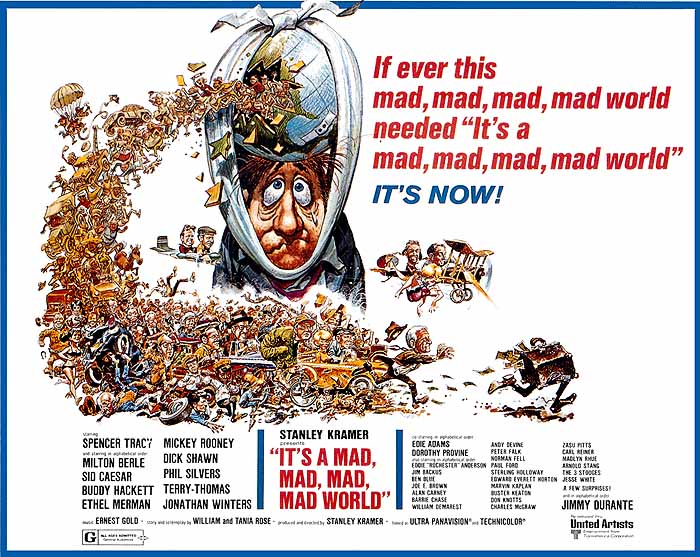
It's a Mad, Mad, Mad, Mad World (1963)

Is that enough Mads?
Stanley Kramer was a well-known producer/director who had made his name directing very serious, socially relevant movies: The Defiant Ones (1958), Inherit the Wind (1960), and Judgement at Nuremberg (1961). But in 1963, Kramer did something no one expected- He made a hit comedy.

Mad follows the stories of five groups of motorists who come across accident victim Smiler Grogan (Jimmy Durante in the first of an onslaught of classic comedian cameos in this film) who literally kicks the bucket (setting us up for the level of comedy to come), but not before he reveals the hiding place of a stash of ill-gotten cash in Santa Rosita State Park. The rest of the film is a madcap chase across California to get the money and get rich. Included in the pursuit is soon-to-retire lawman Capt. T.G. Culpepper (Spencer Tracy) whose loyalty to law and order is sorely tested.

The cast is a who's-who of Hollywood comedians: Sid Caesar, Milton Berle, Buddy Hackett, Jonathan Winters, Terry-Thomas, and Phil Silvers along with comedic actors: Ethel Merman, Mickey Rooney, Dick Shawn, Jim Backus, Eddie Rochester Anderson, Edie Adams, and Dorothy Provine. The aforementioned cameos are equally impressive with appearances by Jack Benny, Joe E. Brown, Andy Devine, Edward Everett Horton, Buster Keaton, Jerry Lewis, and The Three Stooges.

If this number of funny notables seems overwhelming, it is. The film is a series of Borscht Belt sketches strung together by California blacktop. But it doesn't matter. It's hysterical.

Lending poignancy and gravitas to the proceedings is Tracy, who isn't really thought of as a comedic actor despite his brilliance in the Hepburn-Tracy delicacies of the 40's and 50's. Tracy leavens the rampant scenery chewing going on around him with Culpepper's world-weariness and crisis of conscience.

The final scene of the film is legendary and proves that the remedy for pain and suffering can be as simple as a banana peel.


Blazing Saddles (1974)

In an irreverent comedy environment filled with Adam Sandler, Seth MacFarlane, and South Park fare, we sometimes forget that there was a time when line-crossing comedy was rejected by Hollywood. But in 1974, birthday boy Mel Brooks (he turned 90 on Tuesday!) directed what was then considered a comedy shock-fest. Blazing Saddles is a spoof on the classic Western movie genre- but it's something more than that. The little town of Rock Ridge is right in line with the advancing railroad and land-hungry Attorney General Hedley (not Hedy!) Lamarr (Harvey Korman) decides that the best way to get rid of the denizens of Rock Ridge so he can buy up their property is to send them a new sheriff... who is Black.

Enter Sheriff Bart (Cleavon Little) who, with the assistance of washed-up gunslinger The Waco Kid (Gene Wilder) wins the respect of the town and takes on Hedley's gang of thugs (including Slim Pickens as flatulant Taggart, Alex Karras as monosyllabic Mongo, and the divinely tired Madeline Kahn as teutonic songbird Lili Von Shtupp) to save the day.

Amidst the schnitzengruben and fart jokes, Saddles does something really controversial- it takes on the  issue of race. More than just throwing around the N-word, Brooks uses it to make us see how ridiculous racism is.

Little does a wonderful job of playing a class clown who uses humor to break down the racial divide, becoming as big a Western hero as John Wayne- who incidentally turned down a role in the movie because the material was too blue- but famously said he'd be the first one in line to see it.

Murder by Death (1976)

Neil Simon is f-ing funny. Well-known for his television writing for Sid Caesar and hit Broadway comedies like Barefoot in the Park and The Odd Couple the man knows how to pen a joke and create wacky characters. So it should come as no surprise that Simon's Ten Little Indians spoof full of characters that are spoofs of famous detectives is a hoot. The world's greatest detectives have been summoned to the castle of Mr. Lionel Twain (the inimitable Truman Capote) to solve a murder that hasn't happened yet. Will the next murder be their own?

The list of actors playing these send-up sleuths is enough to make you titter: Peter Falk as Sam Diamond along with Eileen Brennan as his Girl Friday; David Niven and the sublime Maggie Smith as Dick and Dora Charleston; Peter Sellers as Sidney Wang (yes, he's doing yellowface- but he's really funny anyway); James Coco as Belgian Milo Perrier and a young James Cromwell as his chaffeur; glorious Elsa Lanchester as Jessica Marbles and her nurse (who Jessica actually takes care of) played with elderly puckishness by the eternal Estelle Winwood.

Filling out the cast are Alec Guinness as a blind butler named Bensonmum and a deaf mute maid played by Nancy Walker.

With a set-up like that, the laughs are guaranteed.


The Cannonball Run (1981)

As a kid growing up in the '70's in the Midwest I was exposed to lots of cars. And not just in my dad's garage- but on TV and in the movies. Nothing spelled overt masculinity like the General Lee on The Dukes of Hazzard or Burt Reynold's Firebird in Smokey and the Bandit (1977). So when a movie came out about a cross-country car race, I was required to see it in order to maintain my manhood. Lucky for me, Cannonball had just as much comedy as it had testosterone.

JJ McClure (the mustachioed wonder himself Burt Reynolds) and his pal Victor Prinzim (corpulent clown Dom DeLuise) are bound and determined to win the illegal road race called the Cannonball- even if they have to pretend to be paramedics so they can drive above the speed limit without being bothered by all those smokeys. But these two jokers aren't alone.

There is plenty of competition- and I mean plenty. Roger Moore, Dean Martin, Sammy Davis Jr., Adrienne Barbeau, Terry Bradshaw, Mel Tillis, Jackie Chan, Bert Convy, and Jamie Farr all hit the road to win the prize and out drive and outsmart each other. Barroom brawls, boob jokes, and a long-fingered proctologist (played by wonky-eyed Western star Jack Elam) ensue.


One of my favorite parts of Cannonball is the compulsory blooper reel during the final credits. There's nothing better than watching Reynolds and DeLuise unable to maintain a straight face around each other. It makes you wonder how they were ever able to finish the movie.


Wherever you are, Little Brother, I hope you have unlimited access to the movies that make you laugh.


Friday, June 17, 2016

Top 5 Big Daddies

Does anyone else think of their fathers in terms of movie stars? Maybe it's because the first movie I remember seeing with my dad was Escape from Alcatraz (1979), but I always felt that my dad had a Clint Eastwood vibe to him. Eastwood was lean, quiet, and direct. His eloquence came from action.

He seemed to be a man raised from the earth, who sought out justice- or at least his idea of it. That is my dad. I mean, my dad never shot up Mexican towns (that were actually in Italy), snarled a catch-phrase while pulling out a handgun, or drove a pick-up truck with an orangutan. But he did give hell to sports teams on the TV, come up with a quick a speech before a spanking, and his pick-up truck usually had four kids in the back. Whatever the reason, I can't help but think of my dad when I watch a movie with Clint Eastwood.

In honor of Father's Day, here are my Top 5 cinematic fathers to compare your dads to:

Home from the Hill (1960)


Would you be surprised if I told you that Vincente Minnelli directed an East Texas melodrama exploring the nature of father-son relationships and the expectations of masculinity? That doesn't have any musical numbers? Well he did. Home from the Hill is the story of the Hunnicutt family: big-booted, woman-chasing patriarch, Captain Wade (the always watchable Robert Mitchum); long-suffering turned to ice-queen mother, Hannah (the also always watchable Eleanor Parker); conflicted son, Theron (the always tanned George Hamilton); and illegitimate son, Rafe (the always- well whatever George Peppard always is.) The plot is pure Texas mythology with wild pig hunts, barbecues, and squalid affairs making life on the prairie a hoot and a holler.

In another director's hands, this film could be all about how a boy becomes a man under the watchful eye of his father. But Minnelli doesn't buy that idea at face value. Theron is more sensitive than his dad and questions the manly shadow he's expected to cast alongside his legendary father's. Mitchum without doing or saying anything exudes the kind of easy masculinity that so many of us sons can never achieve- and watching Hamilton's slight build try to fit in his boots is uncomfortable- as it should be.

Minnelli's genius ability to compose space that reflects character and theme is on full display here. Mitchum's den holds all the accouterments of the world's most exciting man- stifling all who enter. Theron's more studious space is a counterpoint to the boarshead and bear rugs just downstairs. Minnelli expertly makes these personal spaces speak volumes about their inhabitants- and their incongruity- their separateness existing beneath the same roof.

The exquisite balance between performance and filmwork makes Home worth coming back to.

And the barbecue will make you super hungry!


Big Fish (2003)


There is nothing more enchanting than a good story teller, and Tim Burton has woven some doozies in his time. With Big Fish, Burton tosses away the cartoon-ish trappings of his film work and tells the story of a man who has spent a lifetime telling tall tales and his son who is desperate to believe them.
Ed Bloom (Albert Finney) loves to tell a good story- his favorite repeatable yarn dealing with a giant fish in the local lake that he has been having run-ins with his whole life. Ed is also dying. His only son Will (Billy Crudup) and his pregnant bride (Marion Cotillard) come to help Will's mom (Jessica Lange) take care of Ed as he weakens. Everyone loves Ed and his stories, his eyes wickedly glinting at his new daughter-in-law as she sits on his bed. Who wouldn't wickedly glint at Marion Cotillard?

But Will is tired of the stories. Will wants to know his father- the real man- not the folk tale legend (played as a youth by Ewan McGregor) who met giants, discovered hidden towns that didn't wear shoes, faced- off with a witch (Helen Bonham Carter), wooed the girl of his dreams with a football field of daffodils, and finally caught that old monster fish in the lake.

But what if we are the stories we tell? What if the truth is there- and the story leads us to the discovery of that truth in a way that simply flipping through a photo album or answering questions about dusty papers can't? Perhaps a life well-lived is a story well-told.

Just the cast list is reason enough to see this movie. They are all gems. But Burton really makes a unique film in the context of the rest of his canon. He does an amazing job of weaving in the fantastic without making it overwhelm the simple story of a son re-connecting with his father. He innately understands that the joys of the imagination are not just for children. It is the most adult movie he's ever made- and I challenge anyone not to cry at the end.

Tree of Life (2011)


I know that this movie is one of those love it or hate it situations- but I love it... most of it. Director Terrence Malick tends to infuriate some with his specialized way of filming his stories. But I have always been drawn to his use of image over dialogue. And Tree of Life is no exception. The timeline for Tree is malleable and flips back-and-forth from modern day to 1950's Texas to the beginning of the universe to death. That's a lot to cover- and quite honestly, I could have done without the Discovery Channel-esque "How the World Began" section. But Malick uses the story of Jack (dependably moody Sean Penn), a man haunted by the suicide of his brother and his relationship with his father (Brad Pitt) to visually explore the things that we take and those that are given to us throughout our mortal journeys.

What really grabbed me about this movie was Malick's use of the tactile. Closeups on young Jack's hands tracing his brother's hand on the other side of the window or how a father touches a son's head. The film is so beautiful in how it communicates this human contact in a simple, connective way. It shows deep bonding without a lot of "I love you, kiddo" dialogue.

Pitt is very much responsible for the success of that image of a father and sons. The way Pitt touches his children is so tender and natural- it brought tears to my eyes. I at once felt the warm joy of those touches- while simultaneously running through my memories for the times my dad tousled my hair. Pitt is a father of- God I've lost count of the number of his brood- but he was clearly able to tap into that feeling of elation and pride of being with his kids. It radiates from him in the scenes with his cinematic sons like a soft light. It's magical.

The film won the Palm d'Or at Cannes and was nominated for three Oscars including Best Director and Best Picture, so clearly CGI dinosaurs notwithstanding, the film struck a chord. The image of the neighborhood children running through the mist of an insecticide truck in the twilight is durable marking our childhoods as moments of wonder shrouded by hindsight.

Bicycle Thieves (1948)


I love the post-war neorealism film genre. The almost gothic look of these films shot in the rubble of war-torn Europe made a profound setting for stories of survival and change. Like flowers sprouting out of decimated churches and homes, the characters in these movies were survivors learning how to get along in a world that had gone mad- and was now trying to right itself. Vittorio De Sica's Bicycle Thieves is a perfect example of the best this genre has to offer.

Antonio (Lamberto Maggiorani) is desperate to find work to support his family in post-WWII Rome. He finally is able to get work as a poster paster (say that five times fast) but he needs a bike to be able to get around town quickly. His wife Maria (Lianella Carell) pawns her dowry (Sheets. You could pawn sheets.) so that Antonio can get a bike and start making money. But no sooner does he start work, then someone steals his bike- and Antonio and his young son Bruno (Enzo Staiola in his film debut) begin a desperate hunt all over Rome for the thief and the bike.

The relationship between these two is central to the film. As the father struggles to do whatever it takes to survive, he also has to teach his son the difference between right and wrong. Some of those choices are reflected in little Bruno's eyes as he watches his father grapple with a new, lawless world. Is it better to steal than starve? Is there anything thicker than blood? Can a father lose his son's love and respect?

The realistic shooting style was all the rage in Europe- as much a product of necessity as artistic style- and De Sica perfectly captures a sense of the real Roman streets and people at the time.
There is no attempt made to clean-up dirty faces or knees- or to pretty up the buildings ravaged by war. De Sica shoots Rome as it was- poverty-stricken, proud, and struggling to find a new identity. The fresh and spontaneous performances from mostly non-actors are all superb in drawing us into a filmed reality. It was a reality that most modern audiences probably can't imagine. But thanks to directors like De Sica, we have movies to remind us.

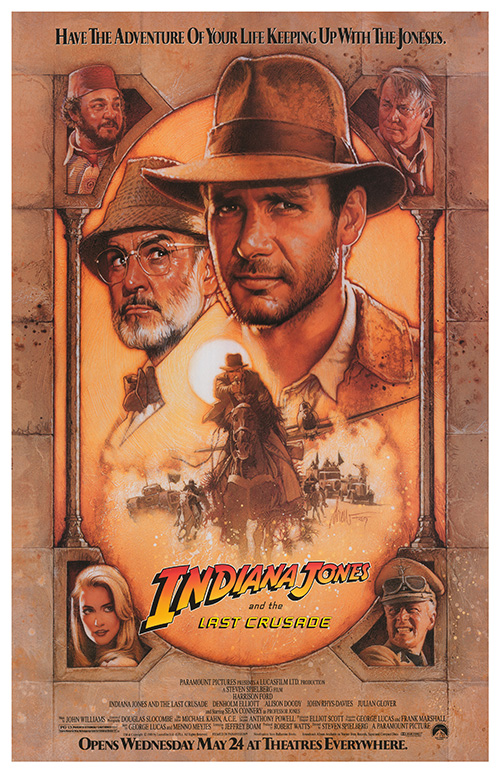
Indiana Jones and the Last Crusade (1989)


There are moments when I wish I could be in the pitch meetings for famous movies.

Some pitch guy: So we've had mega blockbuster success with Indiana Jones. We had him search for the Ark of the Covenant and fight Nazis, and then we sent him to India to find some magic rocks and fight an Indian cult-


George Lucas (eating a burrito): I still don't know what we were smoking on that one.

Steven Spielberg: Ssh, George! And stop eating. Continue pitch guy.

Some pitch guy: So for this next movie why don't we have Indy fight the Nazis again- but this time he does it with... his Dad!


George and Steven: No.

Some pitch guy: But he's looking for the Holy Grail.

George and Steven: No.

Some pitch guy: But what if the dad is played by Sean Connery?

George and Steven: Brilliant!

Steven: Great idea, George!


George: Thanks, Steven! Glad we thought of it. Pitch guy, I need 24 chalupas. Do a Taco Bell run.

Keeping a successful franchise going isn't as easy as our current Marvel Universe makes it seem- but the Indiana Jones movies have always been great fun to watch (with the exception of number four. I pretend number four never happened). In the third entry, The Last Crusade, Indy (Harrison Ford, of course) is busy teaching college when he is informed that his father (the afore-mentioned Connery) has disappeared while searching for the Holy Grail. So Indy slaps on his fedora and bullwhip and goes out to rescue him. Along the way he runs into the Third Reich again, and literally, Hitler.

The movie is full of the biblical lore, beautiful period design, exotic locales, and non-stop action that made the previous movies so successful. But what sets this one apart is the interaction between the two Joneses.

Ford and Connery while playing two people often at odds with each other, seem to be having a blast. The relationship they create is funnily combative with just the right amount of treacle- enough to not make either of these guy's guys gag. Both of them are such big stars that they could eat up all the screenspace- but they don't. They share the film with what looks like pleasure, creating a father-son relationship that highlights what each can learn from the other. And can't we all benefit from being tied to our dads in a fiery castle every now and then?

If those aren't enough father figures for you, check out the Charlie Chaplin silent classic The Kid (1921) at The Film Forum this Sunday.

Happy Father's Day, Pops.