Tuesday, July 17, 2018

You Kiss Your Mother With That Mouth?: Savage Grace

Sometimes ignorance is bliss. A couple weeks ago, one of my friends recommended I watch Savage Grace (2007). I vaguely remembered the title- and once I recalled Julianne Moore was in it- I was good to go. I would watch La Moore poop in a can- and for all I know, that happens in the upcoming Bel Canto (2018). What I'd forgotten was that this was the somewhat infamous based-on-a-true-story film about an uncomfortably close relationship between a mother and son. I didn't look any further into it than that- and I'm glad I didn't- cause the ending made my jaw drop.

Savage Grace recounts the life of our narrator, Antony Baekeland (Eddie Redmayne), heir to the Bakelite fortune and apple of his omnipresent mother's eye. Barbara (the aforementioned not-pooping Julianne Moore) has shifted her affections to her son because her icy husband (the nicely built Stephen Dillane) is tired of her social-climbing and philandering. As Antony tells us, "I was the steam when hot meets cold." As we watch Antony's story unfold, we realize that steam can cloud and confuse what we see.

What made Savage Grace so interesting to me was the classic style in which director Tom Kalin shot it. I don't just mean the beautifully realized period costumes and exotic European hotspots from the Forties to the Seventies that populate the film. For a film that is so much about sex, we see very little of the act. Glances, touches, and cuts to "the next morning" take the place of our seeing what actually happens when passions become unmanageable.

Classic movies did this to avoid the evil red pen of Joseph I. Breen. But Kalin does it to allow our imaginations to fill-in the blanks. When we do catch these moments, Kalin focuses more on faces than on bodies. It is not about the act- it is about what is going on internally for this fucked-up family.

Objects also receive unusual focus in the camera frame. Whether it's the dog collar of a long-dead pet, a record player, the serving of morning tea, or the accoutrements of a failed suicide attempt, objects hold the permanence in this story over the people. This is after all a memory play- and memory thrives on physical anchors. Throw in some mirrors and portraits and in style, Savage Grace feels like a Minnellian or Sirkian melodrama but with content that far exceeds anything classic Hollywood could have produced.

Moore is absolutely magnetic as the emotionally starving Barbara, and Redmayne gives a wounded, natural performance free of the tics and tricks he's picked up lately. If you don't know about the true story, I recommend waiting to research it until after you've seen the film. Trust me. Give yourself a little surprise in a world that has become reliably insane.

Wednesday, July 11, 2018

Babsolutely Babulous

I'm a binge-watching failure. When it was announced that six of Barbra Streisand's television/concert specials along with a special edition of A Star is Born (1976) would be released on Netflix on June 15th, I should have set time aside in my funemployment schedule to watch them all and immediately report back to my faithful readers.


Well... I'm doing that now... almost a month later. In my defense, it was a much more all-consuming task than I first thought- and I needed to make time to see Liz Taylor and Mia Farrow in Secret Ceremony (1968). I became so guilt-ridden over not finishing all the shows that I dreamed about having dinner with Barbra and breaking her toilet.

But better late than never as they say.

For your Babs binge-ing pleasure, here is my ranking of the six classic specials and the most recent Netflix-produced concert special- Best to Not As Best:

Barbra Streisand: A Happening in Central Park (1968)

Fresh from shooting Funny Girl (1968), Streisand flew back to New York City in June of 1967 to perform in Central Park in front of 135,000 fans- okay maybe it was 150,000- but who other than Barbra is counting?
Streisand is literally a force of nature. As she sings the winds rise, her gown billows, and her voice soars. Totally in her element she is assured, funny, and seemingly relaxed- like the calm before the approaching storm both literally and figuratively. In a little over a year she would become a Hollywood superstar and Oscar-winner with the release of Funny Girl.

Broadcast in September 1968 on CBS (appropriately timed with the release of Funny Girl) the special  included some of her best-known hits of the time (and her version of Silent Night?) and picked up an Emmy.


Barbra: The Concert (1994)

When it was announced that Streisand was going to return to live performance after a 28 year absence, her fans went bat-shit and all 18 shows sold out in an hour. Starting with a New Year's show in Las Vegas in December of 1993 and culminating with her "last" show in Anaheim in July of '94, the tour was a great success with a bout of laryngitis thrown in for some drama at the end. If you don't believe me, watch the tour promotional videos woven throughout the concert.

The HBO special was shot at her final show in Anaheim, and it is superb. Streisand is no longer the young lady with the big voice singing her heart out to get noticed by Hollywood. She is now a legend- the veritable priestess of American voice whose movies and career garner worldwide attention no matter how good or meh they are. Streisand is in full control... of everything- including her audience patter- rehearsed and planned for desired effect.

La Streisand has the deep musical history to fill an over two hour show with recognizable standards- many of which she made famous. Marvin Hamlisch's brilliant arrangements and song selection are all sung with a mastery that no one can match- no, not even Celine Dion. When Streisand duets with her younger self in the final scene of Yentl on a giant video screen, the audience explodes. It is Streisand's emphatic declaration that she was there, and she is still here. The special would go on to win 5 Emmys.


My Name is Barbra (1965)

Here she is! That plucky Brooklyn girl you've all heard about is ready to take on the world in her first musical television special!

Imagine a time when Barbra wasn't a household name. Well, in this 1965 CBS special, Babs launched herself into American living rooms with the hopes of changing all that.

It's really amazing to watch her vitality and her youth- and that voice! While the first two sections of the special are staged and in my opinion are only saved by a selection of Halston hats in the Bergdorf Goodman, the last section is a triumph. Barbra just sings- and it's transcendent. The voice is pure, and hungry, and at this point she hadn't sung "My Man" five bajillion times.

Color Me Barbra (1966)

After the success of My Name is Barbra CBS jumped at the chance to team with Barbra and producer  Martin Erlichman again in March of 1966 for a COLOR special. What better way to show off the abilities of a color TV set than to have Barbra run through the Philadelphia Museum of Art? Like its predecessor, the sketch portion of the program (including a "circus" set) feels forced- with the exception of Streisand's mod "Gotta Move" number. The fireworks start in the final segment when Streisand drops the schtick and just sings.

Barbra: The Music... The Memries... The Magic! (2017)

Streisand inked a lucrative deal with Netflix to produce a special for her 14 city tour in 2016 promoting her most recent Broadway duets album. Previous specials could skirt Barbra's age, but at this point she is 74. And while the top registers and clarity of her younger voice are strained, Streisand wisely dials those aspects down and focuses on her other genius ability- as an interpreter of songs. She knocks "You Don't Bring Me Flowers" and "Losing My Mind" out of the park- even if she can't hold that last note from "Don't Rain on My Parade" like she used to.

Stick around for the video in memoriam for her beloved Coton de Tulear, Sammie. It's so overly produced, it feels like a parody video. But it only takes a quick YouTube search to discover that Barbra's not alone in this sort of tribute to her four-legged best friend.


Barbra Streisand... and Other Musical Instruments (1973)

This show is just plain weird. Airing in November of 1973, the concept was that Streisand would transcend her Broadway/standard catalogue and sing along to music from different countries. It's sort of like "It's a Small World" on LSD with Streisand doing an international costume change every couple of minutes. Her African wig was a bad idea- even then- but Streisand seems game to try anything even performing with a computer.

What really saves this special are her duets with Ray Charles. It seems a strange combination at first- not unlike Der Bingle and David Bowie crooning Christmas carols together. But Streisand jumps into the numbers with gusto- and explores the gospel/soul layers of her voice- something she would continue to do throughout the '70's.

Barba Streisand: Timeless Live in Concert (2000)

Have you ever wanted to end the millennium with Barbra? New Year's Eve 1999/2000 in Las Vegas was your chance. The MGM Grand was decked out in a pyramid and three giant, moving video screens to accommodate Streisand and Kenny Ortega's concept of- well I honestly have no idea what their concept was.

There's an opening skit where a mini-me Barbra shows her early pluck before adult Barbra appears on stage to sing with her- all while Brother Time (an immensely talented but wasted on this show Savion Glover) tap dances around whenever Streisand is in need of a costume change or a countdown.

Barbra's in fine voice but the attempt to do something better or different from previous shows comes off more like she doesn't trust her audience to just sit and listen to her. Trust me, Babs. We'll listen and enjoy. Emmy voters did. They gave the special 4 Emmys.


If that's not enough Barbra for you, the 1973 remake of A Star Is Born is also available on Netflix with additional footage. But don't say I didn't warn you...


Friday, June 1, 2018

Hedy & Edies

Last week I escaped my real life by watching the real lives of famous people. I can't really compare my life to classic film star Hedy Lamar, but if funemployment goes on much longer, I may have something in common with the legendary Big and Little Edies of Grey Gardens.


Here are my reviews of Bombshell: The Hedy Lamarr Story (2017) and That Summer (2017).

Bombshell: The Hedy Lamarr Story

I'll be honest. Even as a self-described classic film nerd, I was only marginally aware of Austrian film actress Hedy Lamarr. I knew about her controversial nude swimming scene in Ecstasy (1933) and her lawsuit against Mel Brooks for making fun of her name in Blazing Saddles (1974). (Mel loved her so much he just paid her. He figured she'd earned it by giving the world such "cinematic pleasure.") I could pick Hedy out of a lineup, but I had not seen most of her movies. In Bombshell, I learned her beautiful face, figure, and film career were just part of her story.

Born in Austria, Lamarr's natural beauty got her attention early on, and she started appearing in movies by the age of sixteen. At nineteen, she married prominent munitions manufacturer, Fritz Mandl, as one does. It being 1933 and all, Austrian munitions meant doing business with the Third Reich and state visits from Mussolini. Lamarr was Jewish, so she put two and Jew together and snuck out of her posh mansion in the middle of the night and high-tailed it to London. Her risqué scenes in Ecstasy caught Louis B. Mayer's attention, and soon the Austrian-accented beauty was brought to America to add her unique looks and style to Hollywood films until she retired in 1958.

The bombshell that Bombshell drops is that in addition to being a movie star, Lamarr was also a very talented inventor. Raised in her father's chemistry lab, Hedy had a keen scientific mind and was eager to join the war effort against the Nazis.

She helped develop a technology called frequency hopping to prevent Germans from scrambling radio signals that guided American torpedos to their target. While there was some propaganda coverage of her invention, nothing was actually done with it at the time (it included using something like a paper player piano roll). Later, her work was used to create a little thing we now know as wi-fi. Of course, because she was just a gorgeous film actress, she was not credited for her contribution for decades.

The documentary is a beautiful tribute to Lamarr's work both on-screen and off. In particular, the use of audio recordings made toward the end of her life add an authentic, human touch. Her films are not usually cited as memorable examples of great Hollywood filmmaking. Algiers (1938), Boomtown (1940), and Ziegfeld Girl (1941) stand out as good examples of the successful classic Hollywood style, and White Cargo (1942) and Samson and Delilah (1949) as examples of its excesses. It is Bombshell that will insure Hedy Lamarr has a permanent place in Hollywood history.

That Summer (2017)

I adore the documentary Grey Gardens (1975). Big and Little Edie of the titular East Hamptons decrepit manse have always held a hypnotic spell over me. Their ability to live so convincingly (and tragically) in a dream world of their own devising exemplifies how the human spirit can remake itself into whatever it wants no matter the circumstances. So when I heard there was a sort of prequel to the Maysles Brothers masterpiece, I grabbed a hand towel and a broach and headed to the IFC Center.

That Summer is directed by Goran Olsson from footage taken in 1972 by photographer Peter Beard. Beard and Beale relative Lee Radziwill were hoping to make a documentary about the reclusive and eccentric Beales, but after four reels the project was shelved. Two of their camera crew, Albert and David Maysles, would pick up the torch. The Maysles documentary would become a landmark in documentary filmmaking, while Beard's footage was assumed lost and collected dust.

Olsson bookends the now recovered four reels with the background of Beard and Radziwill and the artsy crew they hung out with. Yes, that's Andy Warhol, Paul Morrissey, Truman Capote, Mick and Bianca Jagger and even little JFK Jr. and Caroline hanging out on the beach. But the real focus is the two grand dames of Grey Gardens.

That Summer is like finding a box of old photos that you have never seen before of friends you know and love. There are Big and Little Edie as vibrant, peculiar, and irascible as we remember them. Little Edie poses in her trademark Frankenstein fashion style, vowing in whispers that she has to get the "H" out of here.

Big Edie hobbles around shooing cats away from her portrait and howling, "Edie!" in such a way that it rings throughout space and time. And the raccoons pop up through holes in the roof to eat the Wonder bread that Little Edie tosses to them.

There is nothing revelatory here. No dark secrets unearthed. We do finally meet the dreaded East Hampton Health Department, but otherwise, That Summer is not the in-depth documentary masterwork that Grey Gardens is. Olsson is showing a home movie rather than a character study. But it doesn't matter. Any time spent with these two extraordinary women is a welcome visit to a place and time that is sadly gone except for what celluloid has preserved.

I guess I accidentally had a feminism double-feature that deals with women who were so much more than what society expected of them. #westillhavealongwaytogo

Friday, May 25, 2018

Calling Gloria!: Film Stars Don't Die in Liverpool

I have a love-hate relationship with Hollywood bio-pics. I love the meta-ness of sharing Hollywood history with an audience on the big screen. There's something especially ironic about telling the stories of our movie stars in the movies. But I hate when audiences take these often fact-stretching tales as the gospel truth now and forever. (I'm looking at you Mommie Dearest!) So when I heard they were making a movie about film noir queen Gloria Grahame, I was both clapping my hands in glee, and practicing my patented "what is this shit?" eyeroll.

Grahame was a true original. Born and bred in L.A., she was a beautiful blonde with a nice pair of stems and a great pout. But what made Grahame stand out in the Forties and Fifties was the voracious sexuality that was barley concealed beneath her lipstick. While Marilyn Monroe made a career of offering up a soft sensuality that men craved, Grahame's feline passion enticed- then devoured. It was tailor-made for the Freudian femme fatales of the film noir era, and her complex creations got critical notice, earning her two Oscar noms, winning once.

But if you thought Grahame's screen persona was provocative, it was nothing compared to her personal life: Botched plastic surgery, rumored ravenous sexual appetite, nervous breakdowns, electroshock therapy, four tumultuous marriages- one to volatile director Nicholas Ray and later to her stepson from that marriage, breast cancer battle, and the inevitable struggles to maintain an acting career in Hollywood when you're deemed to be past your prime. Gloria's life had everything you need for a good bio-pic. Too bad Film Stars Don't Die in Liverpool (2017) didn't include any of that.

Based on the autobiography of the same name, Film Stars tells the story of how young actor Peter Turner (Billy Elliot all grown-up and jacked- Jamie Bell) met Grahame, falling in love and carrying on an affair with her for the last couple years of her life. Cinematically styled flashbacks abound between 1981 and 1979, but there is nothing about Grahame's life before she met Peter- no vivd display of the road that led Grahame to the dinky dressing room she occupied on the English theater circuit.

One brief, crackling dinner scene with Grahame's mother (hello Vanessa Redgrave!) and sister hints at the shock and the scandal that preceded dear Peter, but it's a temporary fix that leaves the audience wanting more.

Some bios-pics like My Week with Marilyn (2011) and Lincoln (2012) successfully condense what made a historical figure historical into a small moment of time, but Film Stars focuses on the moment- and it's just not as interesting as the rest of Grahame's life. Annette Bening does a spectacular job of translating Grahame's screen tics and affectations into the personal, but it's not enough to keep Film Stars from dying in Liverpool... and everywhere else.

For a look at what made Grahame worth the bio-pic treatment, here are my Top 5 Grahame Crackers!:

1.) A Lonely Place (1950)
Then husband Nicholas Ray directed Grahame and Humphrey Bogart in this queasy look at an abusive relationship, where love may be hiding a murder. Some of the plot points hit a little too close to home for Grahame and Ray.

2.) Sudden Fear (1952)
Joan Crawford's new husband (the slickly grinning Jack Palance) may not be in it for love- but for money. When Grahame shows up, we know it's the money. Crawford is outstanding in this "wait until the ending" thriller.

3.) The Bad and the Beautiful (1952)
Grahame nabbed the Best Supporting Actress Oscar for playing a southern belle sucked into the Hollywood meatgrinder while her screenwriter husband (Dick Powell) was distracted by rapacious producer Jonathan Shields (the Cleft himself- Kirk Douglas.) Lana Turner's stormy car drive is not to be missed.


4.) The Big Heat (1953)
Grahame learns the hard way not to piss off Lee Marvin when he's holding a coffee pot. Fritz Lang directs this excellent noir with Glenn Ford starring.

5.) The Cobweb (1955)- Vincent Minnelli directs a star-studded looney bin, with Grahame playing the neglected wife of the facility's psychiatrist (Richard Widmark). For the love of God, someone change those curtains!

Monday, May 7, 2018

God's Own Country or Brokeback Yorkshire

I love the English. There's just something about that accent that turns my spine to custard. So it's no surprise that I love gay English movies. Maurice (1987), Beautiful Thing (1996), Weekend (2011), and Handsome Devil (2016) not only provide plenty of eye and ear candy, but there's something about how the emotionally reserved English tell stories about gayness that feels so poignant and vital.
You may add God's Own Country (2017) to that list.

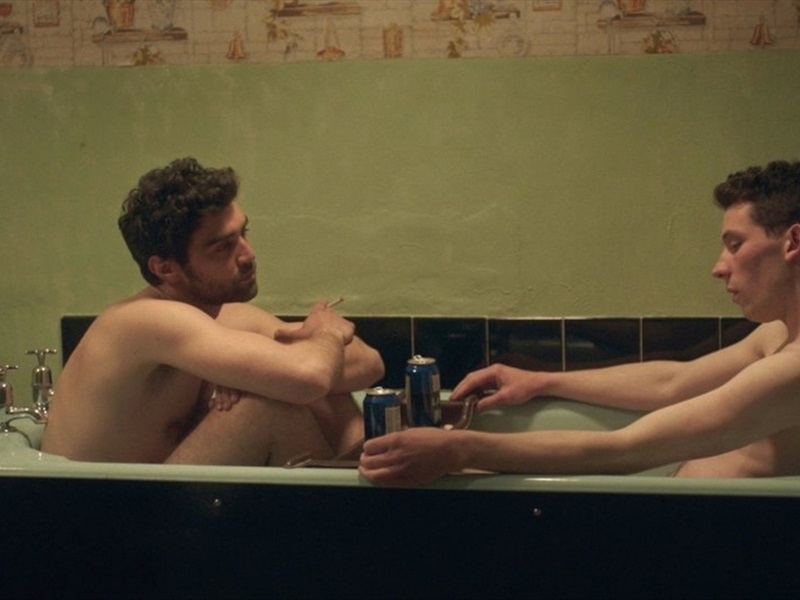
GOC takes place in West Yorkshire where the only thing tougher than the topography and the accent is the people. Johnny (the lanky and somber Josh O'Connor) is right well fooked. He is trapped working on his family's struggling cow and sheep farm. His mother left the scene years ago and his dad is a grouchy, cane-wielding overlord (Ian Hart) taken care of by his hard-nosed Nana (Gemma Jones). And if all that's not bad enough, Johnny's in the closet. Not known for its thriving gay community, West Yorkshire is as much a prison for Johnny's heart as his body. In spite of all that, Johnny's not much of a sympathetic character.

The first glimpse we have of dear Johnny is him unloading last night's alcohol into the toilet. He's an asshole drunk who shouts like a bully and sulks like the world's worst teenager. With all the ardor of a dog in heat, he screws a local in a cow trailer- spit and shoves filling-in for romantic gestures. Johnny believes his love life to be as grim as everything else around him, so there is no chance that he will fall in love with these brief conquests. Until Gheorghe.

The family hires a Romanian immigrant to help with lambing season. Gheorghe (the striking Alec Secareanu) is a man of few words and a tender knack for birthing lambs. Johnny and Gheorghe are sent off to the far reaches of the farm to manage the flock and in no time, Johnny attempts his typical backroom style hook-up.

But Gheorghe will not be treated as a conquest and is powerful enough to force Johnny to let down his walls and let him inside. For the first time Johnny experiences soul-stirring passion with another man- but is there any hope for these two lovers in this place?

Directed by Francis Lee the film is beautiful in its bleakness and brevity. Images of touching and glances communicate more than any of the character dialogue. This unadorned quality leaves an air of fresh reality, with no grand speeches or orchestral flourishes to sweeten this difficult love story.

GOC came out in January, 2017 at the Sundance Film Festival and was overshadowed by the other big gay movie in the festival, Call Me by Your Name. GOC and CMBYN are interesting films for comparison. Where CMBYN feels like an inevitable romance in a rarefied Italian countryside, GOC is at times a painful struggle in an unforgiving landscape. What CMBYN hides in dialogue, GOC reveals in silence. Where CMBYN uses fruit allegory and eschews images of the object of desire, GOC strips down the male form unashamedly. Even though I think CMBYN sucked all the air out of the gay film room last year, it's great that the film industry is making such diverse views of gay life- and doing it so well. It has indeed gotten better.