Friday, May 25, 2018

Calling Gloria!: Film Stars Don't Die in Liverpool

I have a love-hate relationship with Hollywood bio-pics. I love the meta-ness of sharing Hollywood history with an audience on the big screen. There's something especially ironic about telling the stories of our movie stars in the movies. But I hate when audiences take these often fact-stretching tales as the gospel truth now and forever. (I'm looking at you Mommie Dearest!) So when I heard they were making a movie about film noir queen Gloria Grahame, I was both clapping my hands in glee, and practicing my patented "what is this shit?" eyeroll.

Grahame was a true original. Born and bred in L.A., she was a beautiful blonde with a nice pair of stems and a great pout. But what made Grahame stand out in the Forties and Fifties was the voracious sexuality that was barley concealed beneath her lipstick. While Marilyn Monroe made a career of offering up a soft sensuality that men craved, Grahame's feline passion enticed- then devoured. It was tailor-made for the Freudian femme fatales of the film noir era, and her complex creations got critical notice, earning her two Oscar noms, winning once.

But if you thought Grahame's screen persona was provocative, it was nothing compared to her personal life: Botched plastic surgery, rumored ravenous sexual appetite, nervous breakdowns, electroshock therapy, four tumultuous marriages- one to volatile director Nicholas Ray and later to her stepson from that marriage, breast cancer battle, and the inevitable struggles to maintain an acting career in Hollywood when you're deemed to be past your prime. Gloria's life had everything you need for a good bio-pic. Too bad Film Stars Don't Die in Liverpool (2017) didn't include any of that.

Based on the autobiography of the same name, Film Stars tells the story of how young actor Peter Turner (Billy Elliot all grown-up and jacked- Jamie Bell) met Grahame, falling in love and carrying on an affair with her for the last couple years of her life. Cinematically styled flashbacks abound between 1981 and 1979, but there is nothing about Grahame's life before she met Peter- no vivd display of the road that led Grahame to the dinky dressing room she occupied on the English theater circuit.

One brief, crackling dinner scene with Grahame's mother (hello Vanessa Redgrave!) and sister hints at the shock and the scandal that preceded dear Peter, but it's a temporary fix that leaves the audience wanting more.

Some bios-pics like My Week with Marilyn (2011) and Lincoln (2012) successfully condense what made a historical figure historical into a small moment of time, but Film Stars focuses on the moment- and it's just not as interesting as the rest of Grahame's life. Annette Bening does a spectacular job of translating Grahame's screen tics and affectations into the personal, but it's not enough to keep Film Stars from dying in Liverpool... and everywhere else.

For a look at what made Grahame worth the bio-pic treatment, here are my Top 5 Grahame Crackers!:

1.) A Lonely Place (1950)
Then husband Nicholas Ray directed Grahame and Humphrey Bogart in this queasy look at an abusive relationship, where love may be hiding a murder. Some of the plot points hit a little too close to home for Grahame and Ray.

2.) Sudden Fear (1952)
Joan Crawford's new husband (the slickly grinning Jack Palance) may not be in it for love- but for money. When Grahame shows up, we know it's the money. Crawford is outstanding in this "wait until the ending" thriller.

3.) The Bad and the Beautiful (1952)
Grahame nabbed the Best Supporting Actress Oscar for playing a southern belle sucked into the Hollywood meatgrinder while her screenwriter husband (Dick Powell) was distracted by rapacious producer Jonathan Shields (the Cleft himself- Kirk Douglas.) Lana Turner's stormy car drive is not to be missed.


4.) The Big Heat (1953)
Grahame learns the hard way not to piss off Lee Marvin when he's holding a coffee pot. Fritz Lang directs this excellent noir with Glenn Ford starring.

5.) The Cobweb (1955)- Vincent Minnelli directs a star-studded looney bin, with Grahame playing the neglected wife of the facility's psychiatrist (Richard Widmark). For the love of God, someone change those curtains!

Monday, May 7, 2018

God's Own Country or Brokeback Yorkshire

I love the English. There's just something about that accent that turns my spine to custard. So it's no surprise that I love gay English movies. Maurice (1987), Beautiful Thing (1996), Weekend (2011), and Handsome Devil (2016) not only provide plenty of eye and ear candy, but there's something about how the emotionally reserved English tell stories about gayness that feels so poignant and vital.
You may add God's Own Country (2017) to that list.

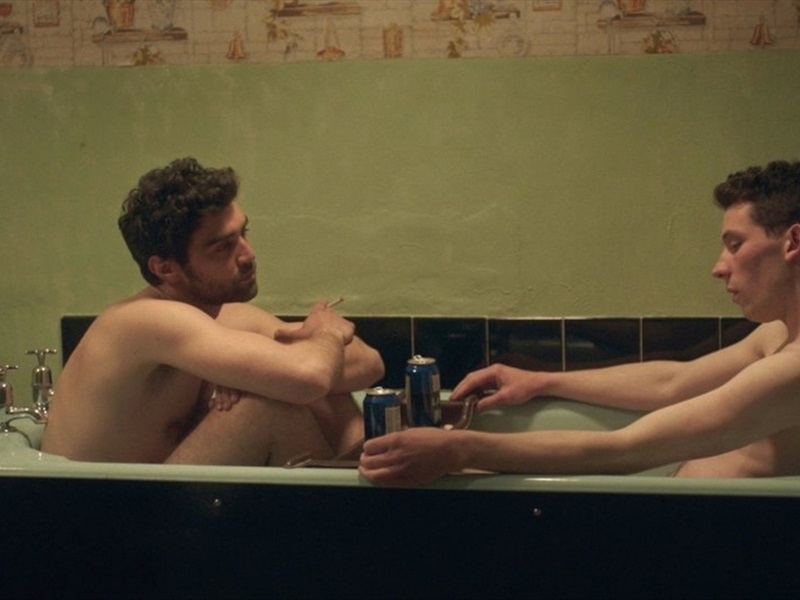
GOC takes place in West Yorkshire where the only thing tougher than the topography and the accent is the people. Johnny (the lanky and somber Josh O'Connor) is right well fooked. He is trapped working on his family's struggling cow and sheep farm. His mother left the scene years ago and his dad is a grouchy, cane-wielding overlord (Ian Hart) taken care of by his hard-nosed Nana (Gemma Jones). And if all that's not bad enough, Johnny's in the closet. Not known for its thriving gay community, West Yorkshire is as much a prison for Johnny's heart as his body. In spite of all that, Johnny's not much of a sympathetic character.

The first glimpse we have of dear Johnny is him unloading last night's alcohol into the toilet. He's an asshole drunk who shouts like a bully and sulks like the world's worst teenager. With all the ardor of a dog in heat, he screws a local in a cow trailer- spit and shoves filling-in for romantic gestures. Johnny believes his love life to be as grim as everything else around him, so there is no chance that he will fall in love with these brief conquests. Until Gheorghe.

The family hires a Romanian immigrant to help with lambing season. Gheorghe (the striking Alec Secareanu) is a man of few words and a tender knack for birthing lambs. Johnny and Gheorghe are sent off to the far reaches of the farm to manage the flock and in no time, Johnny attempts his typical backroom style hook-up.

But Gheorghe will not be treated as a conquest and is powerful enough to force Johnny to let down his walls and let him inside. For the first time Johnny experiences soul-stirring passion with another man- but is there any hope for these two lovers in this place?

Directed by Francis Lee the film is beautiful in its bleakness and brevity. Images of touching and glances communicate more than any of the character dialogue. This unadorned quality leaves an air of fresh reality, with no grand speeches or orchestral flourishes to sweeten this difficult love story.

GOC came out in January, 2017 at the Sundance Film Festival and was overshadowed by the other big gay movie in the festival, Call Me by Your Name. GOC and CMBYN are interesting films for comparison. Where CMBYN feels like an inevitable romance in a rarefied Italian countryside, GOC is at times a painful struggle in an unforgiving landscape. What CMBYN hides in dialogue, GOC reveals in silence. Where CMBYN uses fruit allegory and eschews images of the object of desire, GOC strips down the male form unashamedly. Even though I think CMBYN sucked all the air out of the gay film room last year, it's great that the film industry is making such diverse views of gay life- and doing it so well. It has indeed gotten better.

Thursday, April 19, 2018

Peaches Can't Say No: Call Me by Your Name

I'm still on my admittedly late to the game post-Oscars/funemployment movie viewing jag. I've gone through Three Billboards Outside Ebbing, Missouri (2017) (all hail Frances McDormand and Sam Rockwell) and Coco (2017) (cried like a little nino), but the movie I want to write about today is the much-buzzed-aboot Call Me by Your Name (2017).
I love to talk about adaptations. Nothing sets me off on a tear faster than the comment, "I liked the book better." It's like comparing elephants and whales. They're both awesome mammals- but you can't just throw a humpback whale on the Serengeti and expect it to face off with Jumbo. The mediums of literature and film while connected, are separate, unique experiences, and with the reader's active imagination in play, books very often come out on the winning end of this needless entertainment cagematch. All the same, it's interesting to see what screen adapters do to a book to make it ready for the multiplex.

In the case of CMBYN, I was informed I would love the book.
I didn't.
Don't get me wrong. I'm as geeked to read a gay love story as any other card-carrying homosexual- but Andre Aciman's novel about the sexual awakening of a seventeen-year-old in his family's Italian vacation villa left me wanting to give young Elio a cold shower. One minute Elio's love for visiting grad student Oliver is erotically absolute. The next he claims he couldn't care less if he never saw his handsome face or inhaled his swimtrunks again. It's terrifyingly accurate. It was like reading some of my diary entires from that adolescent age where everything was immensely important and I loved and then hated people at the drop of a hormone. On the one hand, I was impressed by the emotions Aciman captured but on the other, mortified by the immaturity of the badminton game that is a teenager's romantic inner life.

The book was so mired in Elio's conflicted inner monologue, I was curious how Oscar-winner James Ivory would pull-off an adaptation that wouldn't have me shouting, "It gets better, Elio!" at the screen. Ivory and director Luca Guadagnino are successful at making Elio more palatable, but in the process sand away the sharp edges of first love.

Guadagnino made a splash in the indie movie scene with his Tilda Swinton starrer I Am Love (2009). His handling of that tale of a life-altering love affair in Milan made him the perfect candidate for CMBYN. Guadagnino instinctively understands Italy and shoots the countryside as if it is both fresh and ancient at the same time. His camera frequently moves from the manmade to the naturemade, leaving that feeling of permanent impermanence. Time moves in a languid way, making us feel like, "There's always next Summer." And it is that casual quality that short-circuits the tortured passion of Aciman's novel.

Where Aciman's highly passionate text builds Elio's desires to unendurable levels, Guadagnino's camera pulls back. He often shoots the two lovers from a distance, denying us the feeling of intimacy and desire that the traditional closeup can evoke.

I expected some sort of visual exploration of the body that is the focus of Elio's desire, but even his first peek of Oliver's tushy is shot from across the room. I get that part of this camera strategy is to emphasize the distance between these two future lovers, but there were times it felt like Guadagnino's camera was a blasé observer rather than a titillated participant.

There is a laid back, "whatever happens" pace to the romance that belies the fiery passions that made the book enervating beyond the point of comfort. "Will it be bike-riding, swimming, or fucking this afternoon, old chap?"

Sometimes they choose swimming.


A perfect example of what I'm talking about is the infamous peach scene. In the book, after Elio date rapes a peach, his lover proves his passion for him by eating it. Now maybe the filmmakers thought putting something as graphic as eating a jizz-filled stone fruit on the screen would earn them the dreaded NC-17, but I think it could have been figured out (even though I would have had to cover my eyes). What we are left with is a peach-dodge and tears. Crying at various points in the film succeeds in elevating this special relationship, but it can't replace the primal passion that should be paired with it.

I would be remiss if I didn't mention the touching monologue given by Elio's father (the delightfully versatile Michael Stuhlbarg.) It is a beautiful parental acceptance of a child. Add it to Mahershala Ali's speech in Moonlight (2016) as evidence that Hollywood is finally portraying kinder Father-Gay Son relationships.

So if I'm being forced to choose between the book and the movie- I go with the movie- but mainly cause you can't see Armie Hammer's butt in the book.


Friday, March 30, 2018

I Love You Fish Face: Guillermo del Toro's The Shape of Water

I know, I know. You've already heard about The Shape of Water (2018). It won 4 Oscars this year including Best Picture and has been the punchline to every possible fish sex joke that a late-night comedy writer could come up with. While you might say I'm late to the game, I like to think that I waited to see the movie once the hype cooled down. But warm or cold hype, this movie is worth soaking in.

Much has been made of the fish-out-of-water (literally) romance element of Guillermo del Toro's latest gem and rightly so. It's a beaut of a love story between "others" who don't belong in this world- but who do belong to each other. The remarkable acting from all the leads, the green-infused design, and Alexander Desplat's score are all beguiling, but there's another wonderful thematic structure in the movie that I am equally geeked about- the romance that del Toro has with the movies.

Shape is based on- or at the very least inspired by- a classic sci-fi movie character. While no direct mention is made, del Toro's Amphibian Man for all intents and purposes is The Creature from The Creature of the Black Lagoon (1954) and its sequels Revenge of the Creature (1955) and The Creature Walks Among Us (1956). 

Maybe all fish-men look alike (del Toro directed the same actor , Doug Jones, as walking fish dude hero Abe Sapien in Hellboy (2004)), but the design similarities between these two characters is more than coincidence. It's clearly del Toro's "what-if" scenario for the 1950's monster movie icon.

But wait, there's more! Elisa (the fearlessly naked and Oscar-nommed Sally Hawkins) literally lives over a second-run movie theater. Marquee letters spell-out the titles of movies that only a true cineaste would remember- The Story of Ruth (1960) and Pat Boone starrer Mardi Gras (1958).  Next door neighbor and friend Giles' (Richard Jenkins in another Oscar-nommed role) television is tuned to catch Hello Frisco (1943) with movie musical/gay icon Alice Faye crooning "You'll Never Know."

And where does the creature escape to after his horrific, yet hilarious encounter with one of Giles' housecats? Elisa finds him at the movies gazing up at the screen as the biblical epic about a woman who abandons her life for a new faith unfolds in front of an empty audience. When Elisa is finally able to express her love to her amphibious sweetheart, she does so in the magical form of a Hollywood musical number- imagine Ginger dancing next to a slimier Fred.

All of these references lead to a meta-cinematic experience where del Toro shows how we dream and communicate through the language of the movies- in a movie. It's that kind of thoughtful filmmaking that nabbed del Toro the Best Director Oscar and makes The Shape of Water so much more than a girl-meets-fish story.

Friday, March 16, 2018

Please Screw the Gardener: Douglas Sirk's All That Heaven Allows

I love director Douglas Sirk. His devotion to his off-the-chain visual film style makes me happy, no matter who is pining away, dying, or going blind in his films. But I had never seen one of his most definitive works. Until now...

All That Heaven Allows (1955) stars Jane Wyman and Rock Hudson in their second teaming for Sirk. As in Magnificent Obsession (1954), they play lovers who encounter barriers to the fulfillment of their passions. In Obsession it's the fact that Hudson had a hand in Wyman's husband's death, and the unlucky Wyman's blindness. In Heaven, the roadblocks to love seem more realistic- but no-less daunting.

Wyman plays Cary Scott, a widow who lives in an upper crust home in a tony community whose two children are leaving the nest. The image of the respectable town pillar is shattered visually, however, when Cary shows up to a cocktail party in a very un-widowly red dress. Tired of the advances of white-haired insurance executives, Cary instead takes up with her handsome, sensitive, and younger (gasp!) gardener.

Said gardener, Ron Kirby, is played by Rock Hudson- and honestly, I can't think of a good reason to not bang your gardener if he's Rock Hudson. But the rest of the town and her own children are aghast at this flagrant violation of Fifties social mores. Will Cary give up her social standing for her working class man? It's the stuff that soap operas are made of.

What elevates Sirk's films above their treacly plots is his saturated use of color, costumes, and sets to bring out his character's feelings. Technicolor greys, reds, greens, yellows, and violets are frequently used to accentuate moods and underline social levels.

In the opening scene, the color coordination of the dress and car of Cary's best friend (the always enjoyable Agnes Moorehead) with the sky shows that she is woven into the patterns of the town- whereas Cary's red dress is a striking departure from that portrait.

Sirk is also fond of contrasting man's social structures with nature. As in Obsession and Written on the Wind (1956), nature is where we can explore our true selves outside of the ordered lives of our homes, families, and villages. The house that Hudson is planning for he and Cary is built in a rustic old mill- the site of toil and labor in a majestic forest setting. Nothing could be further from the staid, manicured life contained within her colonial home in town.

Todd Haynes used Heaven as a template for his Oscar-nominated film Far From Heaven (2002). Haynes goes one step further by making the gardener a black man, and his leading lady not a widow- but the rejected wife of a closeted gay man. But he uses much of the color technique that Sirk popularized to create a lush world that cloaks social truths in rich hues and idealized nature. It's yet another example of how classic films from the past inform and enrich the movies that directors make today.


Monday, March 5, 2018

Top 5 Movies to Watch When You're Unemployed

If any of you faithful readers have been wishing I would have more time to write blog posts, your wish was my former employer's command! I'm currently unemployed.

Being out of a job isn't all bad. I mean, there are the late night panic attacks about what I will do if I can't pay my rent and have to sleep on a weathered Amazon cardboard box on Hobo's Row on 31st St., and belt-tightening measures like canceling cable and buying wine in a box instead of a bottle- but it's not all bad. Like Burgess Meredith in the famous Twilight Zone episode, I have time enough at last to watch all the movies my DVD collection and Netflix can provide.

Here are my Top 5 movies about folks who are out of work- and tips on how to get by until that next great opportunity arrives:

Sullivan's Travels (1941)

Hot shot movie director John L. Sullivan (Joel McCrea) is tired of making light-hearted Hollywood fare. He wants to make the great American movie about the great American novel O Brother, Where Are Thou? (Yes, the Coen Brothers paid homage to that fictitious title by naming their Depression-era musical after it.)

Sully plans to tell the truth about America's forgotten man, and promptly gets a costume designer to fix him up in the latest hobo chic to join the unfortunate rail-riding men who can’t get a job or a break. After ditching the press corps and picking up a game starlet (the always well-coiffed Veronica Lake) Sullivan learns that life on the other side of the tracks is a desperate struggle for survival where laughs are as hard to come by as pieces of pie.


Sullivan is writer/director Preston Sturges' most ambitious picture. While he was known as a master of farce, this film questions the very validity of comedy. In a society that had struggled through the Great Depression and was on the brink of the Second World War,  Sullivan's Travels asks, how can we laugh when there is so much ugliness in the world? Sturges' answer- Because that's how we'll make it through.

Unemployment Tip #1- Take time to have fun. It helps. It really does.

Midnight Cowboy (1969)

This movie is one of my favorite dramas. Joe Buck (Best Actor Nominee Jon Voight) leaves his dish-washing gig in po-dunk Texas and heads to the big city to be famous as- well, as a cowboy. It's hard to say what the naive Buck intends to do to make it in the Big Apple so he resorts to hustling with what he thinks is a Park Avenue sugar mama (Sylvia Miles in an Oscar-stealing turn), a religious nutjob (a decidedly non-Disney John McGiver), and a yearning student in a porn theater (a young Bob Balaban).

None of these tricks is enough for him to get by- so he goes back to the condemned building he shares with pathetic grifter Ratso (Dustin Hoffman in a gut-wrenching Oscar -nommed performance- even if he's been a real heel of late.) They are a pair of losers without jobs, but they still hold on to their palm-tree shaded dreams.

Unemployment Tip #2- Friends are super important when you're out-of-work. They can raise your spirits and help you make the contacts you'll need for your next big break.

Tootsie (1982)

I didn't plan on having two Dustin Hoffman entries in this category, but apparently he likes to play guys who are out of work in NYC. Tootsie stars Hoffman as Michael Dorsey, an actor who can't get anyone to hire him. They don't understand his art says Michael. You're a pain in the ass to work with says his agent (Sydney Pollack who also directed). Michael decides to show everyone by auditioning for a role in a soap opera as a woman- a gamble that pays off when he is not only cast, but becomes the next 'It' girl.

Michael gets tired of his double D life when he falls in love with co-star Julie (Jessica Lange who won Best Supporting Actress the same year she was also nominated for Best Actress for Frances.) How he solves his gender conundrum is one of my favorite movie moments and earned the film ten Oscar nominations.

Unemployment Tip #3- Think outside the box. The next great job might not be exactly what you did previously.

Up in the Air (2009)


At the height of the most recent recession, who in Hollywood said, "Let's make a movie about a guy who fires people for a living?" Director/Writer Jason Reitman- and with six Oscar nominations, including Best Picture, Best Director, and Best Adapted Screenplay, he was right. Up in the Air opens with a montage of corporate downsizer Ryan Bingham (Best Actor Oscar nominee and all-around suave king George Clooney) canning people. It's hard to say if it's more funny or devastating.

As Bingham flies around the country handing out pink slips like Altoids and pronouncing advice to his new protege Natalie (another Oscar nominee, Anna Kendrick), he begins to see the empty futility of his "What's in your backpack?" life and falls in love with his airport bootycall (yes, another Oscar nominee- Vera Farmiga.) The film expertly walks the tightrope between cynical and schmaltzy, making the point that life is full of chances- whether they come in the form of that uncomfortable call to the HR office, a fleeting airline lounge conversation, or a cinematically-timed epiphany.

Unemployment Tip #4- You're not alone. Lots of people lose their jobs. Talk to some of them and find out what they did to get to their next chapter.

Two Days, One Night (2014)


Marion Cotillard is one of the most thrilling actresses working today, and this dark Belgian gem proves it. Sandra (Cotillard) is a single mother who after taking time off for a nervous breakdown, returns to her job at a solar panel plant.

Unfortunately, her co-workers did such a great job of covering for her, the company has decided her position is redundant and with her gone, they can give a bonus to the remaining workers. Sandra begs for another chance and her sadistic boss tells her that if she can convince her co-workers to give up their bonuses, she can keep her job.

The rest of the film is her desperate quest to connect with her associates over a weekend and save her job. It's heartbreaking. Cotillard is so raw and fragile and frantically compelling. Each small bit of hope she digs up, brings us to the edge of our seats. She earned an Oscar nom for the effort, but that was also a job she lost.

Unemployment Tip #5- Be persistent. Sometimes you can't take 'no' for an answer.

So, if you're out of work (like moi) know that movies can show you how to get your next big break- or at least entertain you in the meantime.