Friday, December 16, 2016

Ain't No Drama Like a Period Drama

To get us all into the Christmas spirit, Film Forum is showing a new 4K restoration of one of my all-time favorite movies, The Lion in Winter (1968). I love period dramas. They allow us to be transported back to a time where there were no xylophone ringtones, Kardashians, or Cheeto-colored despots- I mean there were despots- they just weren't orange.

So here are my picks for Top 5 Period Dramas:


The Scarlet Empress (1934)

Marlene Dietrich and Josef von Sternberg were a team made in cinematic heaven. No one understood how to shoot and light Dietrich in as affecting a way as Sternberg, and no actress could match Dietrich's screen presence to bring Sternberg's black and white fever dreams to stunning life. Their sixth film outing was the story of Russia's Catherine the Great with Dietrich playing the czarina from a young maid (pincurls and a wide-eyed gaze weren't enough to convince anyone that Dietrich was sixteen) up until she took the reigns of power.

This film is less about history and more about Sternberg's visual design. The Russian palace is a mindbending treasure trove of icons and Goya-esque statuary. As Catherine roams the halls in finery that would make PETA see red, she at first seems like an innocent lost in a twisted world where male power distorts everything it touches. But soon Catherine learns how her sex gives her a unique tool to get what she wants and usurps the plots of her wackadoo husband, Peter (played with lurid insanity by Sam Jaffe).

With the help of the tight-pantsed Count Alexei (John Lodge before he became a Republican Congressman) and an army full of men that she has seduced, Catherine saves herself and Mother Russia all while riding a horse in full military regalia. It puts any picture of Putin on a horse to shame.

The Private Lives of Elizabeth and Essex (1939)

Bette Davis was considered the Queen of the Warner Brothers lot, so it makes sense that she was cast as an actual queen in Michael Curtiz's historical epic about England's Queen Elizabeth I.  Since classic Hollywood plotlines usually had to include a romance, the script focused on Elizabeth's dalliance with the Earl of Essex (Errol Flynn proving yet again that he was one of the most entertaining stars of the time). The romance as depicted ran hot and cold with the passions at both extremes playing right into Davis' wheelhouse. It also didn't hurt that Davis and Flynn didn't really get along, so scoldings and slaps have an extra bite to them.

Davis carries herself regally, thrusting her hips as she walks in the voluminous gowns that Orry-Kelly strapped her into. Press releases at the time gabbed that the costumes were so heavy that Davis was losing a couple pounds a day. Behind the period garb, the red wigs, and partially shaved head (Davis complained her eyebrows never grew back right) Davis gives a royal performance with her bouts of bravura counterbalanced by moments of loss and realized duty. With fine support from Flynn, Olivia de Havilland, and Donald Crisp, this Elizabeth is an excellent example of Hollywood studio filmmaking during its Golden Age. And while historians might pull their hair out watching it, it's a good film for those of us who prefer Hollywood Queens to British ones.

The Lion in Winter (1968)

As mentioned at the top, Lion in Winter is one of my favorite movies. Based on the James Goldman play, Lion details a Christmas late in the reign of Richard II (Peter O'Toole) when the royal family converges on a castle in Chinon to connive, buttkiss, and doublecross each other in the hopes of gaining the throne once dear Richard kicks the bucket. The dialogue is sly and vicious ("What shall we hang? The holly or each other?") and is lifted almost word-for-word from Goldman's play. But what really makes this movie special, is the performances.

Kate Hepburn's performance as Eleanor of Aquitaine is my favorite in a career full of extraordinary work. Hepburn by this time had become an older woman, and in her eyes we see the acceptance of fading beauty, the fierce desire to fight it, and memories of triumphs long gone. Her monologue in the mirror is heartbreaking- but inspiring- proving that as long as you can still put on your crown, you can rule the world. She would win her 3rd Oscar that year- splitting the honor with Barbra Streisand for her star-making turn in Funny Girl.

O'Toole is wonderful as a scamp king who intends to keep everyone guessing until he wins, and the supporting cast of Nigel Terry, John Castle, Anthony Hopkins, and Timothy Dalton are fantastic. John Barry's haunting period soundtrack uses horns, drums, and voices to evoke the faded glory of the past.


Lion was a product of a new era in filmmaking where realism was preferred over giant furs and double-wide dresses. The sets and costumes are much truer to the period- with dirt, wear and tear, and function over form the order of the day. The castle looks like it was ancient when Richard moved in, and the dogs and peasants run around like they own the place. It was a style that would inspire future historical dramas by placing the focus on story and performance over romanticized costumes and sets.

Amadeus (1984)


If we are to believe Milos Forman's Oscar-winning film about the life of Wolfgang Amadeus Mozart, Mozart was an asshole. But since the story is told from the perspective of Mozart rival, Antonio Salieri, historians should take it for granted that this tale might be a bit skewed.

The film opens on Salieri (Oscar-winner F. Murray Abraham) a decrepit old man whose suicide attempt has landed him in an insane asylum where he gives a lengthy confession to a priest about his frenemy-ship with Mozart (Oscar-nominee Tom Hulce).

Salieri's flashback paints the young musical genius as a l'enfant terrible- a cackling bacchanalian whose taste for wine  and women is only outdone by his talent for writing song. As Salieri watches his career become overshadowed by this squealing vulgarity, he devises a plot to rid himself of this blight on proper music.

Amadeus is great fun to watch. Forman lavishly presents a classical music god in a less-than-flattering- human light while at the same time maintaining his admiration for the man's work.

This irreverent takedown of an idol was met with critical praise and earned 8 Oscar awards. Perhaps less known (and less appreciated) is its influence on my laugh- which I suspect was inspired by my watching of this film at an impressionable age.

Dangerous Liaisons (1988)

Maybe I just have a thing for period pieces, but I also adore this revenge tale about the sexual intrigues of the 18th Century 1%.  The Marquise de Merteuil (Glenn Close) and the Vicomte de Valmont (the sensationally slimy John Malkovich) are bored so they decide to make a bet on whether Valmont can seduce the wife of one of the Marquise's ex-lovers.

Gauntlet and undies are thrown down as Valmont endeavors to win the favor of the upstanding Madame de Tourvel (luminous Michelle Pfeiffer) at his aunt's country home. But affairs of the heart rarely go as planned- even in an intricate game played by masters of seduction.

Liaisons is a fantastic script with wonderful twists and delicious, venom-filled dialogue that almost burns through the celluloid. All the actors are superb (Uma Thurman, Swoosie Kurtz, and Mildred Natwick among them)- with the exception of Keanu Reeves who while quite fetching in wig and tights has problems transferring his Ted voice to a French music teacher.

But the real heart of this film is Glenn Close. Close often plays frosty dames whose interiors are masked by a brittle, smiling facade. But her Marquise is an exquisite human clockwork whose heart was long ago disposed of because it got in the way of her survival. Her downfall is portrayed with devastated shock, and her final moments of the film are heartbreaking. She lost the Oscar that year to Jodie Foster in The Accused- and I still think Close should have won.

I am headed home for some good old fashioned Werth Family holiday hijinx, so there will be no post next week.

But in the meantime, from me to you- Happy Holidays!

Friday, December 9, 2016

Happy 100 Issur Danielovitch!

It's Hollywood actor and producer Kirk Douglas' 100th birthday- and in true NY Post fashion, the scandal rag toasts the birthday boy with a story all about the ladies who lunched on Kirk. It's a fun read- much of it straight from the stud's mouth. But I wonder if we heard from the girls if these kiss-and-tells would be different...

Thursday, December 8, 2016

The Notorious LVB

Classical music giant Ludwig van Beethoven turns 246 today and what better way to celebrate his musical contribution to society than to look at how his music was used in movies?


Here are my top 5 movies that creatively use Beethoven music!

Fantasia (1940)


Walt Disney's experimental, animated, feature-length classical music video was a big risk when it came out in 1940. Disney had success with his cartoon shorts and Snow White and the Seven Dwarfs (1937) and Pinocchio (1940) proved there was a market for full-length cartoons. But Fantasia's melding of animation and classical music in an anthology style had not been tried before. So Disney put Leopold Stokowski on the conductor's stand and churned out eight cartoons with a soundtrack of popular works that included great composers like Bach, Tchaikovsky, Stravinsky, and Schubert.

Beethoven's contribution was his "Pastorale" from Symphony no. 6. The lilting, sweeping tune beautifully underscores a flock of pegasi as they soar through the ancient Grecian sky, one young fledgling in particular having difficulty (and fun) trying out his new wings.

As the piece progresses we join two herds of centaurs (no- it's not centauri)- one male, and one female- who frolic near a verdant pond, hooking up as the music swells. Well, they hook up as much as one can in a Disney film. The scene is sensuous, the animated movement as smooth and graceful as the music that serenades these young horse/people as they discover first love.

Fantasia's first release was a bit of a bomb- mainly because with WWII in full-swing in Europe, that market was pretty much closed to Hollywood films. But in subsequent releases and with a robust home video market, Fantasia has rebounded to become one of the top 3 Disney films.

I don't know if before Fantasia people imagined cartoons when they listened to classical music, but after- it's impossible to close your eyes and not imagine Mickey in his sorcerer's cap fighting off all those brooms when you listen to Dukas' The Sorcerer's Apprentice.

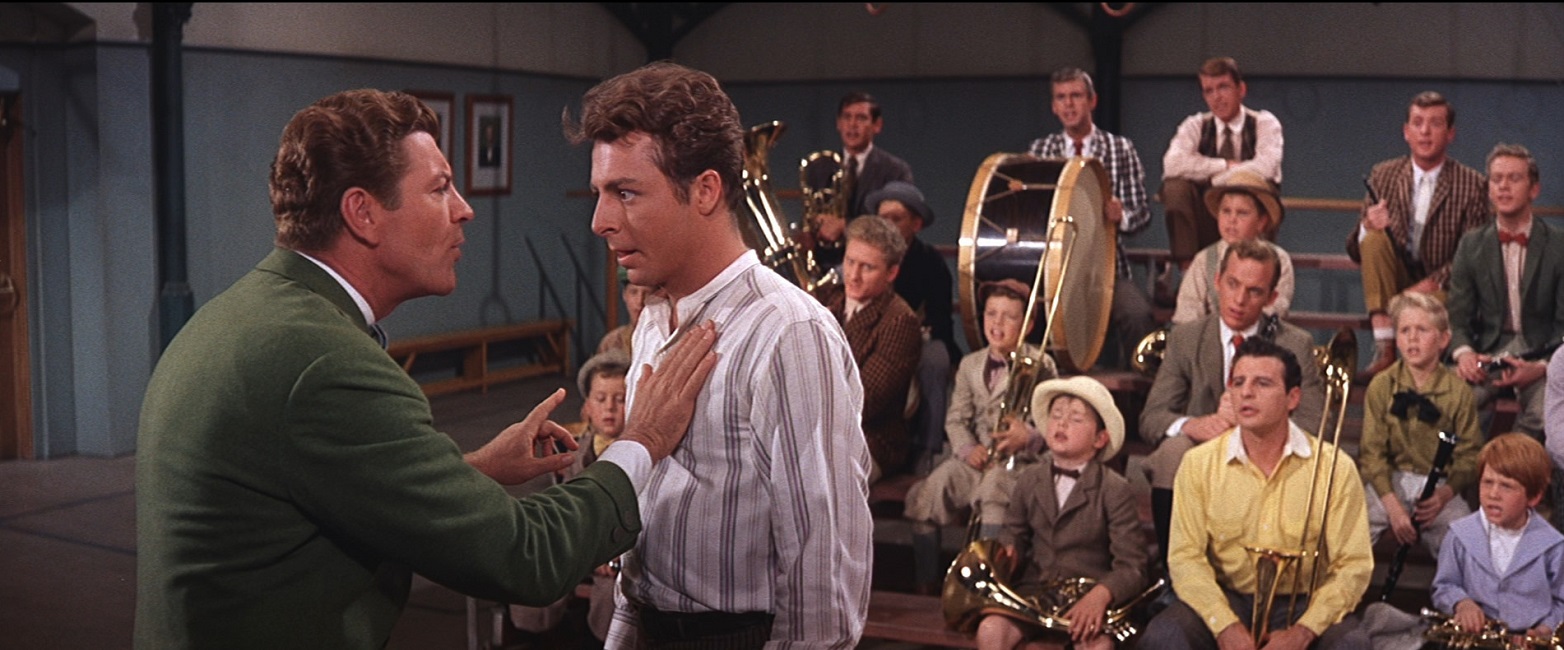
The Music Man (1962)

There is a lot of music in The Music Man. Most of it was composed by Tony-winning Meredith Willson. But there is one song he didn't write. Professor Harold Hill (Robert Preston serving lovable scamp realness) has pioneered a new form of music education called "The Think System." Rather than practice with your band instrument, you think about the song until you will instinctively know how to play it. Of course, Professor Hill intends to be several towns away before the River City-zens realize they've been bamboozled into paying for a bunch of band uniforms and equipment that their kids can't play. But when Prof. Hill is snared by the law (and love) he has to prove that his system works. Will Beethoven's Minuet in G issue forth from the instruments of the River City Boys Band?

Music Man is a wonderful piece of musical Americana that while admiring saintly Midwestern ideals, has a great deal of pleasure poking fun at Hawkeye morality.

Portraying the cultural revolution of 1912, the musical was popular in part because it sweetly mirrored the generational changes that were taking place in the 1950's. In fact, at the 1958 Tony's Music Man beat the other musical that dealt with the volatile shift in our American culture- West Side Story.

Personally, I think the Tony's got it wrong that year.

A Clockwork Orange (1971)

Nothing tops off an evening of violence and sexual abuse quite like a Beethoven tune- or at least that's how our lil' droogie Alex (the sadistically impish Malcom McDowell) feels in Stanley Kubrick's A Clockwork Orange.

We get a tour of Alex's room and his thoughts as he plays Beethoven's Symphony No. 9, reveling in the bliss that the music brings to him. It's a deliberate juxtaposition to show this vicious beast soothed by classical music- a thug who has no respect for human life, but reveres the beauty of classical music. It gives depth to a character that could have just been a one-dimensional sociopath.

After being treated by the Ludovico Technique to rid Alex of his nastier tendencies, however, Alex discovers that the Ninth Symphony was playing in the background of the films used to implant revulsion for acts of sex and violence.

So now the very first strains of his beloved music make poor Alex violently ill. When he is kidnapped by one of his former victims, Ludwig Van becomes a weapon against Alex instead of an ecstatic escape. Alex's pleasure from inflicting pain becomes pain inflicted from a former pleasure. It's just the sort of sick twist that Kubrick appreciated.

Saturday Night Fever (1977)

Everyone needs a good entrance song. Whether it's Pomp and Circumstance or  "Bitch I'm Madonna", we all like an anthem to play when we walk into a room. Tony Manero is no different. The strutting disco king (John Travolta in his Oscar-nominated performance) of Saturday Night Fever is a man with many insecurities. But when he enters the club and hits the dancefloor, he is the master of all he surveys. Director John Badham underscores Travolta's entrance scene  with "A Fifth of Beethoven"  a disco re-working of Beethoven's Fifth Symphony by Walter Murphy and the Big Apple Band.

It's an interesting choice. Does Beethoven give heft to disco, or does disco make Beethoven more cool? A similar question can be asked about Saturday. Does Badham's heartfelt exploration of urban youth disillusion and ennui make disco deeper, or does disco make this story more accessible to the Seventies audience?

Either way "A Fifth of Beethoven" was so successful it spurred an interest in "popularized" classical music resulting in K-Tel's Hooked on Classics series- my first exposure to the likes of Beethoven.


Misery (1990)

Rob Reiner's Misery has plenty of instances of dark humor- like an obsessed fan (played with unfettered relish by Oscar-winner Kathy Bates) who names one of her pigs after the beautiful heroine of her favorite novel series, Misery. But nothing tops Reiner's use of Beethoven's "Moonlight Sonata" in the infamous hobbling scene.

Kidnapped author Paul Sheldon (a perfectly tortured James Caan) awakens after being drugged  to the strains of Liberace playing the "Moonlight Serenade" and Annie (the aforementioned literary pig-namer) standing over him with a sledgehammer. What ensues is known as hobbling, and it's gag-inducing- but the scene is even more surreal as Beethoven's music underscores the graphic torture.

More than just a juxtaposition between light music and the violent scene, the choice of classical music also mirrors Annie's character- a woman who calmly and smoothly glides around the room like a Beethoven tune- before hammering your ankles into absurd angles.

I wonder how ol' Beethoven would have felt about being such a memorable part of these flicks?


Friday, December 2, 2016

That's Showbiz, Kid

Tuesday night my friend Dave took me to Lincoln Center to see the new documentary Best Worst Thing That Ever Could Have Happened... (2016). Directed by one of the stars of the original doomed Broadway cast, Best Worst chronicles the creation of the Stephen Sondheim/Harold Prince musical Merrily We Roll Along (1981) which famously closed after only 16 performances.

It's a really great documentary that parallels the story of Merrily with the lives and careers of a cast of Broadway hopefuls whose lives didn't exactly turn out the way they thought they would. It reminded me that life in the spotlight isn't always what it's cracked-up to be- and often the backstage story is as interesting as what gets shown on the big screen.

Here are my Top 5 Documentaries about people in the movie biz:

Marlene (1984)

Marlene Dietrich was one of the biggest stars of the Golden Age of Hollywood. Launched as Paramount's answer to Greta Garbo, Dietrich quickly became a star in her own right, lighting up silver screens (and bedrooms) from the early '30's until the late '50's with her unique brand of Teutonic beauty and glamour. But after her performance as German war widow Frau Bertholt in Judgement at Nuremberg (1961), Dietrich said goodbye to Hollywood and focused on her traveling one-woman show until a nasty spill off a stage in 1975 broke her thigh and her spirit. Dietrich would eventually seek the comfort of her Paris apartment- and in true Garbo fashion- wanted to be left alone.

In the early '80's Dietrich's Nuremberg co-star, Maximilian Schell coaxed Dietrich into participating in a documentary about her legendary life. Well, sort of. Dietrich agreed to be interviewed for the documentary- but not to be filmed. So Schell was left with a set of audio tapes and film clips of her old movies to construct a whole documentary. But he did it. Shot like an art film, Marlene uses Dietrich's voice and shadowed reconstructions to bring to life the great star at a time when she was no longer the glamorous Hollywood icon- but an angry recluse whose memories bounce from German to English and from reverence to venom at the tap of a cigarette.

It's a strange and sad portrait of stardom that would garner an Oscar nom for Best Documentary. Read Dietrich's daughter's biography Marlene Dietrich for more fascinating insight into this riveting Hollywood personality.


Divine Trash (1998)

John Waters has always been an out-loud and proud ambassador for his unique brand of cinematic kitsch/filth. His pencil-thin mustache is as recognizable as the trashy characters from his films. But there's more to this indie film idol than meets the eye. Steve Yeager's documentary Divine Trash wonderfully chronicles Waters' rise in the Baltimore suburbs along with his muse, Glenn Milstead- better known as drag artist Divine. The two began making films together in 1966 and their unique brand of raunchy comedy and equally perverse castmates took them from 8mm short films to nationwide cult hits.

But what is intriguing about this offscreen look at some of the most notorious movies ever made (the "singing butthole" guy from Pink Flamingos (1972) refused to be filmed in full lighting) is Waters' dedication to filmmaking.

From the very beginning he studied editing and shooting to create the "homemade" quality of his films. While his eyes twinkle about all the drugs they were on, actress Mink Stole recalls how important the script was- having to endure multiple re-takes until she got lines and blocking exactly right.

As loose and amateur as Waters' films feel, he was in fact using his camera and his actors to very specific effect. While it doesn't deal with his more mainstream successes like Hairspray (1988), Divine Trash gives us a window on the mind and revolutionary times of one of filmdom's most unique storytellers. And if you'd like to see a list of movies that John Waters likes, click here.

On Cukor (2000)

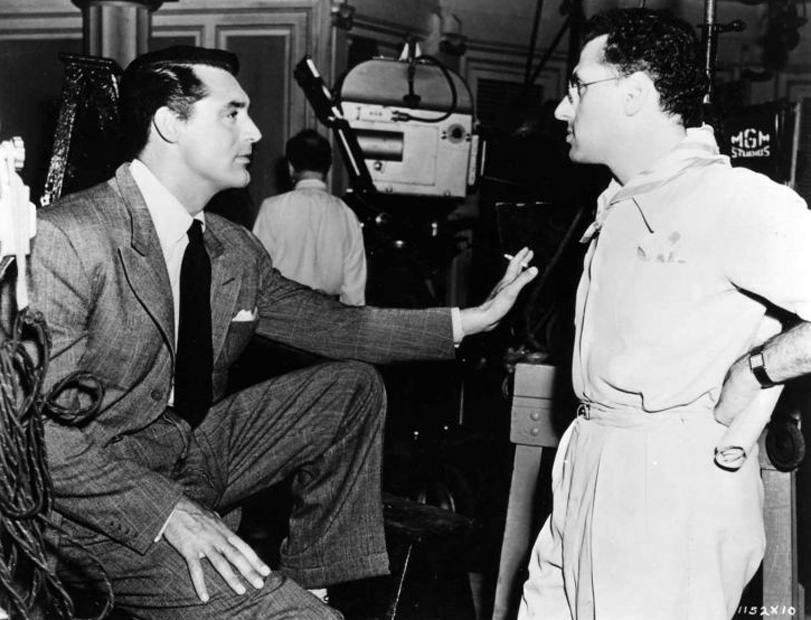
George Cukor was one of the greatest directors of the Studio Era. Not everyone thinks of Ol' George when naming iconic directors because he wasn't known for a striking visual style. What Cukor excelled at was smart properties and getting the best performances from his actors.

Twenty-one actors were nominated for Oscars in Cukor films and five of them took home the trophy. Cukor was labeled a woman's director because of his work crafting performances with actresses like Greta Garbo, Joan Crawford, and Kate Hepburn. But Cukor was also masterful with some of the best male actors in the business like Spencer Tracy, Cary Grant, and Jimmy Stewart.

Cukor's long history in Hollywood is covered in loving detail in the American Masters special On Cukor, and it's particularly fascinating because it delves into Cukor's homosexuality. Cukor was a classic example of a Hollywood mover and shaker whose sexuality was well-known, but never discussed publicly. The Tinsletown Closet allowed some artists to be gay, but never in situations where the public or press could find out.

For Cukor it meant hiding his sexuality at work, but Angela Landsbury who earned an Oscar nod in Cukor's Gaslight (1944) tells of Cukor's Sunday brunches at his home where he and his friends could let their hair down and be themselves. Oh if that pool could talk. On Cukor is a wonderful glimpse of Cukor's extraordinary body of work and his guarded private life.

Marilyn Monroe - The Final Days (2001)

Speaking of Cukor, Marilyn Monroe and Cukor paired-up on one of Hollywood's most famous unfinished films. Cukor directed Monroe in the My Favorite Wife (1940) re-make Something's Got to Give (1962). Their previous film together Let's Make Love (1960) was only successful in getting Monroe and her co-star Yves Montand's affair into the gossip rags. Monroe's next film The Misfits (1961), while fascinating, was a box office dud. So Monroe and 20th Century Fox hoped that Something and Cukor could re-establish her as the queen of the box office. She missed the throne... 

The Final Days details the making of Something with interviews with many of the people involved in the project and footage from the film- thought lost long ago. They reveal a woman who was fighting for her career while at the same time struggling with personal demons that would ultimately scotch the film- and later her life. It is a touching portrait of a woman the world has consistently tried to define- but always falls short of fully discovering.

The documentary ends with a reconstruction of forty-five minutes of Something so that we can take a peek into that remarkable world of "What if?" Monroe is luminous and funny- her Sixties look beguiling. It's hard to believe that the tragedy that would end her life was just two months away.

The Kid Stays in the Picture (2002)


Robert Evans was discovered by Norma Shearer because she thought he looked like her deceased producer husband, Irving Thalberg. Evans would go from playing a producer to being one. Producers and agents are often the catalysts to so much of what we see on the screen long before it ever makes it there. The deals, the dinners, the phonecalls- all the work that goes into a picture is usually hidden from public view. But The Kid Stays in the Picture is one of those movies that makes the audience feel like they are insiders in the Hollywood Game.

Evans started off as an actor, but quickly realized his charm and savvy could make more moolah as a producer. Evans landed at Paramount after nabbing the screenrights to The Detective (1968) for Frank Sinatra and for the next almost forty years he has been hustling to make some great movies. If his list of movies is impressive (The Godfather (1972), Chinatown (1974), and Marathon Man (1976)) his life as the quintessential Hollywood producer is the stuff of movie legend. 

The Kid is based on Evans' autobiography of the same name, so one gets the feeling that not all the bodies are exhumed (like his close friendship to Roman Polanski during his child rape case), but Evans' coke-fueled downfall is covered with enough candor to make us feel like Evans is shooting straight with us. His Rolodex is a collection of the biggest Hollywood stars of the '60's and '70's and this film allows us to flip through it... and watch Dustin Hoffman do his Robert Evans impersonation.

What are your favorites docs about Hollywood?