Friday, July 15, 2016

Top 5 New York, New York Movies

This week I've been busily showing my visiting sister and niece the Big Apple. Sure they get to see tourist sites like Times Square, One World Trade, Central Park, and Rockefeller Center- but they also get to experience those little spots that make New York unique- like PenelopeMarie's Crisis, and even a drag restaurant where Joan Rivers is still alive.

I'm in a New York state of mind, and I can't help but remember all those movies that have used New York City locations so effectively- essentially making me fall in love with a real city by watching celluloid fantasies. And coincidentally, the new Ghostbusters movie comes out today with lots of shots of Manhattan. Don't believe the haters. It's fun. Trust me.

So here they are- my Top 5 New York, New York movies!:

Sweet Charity (1969)

Charity (the one and only Shirley MacLaine) is a dancehall gal whose romantic life is as confused as she is. If she isn't getting thrown off a bridge in Central Park, she's being abandoned in a movie star's bedroom (with a bedspread made of three kinds of fur!), or dumped by her fiance (the recently RIP John McMartin) because her job is a little too risque for his taste. But through it all Charity's pluck endures and insures there is always another musical number right around the corner.

The plot is based on the Fellini classic Nights of Cabiria (1957) and tends to wander around town. But MacLaine's goofy screen persona and the fantastic songs like the opening number, "My Personal Property" really make Sweet Charity a pleasant trip. The biggest hit from the show, "Hey Big Spender" is a cabaret bar mainstay- and the West Side Story-esque visuals of "There's Gotta Be Something Better Than This" make you want to leap around on your rooftop like MacLaine, Chita Rivera, and Paula Kelly.

MacLaine croons the sweet "It's a Nice Face" to a passed out stranger in an elevator and "Rich Man's Frug" gives the mini-dress and the pony-step a real meltdown at The "God I wish this place actually existed" Pompeii Club. Charity isn't very deep- it's just plain old fun.

Much of director Bob Fosse's creative use of song and site benefits from being shot on location in New York City with Central Park, the Top of the Rock, Yankees Stadium, and Wall Street setting the stage for Charity's romance and dance numbers. It might be said that Charity's real love affair is with New York. Look for a brief cameo by future Harold and Maude (1971) star Bud Cort at the end.

Sweet Smell of Success (1957)

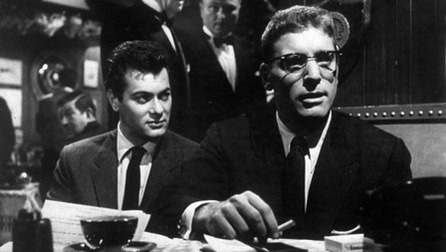
A sweetly titled movie that is not so sweet, Sweet Smell is the acid-toned story of young press agent, Sidney Falco (Tony Curtis), who is willing to do anything to get in good with Walter Winchell-esque Broadway columnist J.J. Hunsecker (Burt Lancaster- who co-produced as well as starred). But as always happens to these ambitious young thangs, Sidney gets much more than he bargained for when he waltzes with the devil.
The film is legendary for its dialogue- a verbal dance with tongues made of barbed wire. Ernest Lehman who wrote the short-story the piece is based on worked up the film script initially, but became deathly ill so famed playwright Clifford Odets finished the job. Lehman would later admit that the working environment with Lancaster & Co. was toxic, and nearly killed him. But with lines like, "The cat's in the bag, and the bag's in the river," it would seem the script's birth by fire was worth it. The Vanity Fair expose on the making of the film is well worth a read.

Lancaster and Curtis are terrific with both screen idols dropping their "good guy" images to play two of the slimiest characters ever teamed-up on the screen. The darkness of these two characters is mirrored by James Wong Howe's stunning chiaroscuro lighting scheme that makes the inside of popular bars and nightclubs look like depraved opium dens- all to the strains of a jazzy Elmer Bernstein score.

1950's Times Square is on full display here with the legendary intersection and real life locations like the Brill Building, 21 Club, and Toots Shor Restaurant providing the frenetic energy that drives the film (even though the interior of 21 was recreated on a Hollywood set). The director found it hard to get some of those shots as the screaming Tony Curtis fans frequently broke through barricades to get a piece of their matinee idol. Don't bite too hard girls. He tastes like "a cookie full of arsenic."

The King of Comedy (1982)

Director Martin Scorsese is a New Yorker born and bred- so it's easy to see why The City That Never Sleeps is a main character in many of his early films. While Taxi Driver (1976) is legendary for its NYC locations, I'm also fond of Scorsese's use of the city in his stab at the entertainment biz, The King of Comedy.

Rupert Pupkin (Robert De Niro before he stopped trying) is an aspiring comic. He's done the work. He's crafted his jokes. He's followed the careers of successful comics. Heck, he's even created a talkshow set in his apartment complete with cardboard cutouts for guests and a wallpaper audience. What more does he need to do to get a gig? In Rupert's mind, kidnap the most successful talkshow host in America (Jerry Lewis playing himself?) and make him put Rupert on his show.

King of Comedy is so great because while it winkingly highlights the impossibility of making it in the entertainment industry, it also shines a blacklight on the obsessed uber-fans that provide the fuel for our stars. Pupkin isn't just crazy for stalking Jerry Langford, he's crazy for wanting to be like him in the first place. De Niro does oddly-intriguing crazy well, and Rupert, while clearly insane, feels as sad as he does threatening.

The same cannot be said of his friend Masha. In the hands of Sandra Bernhard, this obsessed fan is every star's worst nightmare- a sex-crazed lunatic who has no regard for personal space or volume. Lewis as Langford plays the role of a lifetime as the world-weary, nasty comic- sick of fame, sick of fans, and sick of himself.

'80's Midtown Manhattan is on full display here with lots of West Side and Times Square grittiness to take the shine off the television talkshow. My favorite location is the former Paramount Building at 1633 Broadway- where I have worked for the last 16 years.

Manhattan (1979)

Woody Allen is the quintessential New York filmmaker. No other director (except for perhaps Scorsese) has had a bigger role in depicting New York City on the big screen. So it should come as no surprise that Allen's movie Manhattan is a visual loveletter to his favorite town.
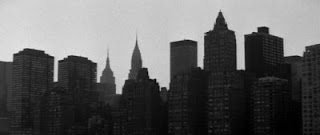
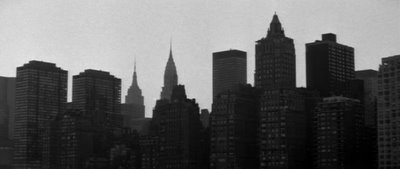
The film opens with a black and white montage of New York underscored by Gershwin's "Rhapsody in Blue": The Manhattan skyline, Staten Island Ferry, 5th Avenue, Washington Square Park, Fulton Fish Market, Guggenheim Museum, Central Park. Allen narrates, "New York is my town- and it always will be." He has a confidence about this place- a confidence in its joys, letdowns, hypocrisies, and human truths.

Allen plays Isaac Mortimer Davis, a twice-divorced, 42-year-old TV comedy writer who is hopelessly entangled with a 17 year-old girl (Mariel Hemingway). It's creepy even without the events that would unfold later in Allen's personal life.

But Isaac also finds himself attracted to the woman that his best friend is having an affair with- the much more grown-up Mary (Allen's then muse, Diane Keaton). The two talk as the sun comes up over the Queensborough bridge- and one of the most iconic shots of New York City is born. The romantic entanglements ensue with the sort of hopeless optimism that has become Allen's trademark.

Allen skillfully uses New York City as a sort of picture frame for the film's various scenes. Whether it's the aforementioned dawn-breaking conversation in Sutton Place, or Allen and Keaton getting to know each other in the shadows of the Hayden Planetarium, or the final scene where Allen confronts his young paramour in the lobby of a New York apartment building, the city is more than a setting. It accents and reflects the internal desires of Allen's characters, drawing us into their city and their lives.

Allen has set some of his films in other towns, but there is an ease and a comfort to his New York work that sets it apart. You can tell Woody Allen loves New York- and he passes that love on to the audience.

Eyes of Laura Mars (1978)

I love a good feminist horror film. Some may scold me for using the term 'feminist' in relation to a thriller movie about a fashion photographer and a serial killer- but trust me Laura Mars is all about critiquing the male gaze. Laura (the uber fashionable Faye Dunaway) is a famous photographer along the lines of Helmut Lang who likes to take pictures of models in gruesome murder poses. The girls are scantily clad and are usually being killed. Laura assumes these "visions" are just her creative intuition, but when she begins experiencing spells where she sees through the eyes of an actual serial killer, and that she is the next target, she seeks help from skeptical New York detective John Neville (Tommy Lee Jones).

The conceit of a woman who loses her sight to see what a man sees, then duplicates that vision in her own art is a clever way of addressing the relationship between women, men, and media. So many of us are swept up by the images we see- without thinking that the source of these images (even if they are created by women) is often from a male perspective.

The makeup, the hair, the clothing, the advertising of these products- it's all created to please men. In Laura Mars, director Irvin Kershner hints that this image is destructive, and women can be complicit in how they are viewed by men and themselves. After all, Laura sees herself from her stalker's perspective.

All that deep-dive analysis aside, the film is a really fun thriller with Dunaway throwing herself into the role of terrified victim with wide-eyed relish. The fashion shoots are a scream as is Rene Auberjonois' performance as a flamboyantly gay manager. His Lloyd Bridges impersonation is to die for.

The film was shot in several New York locations including the apocalyptic fashion shoot in Columbus Circle, the warehouse photography studio along the Chelsea waterfront, Dunaway's slit-skirt trot along Canal and Greene Streets, and the model funeral at Westchester's own Ferncliff Cemetery- the final resting place for such luminaries as Joan Crawford, Judy Garland, and Madame Chiang Kai-shek. If you're going to be pursued by a crazy psycopath, there's no place chic-er than New York City.

What movies make you think of the Big Apple?


Monday, July 11, 2016

Not Just Another Elderly Romance- 45 Years

I love being surprised. When I first heard about Andrew Haigh's (he of Weekend (2011) fame) film 45 Years (2015) I thought, "Oh. A British romantic drama starring Oscar-nommed Charlotte Rampling. I'll have to watch that... someday." Well, someday came around yesterday- and boy am I glad I didn't wait 45 years to see it.

Rampling is Kate Mercer, a woman looking forward to her 45th anniversary party with her husband Geoff (Tom Courtenay). But before the joyous occasion, Geoff receives a letter informing him that the body of Katya, the woman he loved before he met Kate, has been discovered frozen in a glacier in Switzerland. This news sends seismic waves through what appeared to be a stable marriage as Kate suspects that Geoff has never gotten over the girl who disappeared before his very eyes oh so many years ago.

The Haigh Approach to drama is beautifully subtle to behold. There are no screaming matches or thrown vases. These two proper English-folk would never do anything so boorish. But the emotions are there- boiling under the surface- bursting forth in a short comment or a rejected touch.

Rampling in particular is spellbinding in her restraint. The tension from the movie emanates from her performance- like a string vibrating until the point we must hear it. It's like a horror movie- only instead of being nervous waiting for a knife-wielding maniac to jump out from behind a bush, we are holding our breaths waiting for Kate to let forth with a searing emotional display.

What elevates this film is its blending of genres. The storyline is the stuff that romantic dramas are made of, but Haigh adds inspired touches of a female gothic film. Katya is not just an inciting incident. She haunts this film- much like Rebecca haunts Hitchcock's 1940 titular film. Her presence is felt, not just referenced. At one point her image is seen as a ghostly slide projection on a  hanging sheet- like an ethereal portrait gazing from a wall.

The female gothic trope of a separate space in the home (in this case an attic) where secrets lie and truths are discovered is put to use- as is the linking of man and nature. Storms rend the night as emotions fracture and vast, lonely shots of the Norfolk countryside spread out before us as Kate walks her dog and tours the broad channels. Nature both mirrors Kate's anger and loneliness, and frames this one moment within the vastness of a 45 year marriage.

As with Weekend, 45 Years ends without a clean-cut resolution, but that seems to be the point of Haigh's realistic style. Romance in real-life has few clean-cut endings- so why should romantic movies? This slice of older life is touching and beautiful and well worth the watch. Also of note, the delightful Geraldine James who you may remember as the "Bitty Mama" from TV's Little Britain shines as the requisite best friend.

Friday, July 8, 2016

Back to Black

The other day as I passed my boss' table in her office, an old VHS tape caught my eye. At first I saw "That's Entertainment" and I got all warm and fuzzy inside because I love that classic compilation film- or as I like to think of it- 1940's music videos. I could sit for hours and watch those clips of Gene, Fred, Esther, Judy, and Ann from the greatest MGM musicals. But on closer examination, I noted the cover said "That's Black Entertainment" which is something entirely different. After promising to return the tape on pain of dismemberment I ran home and re-attached my VCR to my TV, and sat down and watched the history of Black film unfold.

That's Black Entertainment (1989) chronicles the independent Black film industry that existed from the early part of the Twentieth Century through the late Fifties. Because most movie theaters were segregated, Black Americans were forced to watch movies in Blacks-only theaters which gave filmmakers the opportunity to create films that spoke to Black audiences about Black culture. Filmmakers like Oscar Micheaux and Spencer Williams (Andy of Amos and Andy fame) were able to capture scenes of American life from the Black perspective. Issues of religion, crime, drug and alcohol abuse, police brutality (yep, it ain't nothin' new), and the importance of family were all being explored during a time when Hollywood only showed blacks as maids, slaves, or entertainers. There were even newsreels and shortfilms made exclusively for Black audiences to give African-Americans the same movie-going experience that their White counterparts enjoyed.

Because Hollywood refused to show any of these films in White theaters, the productions were funded on a shoestring budget. Often the acting talent was untrained, and the camerawork basic- with one-take scenes used to save money. But there were actors and actresses who were discovered in these films who went on to star in mainstream films for larger audiences.

Paul Robeson was mainly thought of as a Broadway star- but he did make Black independent films, as well as star in mainstream Hollywood movies like Show Boat (1936) and King Solomon's Mines (1937). Lena Horne starred in The Duke is Tops (1938) before being snatched up by Vincente Minnelli to star in films like Panama Hattie (1942) and Cabin in the Sky (1943). 

Nat King Cole, Ethel Waters, and Cab Calloway received their cinematic starts in Black films- and even little seven-year-old Sammy Davis Jr. is shown as a tap dancin' tyke running for office in Rufus Jones for President (1933) (I hope Hillary can at least soft-shoe)
Black music stars seemed to be able to crossover into mainstream Hollywood more successfully, because their recognizability and influence over the music industry allowed for an easier transition to a white audience who would be familiar with them from their recording careers.

But black actors and actresses seemed only able to crossover as long as they played roles as servants or in Steppin Fetchit's case, as racist punchlines. While the level of production in the independent films was lower, the depictions of Blacks was generally better- forcing actors to choose between socially-responsible work and money from the Hollywood roles that perpetuated negative stereotypes.

The era of the independent Black film industry changed for a couple of reasons. Most importantly we stopped segregating black and white audiences, so smaller producers had no ability to compete with the Hollywood studios in the same theaters.  And with the emergence of actors like Sidney Poitier and Harry Belafonte, black audiences could feel more included in the mainstream films that Hollywood was producing. It was a minority of the Hollywood output, but films depicting Black characters in a more positive light were now available, making the Black independent films no longer the sole source for Black stories.

Independent Black artists would continue to make independent films, though. Genres like the blaxpoitation film became popular first as low-budget indies before being appropriated by Hollywood to cash-in on their built-in appeal. In the last couple decades Atlanta has emerged as a Black Hollywood that has reinvigorated independent Black films for primarily Black audiences. Perhaps it signals a renaissance in this historically rich American film genre. At a time when this country is torn with racial strife- it will be important to see Black stories told from Black perspectives without the Hollywood whitewashing.


Friday, July 1, 2016

Top 5 Tear Curers

The John Turner and Geoffrey Parsons lyrics to a song written by Charlie Chaplin enjoin us to, "Smile though you're heart is aching. Smile even though it's breaking." I've always felt that prescription might be a titch overly-optimistic in dealing with real heartache, and when I and my family experienced a great tragedy last week, I wondered whether smiling was even an option.

But from the moment I landed back in the arms of Mother Kansas and my family, I discovered that we all instinctively chose humor as a way to deal with our grief. I wasn't in our old kitchen more than ten minutes before someone pointed at my belly and asked if it was a boy or girl. My rejoinder about reflections from bald foreheads, and volume levels on hearing aids quickly had us all smiling- nay- laughing. In a matter of moments we had launched into the familial repertoire of fart and poo jokes including modern updates like Poo Pourri. Grief was softened by the simple kind of humor we didn't have to think about.

This discovery led me to ponder what movies might be just the right level of low comedy to help us forget our troubles and "smile through the fear and sorrow."

Here are my Top 5 Tear-Curing Movies:

The Music Box (1932)

There are those that prefer The Three Stooges, and those that prefer The Marx Brothers. But for my money, the best of the early comedy teams was Stan Laurel and Oliver Hardy- Laurel and Hardy if you're nasty. The simplicity of these two characters- one a self-righteous know-it-all, and one a bumbling softie- allowed them to be placed in a myriad of situations and produce comic results every time. Whether they were prepping a boat for their new fishing venture, tromping through the Sahara with the Foreign Legion, or trying to go to a lodge meeting in Chicago without their wives knowing, these two performers consistently produced comedy gold.

In this Academy Award-winning short, Stan and Ollie have to deliver a piano to a house... on top of a long flight of steps. Nothing goes right for these two movers and whether it's their own horse, a sassy nanny, a bombastic music professor (the hair-tugging Billy Gilbert), or even the steps themselves, it feels like the world is against these two. But Laurel and Hardy never stop. They keep heaving and ho-ing that piano until it is delivered. "Service with a smile."

This short is iconic, partly because these two everyman characters are so universal- their bungling  and pride so recognizable in all of us. Visually, the image of two men engaged in a near-impossible task that they won't quit at speaks to us on a Sisyphean level of the comedy to be found in our own trials. Which is a fancy way of saying The Music Box will always be funny.

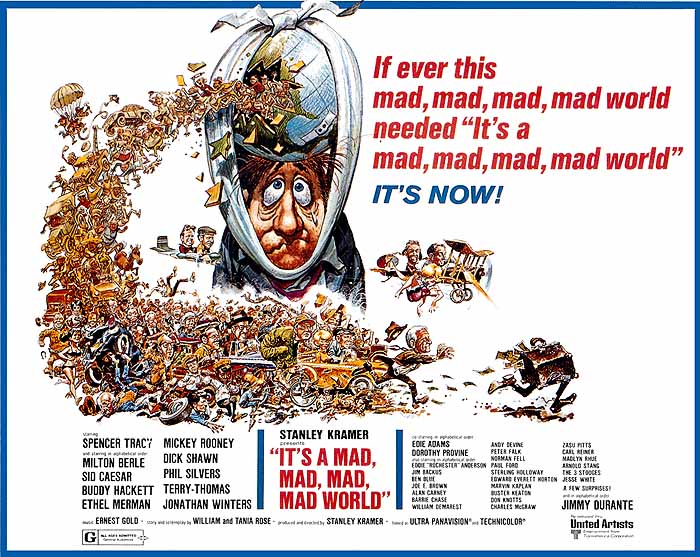
It's a Mad, Mad, Mad, Mad World (1963)

Is that enough Mads?
Stanley Kramer was a well-known producer/director who had made his name directing very serious, socially relevant movies: The Defiant Ones (1958), Inherit the Wind (1960), and Judgement at Nuremberg (1961). But in 1963, Kramer did something no one expected- He made a hit comedy.

Mad follows the stories of five groups of motorists who come across accident victim Smiler Grogan (Jimmy Durante in the first of an onslaught of classic comedian cameos in this film) who literally kicks the bucket (setting us up for the level of comedy to come), but not before he reveals the hiding place of a stash of ill-gotten cash in Santa Rosita State Park. The rest of the film is a madcap chase across California to get the money and get rich. Included in the pursuit is soon-to-retire lawman Capt. T.G. Culpepper (Spencer Tracy) whose loyalty to law and order is sorely tested.

The cast is a who's-who of Hollywood comedians: Sid Caesar, Milton Berle, Buddy Hackett, Jonathan Winters, Terry-Thomas, and Phil Silvers along with comedic actors: Ethel Merman, Mickey Rooney, Dick Shawn, Jim Backus, Eddie Rochester Anderson, Edie Adams, and Dorothy Provine. The aforementioned cameos are equally impressive with appearances by Jack Benny, Joe E. Brown, Andy Devine, Edward Everett Horton, Buster Keaton, Jerry Lewis, and The Three Stooges.

If this number of funny notables seems overwhelming, it is. The film is a series of Borscht Belt sketches strung together by California blacktop. But it doesn't matter. It's hysterical.

Lending poignancy and gravitas to the proceedings is Tracy, who isn't really thought of as a comedic actor despite his brilliance in the Hepburn-Tracy delicacies of the 40's and 50's. Tracy leavens the rampant scenery chewing going on around him with Culpepper's world-weariness and crisis of conscience.

The final scene of the film is legendary and proves that the remedy for pain and suffering can be as simple as a banana peel.


Blazing Saddles (1974)

In an irreverent comedy environment filled with Adam Sandler, Seth MacFarlane, and South Park fare, we sometimes forget that there was a time when line-crossing comedy was rejected by Hollywood. But in 1974, birthday boy Mel Brooks (he turned 90 on Tuesday!) directed what was then considered a comedy shock-fest. Blazing Saddles is a spoof on the classic Western movie genre- but it's something more than that. The little town of Rock Ridge is right in line with the advancing railroad and land-hungry Attorney General Hedley (not Hedy!) Lamarr (Harvey Korman) decides that the best way to get rid of the denizens of Rock Ridge so he can buy up their property is to send them a new sheriff... who is Black.

Enter Sheriff Bart (Cleavon Little) who, with the assistance of washed-up gunslinger The Waco Kid (Gene Wilder) wins the respect of the town and takes on Hedley's gang of thugs (including Slim Pickens as flatulant Taggart, Alex Karras as monosyllabic Mongo, and the divinely tired Madeline Kahn as teutonic songbird Lili Von Shtupp) to save the day.

Amidst the schnitzengruben and fart jokes, Saddles does something really controversial- it takes on the  issue of race. More than just throwing around the N-word, Brooks uses it to make us see how ridiculous racism is.

Little does a wonderful job of playing a class clown who uses humor to break down the racial divide, becoming as big a Western hero as John Wayne- who incidentally turned down a role in the movie because the material was too blue- but famously said he'd be the first one in line to see it.

Murder by Death (1976)

Neil Simon is f-ing funny. Well-known for his television writing for Sid Caesar and hit Broadway comedies like Barefoot in the Park and The Odd Couple the man knows how to pen a joke and create wacky characters. So it should come as no surprise that Simon's Ten Little Indians spoof full of characters that are spoofs of famous detectives is a hoot. The world's greatest detectives have been summoned to the castle of Mr. Lionel Twain (the inimitable Truman Capote) to solve a murder that hasn't happened yet. Will the next murder be their own?

The list of actors playing these send-up sleuths is enough to make you titter: Peter Falk as Sam Diamond along with Eileen Brennan as his Girl Friday; David Niven and the sublime Maggie Smith as Dick and Dora Charleston; Peter Sellers as Sidney Wang (yes, he's doing yellowface- but he's really funny anyway); James Coco as Belgian Milo Perrier and a young James Cromwell as his chaffeur; glorious Elsa Lanchester as Jessica Marbles and her nurse (who Jessica actually takes care of) played with elderly puckishness by the eternal Estelle Winwood.

Filling out the cast are Alec Guinness as a blind butler named Bensonmum and a deaf mute maid played by Nancy Walker.

With a set-up like that, the laughs are guaranteed.


The Cannonball Run (1981)

As a kid growing up in the '70's in the Midwest I was exposed to lots of cars. And not just in my dad's garage- but on TV and in the movies. Nothing spelled overt masculinity like the General Lee on The Dukes of Hazzard or Burt Reynold's Firebird in Smokey and the Bandit (1977). So when a movie came out about a cross-country car race, I was required to see it in order to maintain my manhood. Lucky for me, Cannonball had just as much comedy as it had testosterone.

JJ McClure (the mustachioed wonder himself Burt Reynolds) and his pal Victor Prinzim (corpulent clown Dom DeLuise) are bound and determined to win the illegal road race called the Cannonball- even if they have to pretend to be paramedics so they can drive above the speed limit without being bothered by all those smokeys. But these two jokers aren't alone.

There is plenty of competition- and I mean plenty. Roger Moore, Dean Martin, Sammy Davis Jr., Adrienne Barbeau, Terry Bradshaw, Mel Tillis, Jackie Chan, Bert Convy, and Jamie Farr all hit the road to win the prize and out drive and outsmart each other. Barroom brawls, boob jokes, and a long-fingered proctologist (played by wonky-eyed Western star Jack Elam) ensue.


One of my favorite parts of Cannonball is the compulsory blooper reel during the final credits. There's nothing better than watching Reynolds and DeLuise unable to maintain a straight face around each other. It makes you wonder how they were ever able to finish the movie.


Wherever you are, Little Brother, I hope you have unlimited access to the movies that make you laugh.